
Neurofinance: The Psychology Behind When To Sell A Bull Market
Week Ending 4/28/2017
PERFORMANCE
The US equity markets turned in another solid week, gaining about 1.5%. International markets did even better, +2.34%. Bonds fell slightly, the dollar was even and crude was off boy 0.6%.
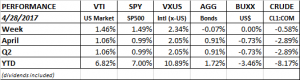
Very strong earnings are moving the markets higher. According to FactSet, as of Friday, the blended earnings growth rate is 12.5%, above the 9% estimate at the beginning of earnings season. This would be the first time since Q4 of 2011 when the SP500 companies reported a double digit earnings increase.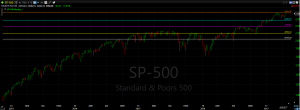
The market is still trading in a range of between 2280 and 2400, and it will have to crack the 2400 line (orange line above) to possibly begin another leg up.
TAX PLAN
Trump proposed an outline for an aggressive tax plan. He is leaving it up to Congress to fill in most of the details. The plan would cut tax rates on corporations from 35% to 15%. There would be a one-time “amnesty” rate of 10% to encourage repatriation of about $2 trillion in profits that US companies have been keeping overseas. The proposal to get those dollars back into the US is a good idea and both parties should support that. The plan also taxes only domestic profits, another smart proposal.
The tax cut would also apply to “pass-through” entities like Sub-S corporations. That would give the pass-through entities a big tax advantage over regular corporations since income on corporate profits is eventually taxed two times, while a pass-through is taxed one time.
A corporation is taxed on its income, and then its shareholders are taxed at some future point on dividends and taxable gains. The tax proposal calls for a 15% corporate tax and a 20% dividend/capital gains tax. For $100 of income, the corporation will pay $15 in tax. That would leave $85 in the business. Let’s assume that $85 is paid out as a dividend, it will get taxed on the personal level at 20%, resulting in another $17 in tax for a net of $68. Meanwhile, the same pass-through entity investor would net $85.
One of the main ideas of reforming the tax system is making it equitable and easy to understand. The pass-through advantage does not do that. That needs to be corrected.
The other huge issue is that the plan would result in trillions in lost revenue. Of course, the argument is that the economy would grow faster, and that would eventually result in most of the lost revenue being recovered. The proposed cuts are too deep and too risky given the country’s fiscal situation.
In sum, the plan won’t pass as proposed but it is a starting point.
GDP
The Commerce Department reported that GDP growth in Q1 was 0.70%, the lowest reading in three years, and not a good start to the Trump era. This is the initial reading and it will be revised down the line, but it continues the string of weak Q1 growth that we have seen over the past several years.
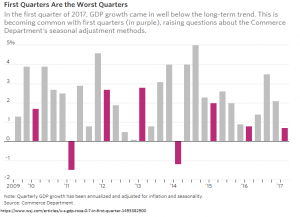
Trump has promised to get growth to 3% plus. That is a tall order. But Q2 growth is expected to improve. The NY Fed’s NowCast currently has Q2 growth estimated at 2.3%, plus 0.20% on the week on positive news on manufacturing and housing data.
On a positive note, wages grew at the fastest rate since Q1 of 2007.
CONSUMER DEBT
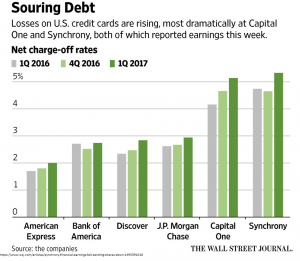
We spoke about this at our quarterly webinar (click to view), trends in consumer debt are turning negative. Credit card lenders are reporting more losses. This is probably the result of leaner credit standards and overspending by consumers. The subprime market is where the hits are being taken and the threat is if there is a spillover effect.
NORTH KOREA
The market has been ignoring North Korea but the heat is rising. Secretary of State Rex Tillerson addressed the U.N. on the need to step up pressure on North Korea. A U.S. nuclear submarine has arrived at a South Korean port. On Saturday, North Korea launched conducted another missile test. Like the one prior, it failed. Trump would not rule out the use of military force in an interview on “Face the Nation” on Saturday.
GOLD
One investment that might benefit from a major geopolitical event like North Korea would be gold. The Gold Miners ETF (GDX) is off 8.2% from its recent peak in mid-April.
Week Ending 4/21/2017
PERFORMANCE
The US equity markets advanced by about 1%, and in the process, at least for now, broke the recent downtrend. International equities were up 0.55%, bonds were about even, the dollar declined and crude fell by 6.7%.
This week will start on a positive note as France’s pro-growth candidate Emmanuel Macron finished first in the Sunday election and advances to the runoff with nationalist Marine Le Pen. Macron is favored and a win will keep the Eurozone intact.
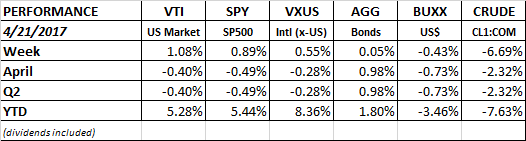
The market has been advancing in a stair step fashion. It trades in a sideways manner, breaks out, then enters another consolidation phase, and then breaks higher again. That might be continuing.

Earnings appear to be on target for an approximate year over year increase of about 11%. Excluding energy, about 7.5%. Improving earnings will work down some of the excess valuation in the traditional ratios like price to earnings, price to sales and price to book.
GOVERNMENT FUNDING
Trump just complicated the process of keeping the government operating. The government runs out of money on Saturday and a deal must be passed to keep the US in business. Trump is now demanding that the legislation include funds for a border wall with Mexico. That is a deal-breaker with the Democrats and will make it more difficult to avoid a government shutdown next weekend.
ECONOMY
Initial jobless claims came in at 244k, a low number. Existing home sales were up 5.7% year over year. Industrial production rose by 1/2% month over month. The flash PMI composite estimate fell to 52.7 from 53.2 That is down but still above 50, indicating growth.
STEEL IMPORTS
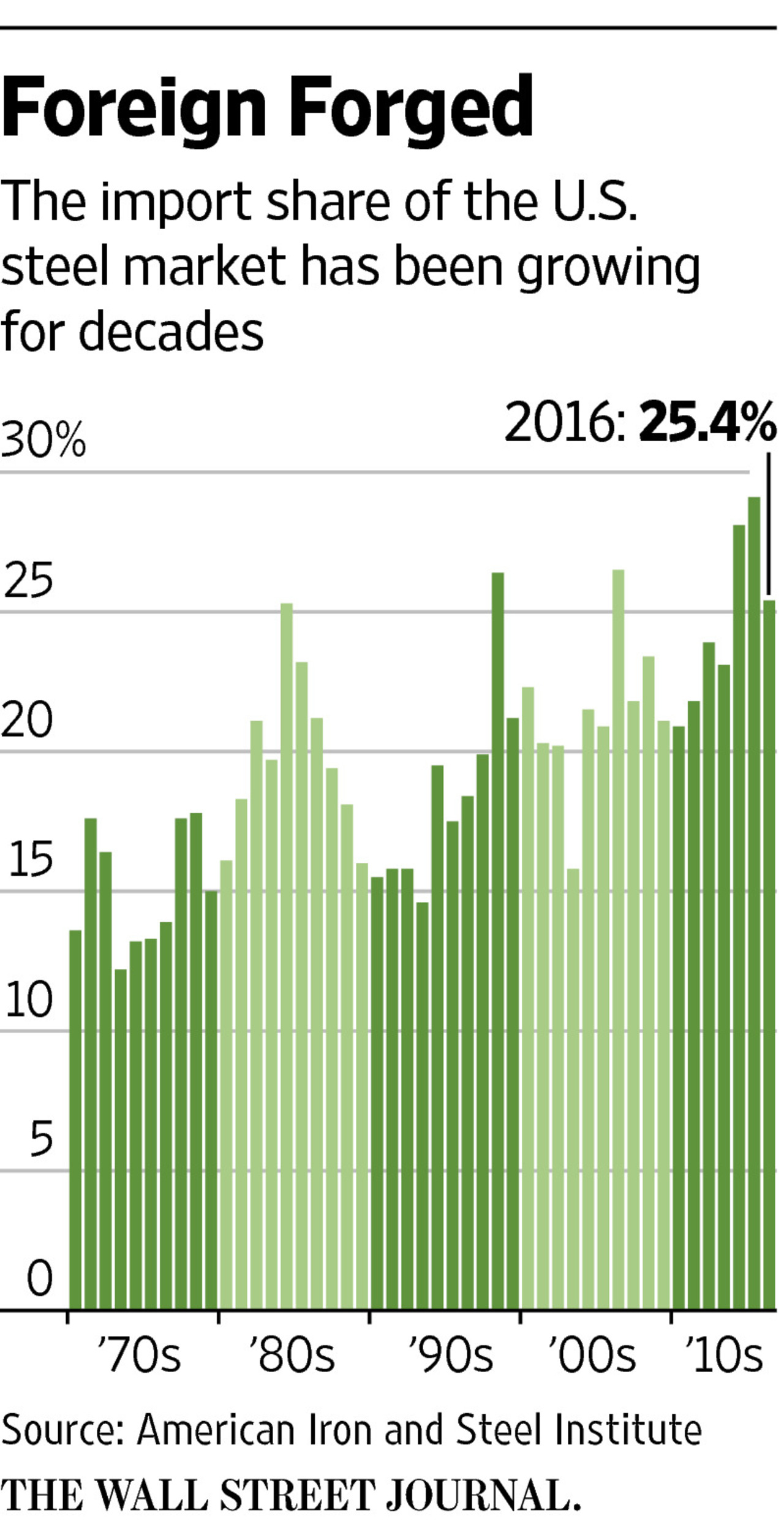
The Trump administration announced that it is opening up a probe into steel imports, indicating that national security might require a cut in imports. The trade law cited to justify the cut in imports requires a study that will be submitted to the Commerce Department that assesses the legitimacy of the national-security claim.
It is one thing to retaliate against a company that is “dumping” product with the help of government subsidies, it is another to implement across the board cuts that impacts even those that compete fairly. Such an across the board cut would possibly result in retaliation against other US manufacturers.
Cutting imports would allow US manufacturers to increase steel prices even further. Manufacturers ramped up prices last year after the government imposed duties on imports from some companies in China and elsewhere. US steel prices are already among the most expensive in the world and impact a wide range of businesses that are the consumers of steel. There are about 60 workers in steel using industries for every steelworker in the US. A mismatch which shows that such an across the board cut might not past a true cost/benefit test.
TAX PLAN
Trump officials plan to release a tax overhaul plan soon. The plan would concentrate on business first (corporate and pass-through entities) and leave individual tax reform for after.
An overlooked statistical concept shows why it is so hard to beat a benchmark
These articles explain the concept of positive skew and how it makes beating a benchmark so difficult.
Why indexing beats stock picking.
Do stocks out perform treasury bills?
Week Ending 4/13/2017
PERFORMANCE/TREASURY RATES/GDP
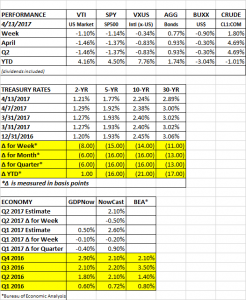
Below are the numbers for the week. No commentary this week as we published our Quarterly Review/Outlook. Click here for the Review/Outlook.
Week Ending 4/7/2017
PERFORMANCE
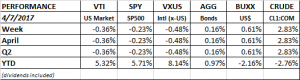
US equities fell slightly, down 0.36%, but that was a good performance given the market was hit with a batch of negative news. On Wednesday, North Korea launched another test missile, on Thursday, the US fired 59 Tomahawk missiles into Syria in response to deadly chemical attacks against its own citizens, and on Friday, in another example of our dysfunctional government, the Republicans eliminated the filibuster rule for Supreme Court nominations. Then there was the payroll report that came in much less than consensus. This market continues to show good resilience in not falling in the face of negative news. But while the market has not been falling, it has also been having a hard time going higher. There were only 72 NYSE stocks at new highs this week, compared to 338 on March 1.
International stocks were down 0.48%, bonds were up slightly, the dollar was up by 0.61% and crude, helped by the missile strikes, advanced 2.83%.
EMPLOYMENT
Non-farm payrolls increased by 98,000, well below the consensus estimate of 175,000 and down from a revised 219,000 in February. Weather might have been a factor as the northeast suffered from a major blizzard. There might be a seasonal factor at work, the March report has missed consensus number in five of the last six years. The unemployment rate dropped to 4.5% from 4.7%. Average hourly earnings were up by 2.7%
Initial claims for unemployment dropped by 25,000 to 234,000. Claims as a share of the labor force hit a record low in February. Even with the lower hiring number, the labor market continues to be tight.
FED
The Federal Open Market Committee’s March minutes show that the Fed may begin to work down its $4 trillion balance sheet later in the year. This would be accomplished by reinvesting less as issues mature. As of now, the Fed has been reinvesting the proceeds from all maturing issues. The aim would be to accomplish this in a “passive and predictable” manner. However, this would put upward pressure on interest rates.
GDP
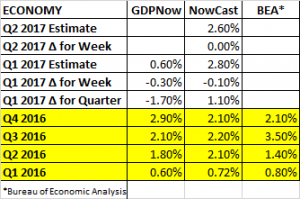
The Atlanta Fed’s GDPNow continues to sink, estimating growth at 0.60% for Q1, that is down from 0.90% last week and from 2.30% at the beginning of the quarter. The GDPNow estimate continues to diverge from the NY Fed’s Nowcast, which is forecasting more solid growth at 2.80% for the first quarter and 2.60% for the second quarter.
Week Ending 3/31/2017
PERFORMANCE
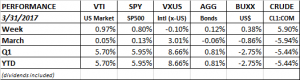
The quarter ended on a positive note as US equities advanced by almost 1% for the week. For the quarter, US equities were up 5.7% and international (x-US) equities advanced 8.66%. The bond aggregate was up 0.81%. The dollar actually declined for the quarter by 2.75% as did crude, -5.44%, although it moved higher on the week by almost 6%.
While the consensus was for value to be the place to invest in 2017, so far it has been large cap growth, especially technology, which dominated the first quarter. The QQQ was up 12%.
TECHNICALS
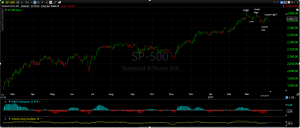
It might be nothing or it might be the start of a sell-off. The market is overdue for a correction of 5 to 10%. On Monday, the market was off 2.27% from its March 1 peak but had a small rally since. If the market turns down over the next few days, that would be two successive “lower highs”.
TREASURY RATES
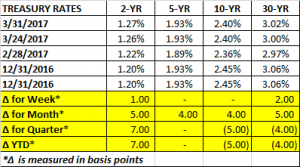
Treasury rates were flat for the week. For March, rates rose about five basis points across the curve and year to date, there has been a slight flattening, with the 2-year note up seven basis points and the 10 and 30-year down about five.
TRADE
The Trump administration indicated it will seek only modest changes to NAFTA. A major push to cut back on international trade via protectionism would be a negative for growth in the US and around the world. A more modest approach to trade was what the market had anticipated when this rally began in November, and that might turn out to be the case. Although the threat of more aggressive action could still happen as the administration irons out its policies.
CONFIDENCE SURGES
The Conference Board’s Consumer Confidence Index surged to the highest level since December of 2000. A high level of confidence has traditionally been associated with better than average growth.
BREXIT
On Wednesday, the UK made it official by triggering Article 50 and letting the EU know that it will be leaving. This begins a two-year period for the UK to negotiate its exit.
MARGIN DEBT
Margin debt hit a record in February. More than $500 billion is currently borrowed against accounts. High levels of margin debt indicate investor confidence but is often a contrary indicator that reveals that investors are ignoring fundamentals and concentrating on making a quick dollar. Margin debt peaked before declines in 2000 and 2008. But margin debt as hit record levels several times previously during this bull run with no negative impact.
ECONOMY
2016 Q4 real GDP was revised up to 2.1% from 1.9%. Year over year, GDP was up 2% for 2016 compared to a 3.1% average historical gain.
The GDPNow model forecasted growth for Q1 dropped to 0.9% on declines in estimates for consumer spending growth. The NY Fed’s Nowcast dropped by 0.1% to 2.9% for Q1 and to 2.6% for Q2.
Initial claims for unemployment came in at 258,000.
Week Ending 3/24/2017
PERFORMANCE/HEALTHCARE/TAX REFORM
The Republicans could not put together sufficient support to pass the American Healthcare Act, thereby leaving Obamacare in place for the at least the near future. The uncertainty of the legislation passing and the possible negative implications for policy proposals that have energized the market since November, made for a rocky week, at least by recent standards. Equities dropped by over 1% on Tuesday, the first time in 160 days the market fell by more than 1%. For the week, US equities were down about 1.4%.
With the ACHA out of the way for the time being, tax reform becomes front and center. That, along with deregulation and repatriation are really tops on investor’s agenda and that is the fuel that has propelled a lot of this market rally. If the healthcare debacle foreshadows potential problems with Trump’s more business oriented proposals, the justification for a good portion of the recent really will come into question, thereby threatening values.
EARNINGS
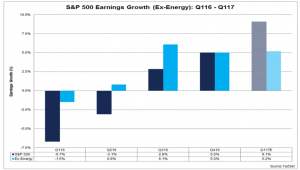
Higher expected earnings has also helped the rally. For Q1, the estimated earnings growth rate, according to FactSet, is a whopping 9.1%. If it happens, that would be the highest year over year increase since Q4 of 2011 when earnings jumped by 11.6%. Much of that increase will be due to the energy sector, where the average price of oil is 50% higher than a year ago. Excluding energy, earnings estimates are for a 5.2% advance.
ECONOMY
The Markit Flash US Services PMI fell 0.9 points to 52.9. That is the lowest level in six months. Service orders were the weakest in 12 months and new manufacturing orders were the weakest since last October.
New home rose 6.1% in February. The sales rate is now at its highest level since August of 2008 on a 12-month average basis, a positive sign for the housing market.
Initial claims for unemployment rose 15,000 to 258,000. Still at a historically low level but up from recent weeks.
The Atlanta Fed’s GDPNow model is forecasting growth of only 1% in Q1. This contrasts with the NY Fed’s Nowcast that currently forecast Q1 growth of 3.0%.
Week Ending 3/10/2017
PERFORMANCE
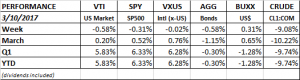
The equity markets fell last week, dropping 0.58% in the US, but international equities were about at break even. Bonds were also down by 0.58% as interest rates continued to rise.
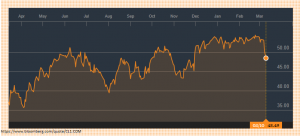
The price of oil fell below $50 for the first time since November as inventories increased to record levels. More negative movement on the oil price is likely to have a spillover effect on the equity and high-yield markets. Oil had rallied in the last several months on news of OPEC production cutbacks. But US shale producers have moved quickly to cash in on the higher prices. That has increased supply in the US at a faster rate than demand. However, demand around the world is increasing and US exports of oil and gas should also increase as time goes on, and that should alleviate some of the excess supply.
EARNINGS
Almost all of the SP500 companies have now reported Q4 earnings. 65% beat the mean EPS estimate and 53% beat the mean sales estimate. The blended earnings growth rate is +4.90%. The estimate at year end was for a 3.0% increase. The forward 12-month P/E ratio is now at 17.7, above the five-year average of 15.0 and the 10-year average of 13.9.
COMPANY INSIDERS
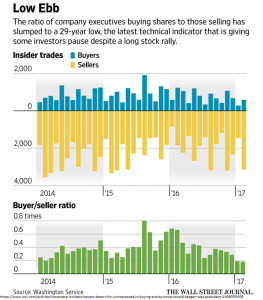
Insider buying has fallen to a 29-year low. There were 279 insider buys in January, the lowest number since 1988. The ratio of buyers to sellers in February also hits its lowest level since 1988.
TRADE WAR
As we have stated many times, the biggest threat to the economy is a possible trade war. Trump’s protectionist leanings are misguided and the “facts” that he relies upon are sometimes wrong. If he misplays his hand and new policies or taxes invite trade retaliation, the result will be less growth or possibly negative growth. German Chancellor Angela Merkel will be talking to Trump about that at their upcoming meeting on Tuesday, according to Der Spiegel magazine. The Spiegel article says that documents provided to Merkel label a US border-adjustment tax as a “protective tariff” and in violation of World Trade Organization rules. Responses from Germany could include higher duties on US imports, or setting up their own “border-tax” for US companies alone. Merkel also plans to call on Europe to pursue trade deals with other countries, to take advantage of the void that the US is no longer filling.
EUROPE
Economic news has been much improved in Europe recently, and their equity market trades in line with historic norms, but there is some major political uncertainty. Here is a look at what is coming up:
Dutch Parliamentary Election – March 15, 2017
The Freedom Party, an anti-EU and anti-immigrant party leads in the polls but is losing ground. The political system would make it difficult to turn that lead into a political majority. The Freedom Party would have to form a coalition with others, that would likely be difficult.
Brexit/Article 50
The break from the EU won’t be so clean. Britain must trigger Article 50 to open up a two-year window for Brexit negotiations, but political infighting is delaying the implementation of Article 50. The transition period will mean more uncertainty for Britain.
French President Election – April 23 (first round) and May 7 (second round)
Marine Le Pen is the leader of the National Front, an anti-EU and ant-immigrant party. The majority of French view the EU unfavorably. Le Pen is expected to advance to the second-round election, where polls show her losing by a wide margin. Her likely opponent, Emmanuel Macon, has been short on details but is running on a pro-EU and pro-business agenda.
German Federal Election – September 24
Recent polls show a close race between the center-right party (CDU) and the center-left (SPD). Merkel leads the CDU. If the SPD wins, they could form a coalition with left-wing parties.
HAPPY BIRTHDAY
Thursday marked the 8th birthday of this bull market. The market hit its low on March 9th, 2009 and that set off this 8-year run. The market has not had a 20% pullback since (20% is often defined as a bear market). That is the second longest stretch of all time, only the 1987 to 2000 market went longer without a bear market.
FED
The Fed has made it pretty clear in recent weeks that a March rate hike is likely. The question now shifts to how many hikes in 2017, will it be two or three? Fed voters seem split between two and three. Fed Governor Tarullo resigned effective in April, and he was likely in the two-vote camp. That would tilt the sentiment to three likely rate increases in 2017 (at this time). The latest jobs information (below) also would lean expectations to three hikes in 2017 as of now.
JOBS
Nonfarm payrolls increased by a solid 235k in February. The unemployment rate fell to 4.7%. Average hourly earnings increased by 0.2%, but the year over year change was 2.8%. Initial claims for unemployment insurance were up 20k last week to 243k, but that is a historically low number. All these data points indicate a very tight labor market and gives the Fed the go ahead for a rate increase next week.
The big negative in the report was retail. Jobs were down 26k in the retail sector, the most since December of 2012. This reflects the shift to on-line retail as brick and mortar stores continue to get hit. This will have some negative impact on the high yield market down the road.
Week Ending 3/3/2017
TRUMP’S SPEECH
In many ways, this was the speech we have been waiting for. Trump leaned towards the optimistic side, gave a speech without insults and attacks, a speech that tried to bring the country together, instead of apart. Other than his short victory speech at 3 am the night of the election, it was the first time Trump actually acted sounded presidential, and because of that, his message was much more effective.
Trump proposed a $1 trillion infrastructure package, replacing Obamacare, lowering drug costs, lower tax rates and free and fair trade.
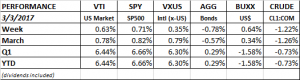
The market liked what it heard and the way it was said, and the Dow jumped 300 points the next day. For the week, US equities were up 0.63%. International stocks advanced 0.35%.
Interest rates, which had been falling recently, turned around and jumped about 20 basis points. That pushed the prices of the bond index down by 0.78%.
Unfortunately, by week’s end Trump was back to his old self. Declaring on Saturday morning, via Twitter, that Obama had tapped his phones, without presenting a shred of evidence. One has to wonder how long the markets can ignore the President’s bizarre behavior
GDP
For all the forward-looking optimism on the markets, the story is not so bright in real-time, at least according the the Atlanta Fed’s GDPNow model. Q1 growth fell to 1.8% from 2.40% on a lower forecast for personal consumption expenditures. The estimate from the NY Fed’s Nowcast was not as dreary, remaining steady at 3.10%. Lower than expected inventories for manufacturers and merchant wholesalers offset the negative news on personal consumption expenditures in their model.
But around the globe the economic outlook continues to look brighter. The global manufacturing PMI increase by 0.2 points to 52.9 in February. the index is now up six months in a row, that is the longest winning streak in three years and the index is at its highest level since May of 2011. 86% of individual countries are now in expansion territory.
FED
The Fed has been more aggressive in sending the message that a rate hike will happen sooner, rather than later. A March rate hike is now likely.
JOBLESS CLAIMS
Initial claims for unemployment dropped by 19k to 223k, the lowest amount since March of 1973. The four-week average now stands at 234,250 and that is the lowest number since April of 1973.