MARKET RECAP
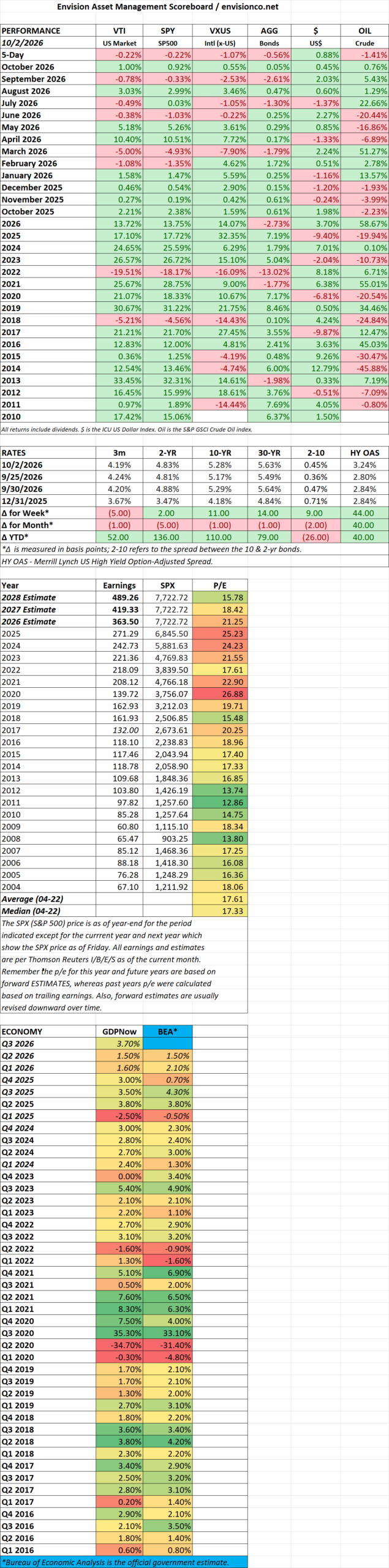
U.S. stocks finished mixed for the week ended October 2, as a cooling September employment report sparked a Friday relief rally that partially offset earlier losses.
Major averages diverged as mega-cap technology buoyed the broader market:
-
S&P 500: Slipped 0.27% to close at 7,722.72.
-
Dow Jones Industrial Average: Dropped 1.26% to finish at 51,176.96.
-
Nasdaq Composite: Gained 0.45% to settle at 27,190.86 after briefly touching an intraday record high.
Friday’s rebound—which saw gains of roughly 0.7% for the S&P 500, 0.5% for the Dow, and 1.2% for the Nasdaq—came as traders pared back expectations for another near-term Federal Reserve rate hike.
Across global markets and other asset classes:
-
International Equities: Vanguard Total International Stock ETF (VXUS) lagged domestic equities, falling roughly 1.1% to close at $85.43.
-
Fixed Income: Despite easing into the weekend following the jobs release, the 10-year Treasury yield rose 11 basis points over the week, moving from 5.17% to 5.28% due to early-week crude strength and lingering inflation concerns.
-
Commodities: Gold slid 3.4% to finish near $4,141 per ounce—marking one of its sharpest weekly declines in months—pressured by elevated real yields and a firmer U.S. dollar.
-
Cryptocurrency: Bitcoin traded relatively flat, finishing near $84,500 compared to approximately $84,000 the prior Friday.
The week’s primary catalyst was Friday’s September jobs report, which pointed to significant labor-market deceleration:
-
Nonfarm payrolls increased by just 29,000, falling well short of the 90,000 consensus estimate.
-
The unemployment rate edged higher to 4.2% from 4.1%, while prior months’ payroll additions were revised downward.
-
Annual wage growth slowed to 3.0%, registering its softest pace since May 2021.
Secondary economic data presented a more balanced picture. Initial jobless claims for the week ended September 26 dipped to 197,000, matching July lows, while continuing claims fell to approximately 1.70 million. Additionally, August core PCE inflation came in cooler than expected at 3.0% year over year, reinforcing the view that the Fed has room to pause and assess incoming data.
Geopolitical developments and single-stock headlines dictated intraday price swings. Crude oil fluctuated after President Trump rejected an Iranian proposal on navigation in the Strait of Hormuz, then eased as Gulf energy flows showed signs of recovery and mediation efforts continued. On the corporate front, Nike’s cautious remarks on Chinese consumer demand weighed on retail sentiment, while strength across large-cap semiconductors, including Nvidia, propelled tech outperformance.
While signs of a cooling labor market gave equities late-week footing, elevated bond yields and persistent geopolitical tension around Persian Gulf shipping leave markets attentive ahead of upcoming inflation reports.
SCOREBOARD