Week Ending 9/25/2026

MARKET RECAP

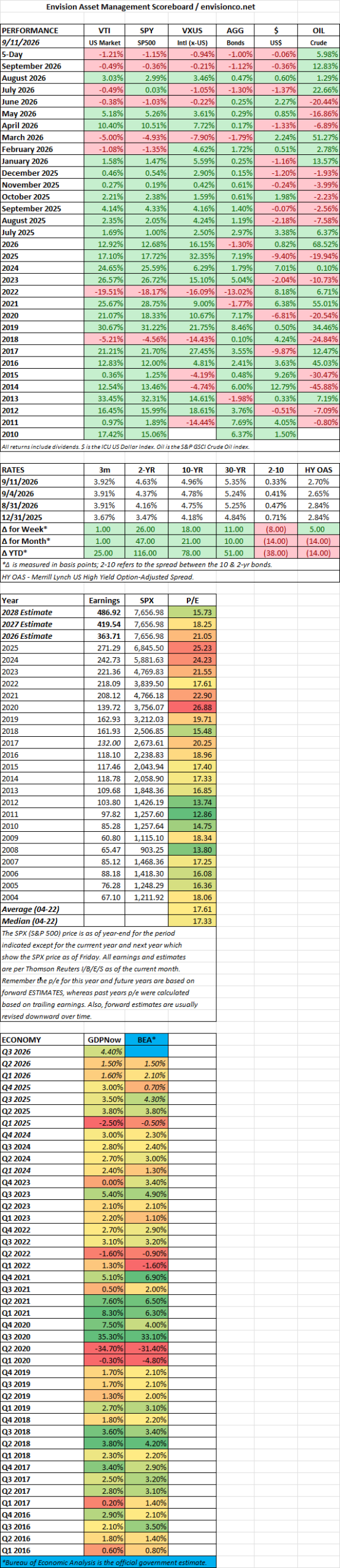
U.S. stocks finished higher for the week ended September 25, rebounding through a choppy stretch marked by crude oil volatility, climbing Treasury yields, and hopes that energy disruptions around the Strait of Hormuz might ease.

Large-cap technology and AI-related names led the rebound, helping the major averages overcome a midweek dip to close Friday with solid weekly gains:

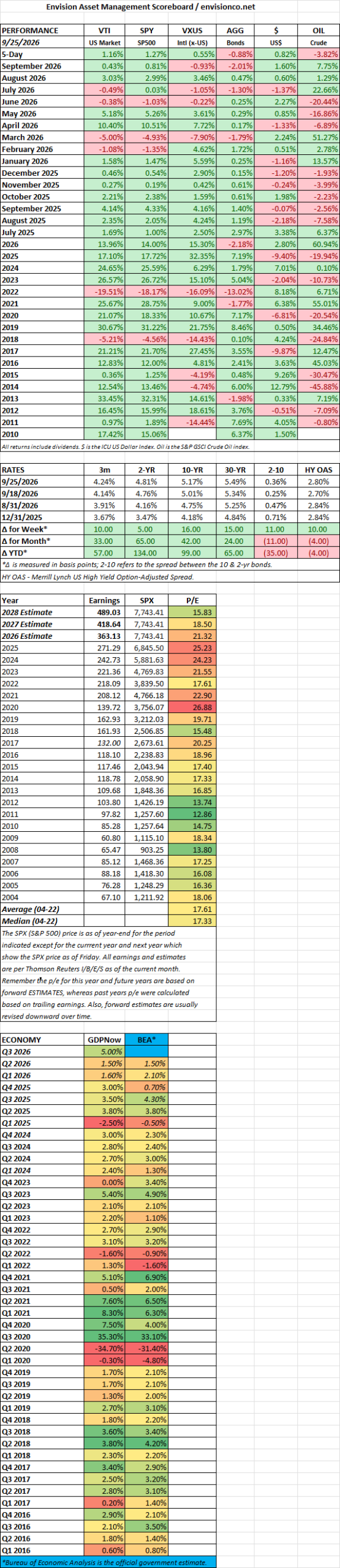
  • S&P 500: Rose 1.21% from the prior Friday to close at 7,743.41.

  • Dow Jones Industrial Average: Added 0.28% to finish at 51,828.62.

  • Nasdaq Composite: Outperformed with a 2.06% gain, settling at 27,068.72.

Market Breadth: Cap-Weighted vs. Equal-Weighted

The tech-led rally highlighted a recurring divergence in market breadth. Over the past month, the cap-weighted S&P 500 resumed its outperformance over the equal-weighted index (Invesco S&P 500 Equal Weight ETF, RSP). While RSP outpaced the broader market during late summer as participation broadened, September’s advance narrowed back toward mega-cap technology and AI leaders, causing the equal-weighted benchmark to lag the headline index over the rolling four-week stretch.

International Equities, Fixed Income, and Commodities

  • International Equities: Vanguard Total International Stock ETF (VXUS) saw a more muted recovery, ticking up 0.55% to close at $86.35.

  • Fixed Income: The 10-year Treasury yield rose roughly 18 basis points to finish near 5.17%–5.18%—its highest area since 2007—as hawkish Fed commentary and firm activity kept another rate hike on the table.

  • Cryptocurrency: Bitcoin gained approximately 4.0%, advancing from around $80,900 on September 18 to $84,100.

  • Commodities: Gold retreated under pressure from higher real yields and a firmer U.S. dollar, with COMEX futures down 2.3% to settle near $4,286 per ounce.

Economic Data & Corporate Earnings

The calendar brought no major monthly inflation or GDP releases this week, leaving markets to trade off secondary data and prior policy signals. Initial jobless claims dipped to 197,000 for the week ended September 19, signaling historically low layoff activity. Earlier releases—including August CPI (3.4% YoY), core PCE (3.3%), and the Q2 GDP estimate (1.5% annualized)—continued to underpin the Fed’s recent quarter-point rate hike to a 3.75%–4.00% target range and its hawkish guidance.

Corporate fundamentals, however, remain a strong pillar of support:

  • Q2 2026 Earnings: The finalized blended earnings growth rate for the S&P 500 surged well above original projections, ultimately exceeding 23% year-over-year (and topping 50% on unadjusted headline EPS driven by mega-cap revisions), marking the index’s seventh consecutive quarter of double-digit earnings expansion.

  • Q3 2026 Outlook: Analysts remain uncharacteristically optimistic heading into the reporting period. Consensus estimates project Q3 year-over-year earnings growth of approximately 27% to 29%, bolstered by upward revisions in Information Technology, Energy, and Financials.

Geopolitics, Energy & Tech Catalysts

  • Diesel Export Ban Rumors: Intraday energy volatility surged midweek following reports that the White House was reviewing a potential 90-day ban on U.S. diesel exports to tame pump prices. Industry groups, including the American Petroleum Institute (API), warned that restricting exports would force Gulf Coast refiners to curtail runs and exacerbate fuel shortages. Energy Secretary Chris Wright and White House officials walked back the report by Wednesday, clarifying that a blanket ban is not on the table and calming crude markets into Friday.

  • Meta Muse Launch: Technology sentiment was buoyed by Meta’s rollout of Muse, its autonomous, multi-modal personal AI agent capable of executing complex end-to-end tasks, web navigation, and scheduling across desktop and mobile ecosystems. The launch reinforced investor conviction in commercial AI monetization, lifting mega-cap tech.

  • Global Trade: High-level meetings between President Trump and China’s Xi Jinping during U.N. week yielded limited incremental dialogue without delivering a meaningful breakthrough on structural trade disagreements.

Equities demonstrated resilience by absorbing another leg up in yields and elevated energy costs. Looking ahead, that underlying strength will be tested with the upcoming release of August PCE inflation figures, the final revision to Q2 GDP, and the September employment report.

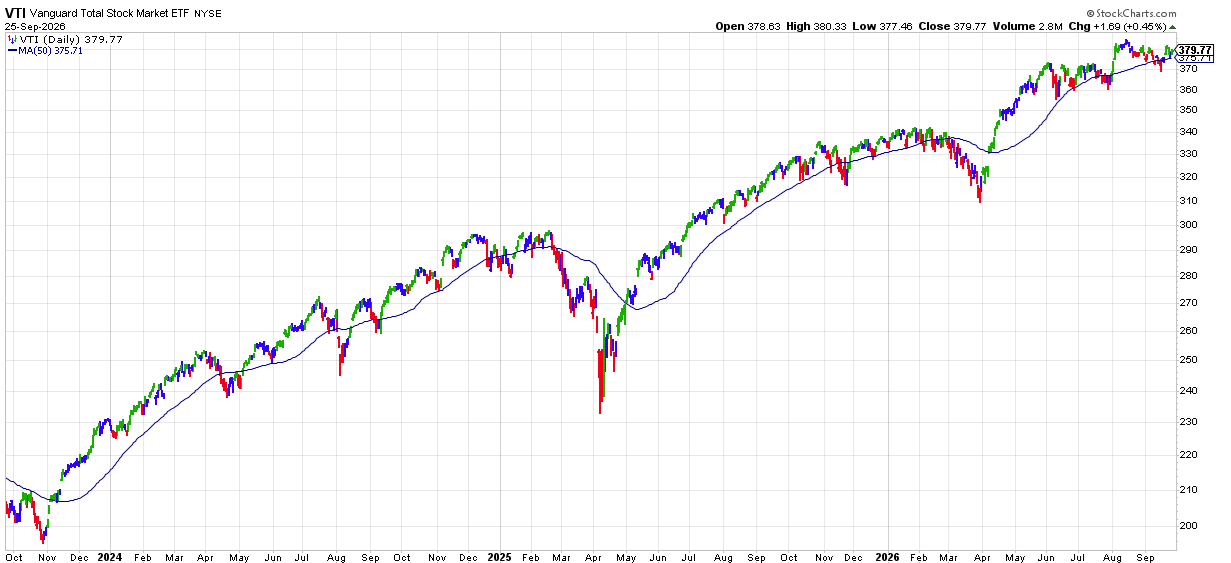
US STOCK MARKET (VTI)
SCOREBOARD
Week Ending 9/18/2026

MARKET RECAP

U.S. stocks finished a choppy week mixed after the Federal Reserve delivered its first rate increase in three years and signaled that another hike remains on the table before year-end.

Performance diverged sharply across benchmarks:

  • S&P 500: Slipped 0.08% to close at 7,650.50.

  • Dow Jones Industrial Average: Dropped 1.69% to 51,682.64, logging its third consecutive weekly decline.

  • Nasdaq Composite: Rose 0.72% to 26,522.55, as resilience in semiconductors and mega-cap technology helped counterbalance broad weakness in financials and industrials.

Across other major asset classes:

  • International Equities: Vanguard Total International Stock ETF (VXUS) fell 1.45%, mirroring the pressure on non-U.S. risk assets.

  • Fixed Income: The 10-year Treasury yield rose from roughly 4.96% to finish near 5.00% on Friday, revisiting levels last seen in 2023 and keeping rate-sensitive sectors under pressure. The 2-year yield increased from 4.63% to 4.76%.

  • Cryptocurrency: Bitcoin rebounded into the weekend, finishing near $80,900 for a gain of roughly 4.8% from the prior Friday.

  • Commodities: Gold held steady, finishing virtually unchanged around $4,390 per ounce.

Labor data continued to support the central bank’s hawkish stance. Initial jobless claims fell to 196,000 for the week ended September 12—beating expectations and marking the lowest level since mid-July—while continuing claims also moved lower. Paired with the Fed’s quarter-point rate hike and firmer guidance, the figures kept market participants firmly focused on persistent inflation rather than the prospect of policy easing.

While markets absorbed the policy shift without a widespread sell-off, the pronounced divergence between technology and the broader tape—alongside a 10-year yield hovering at 5.00%—leaves sentiment guarded ahead of upcoming economic releases.

SCOREBOARD

Week Ending 9/11/2026

MARKET RECAP

U.S. stocks finished lower for the holiday-shortened week ended September 11, pressured by climbing Treasury yields, sticky inflation data, and a midweek surge in crude oil.

From the prior Friday’s close through September 11, the major averages posted modest to moderate declines:

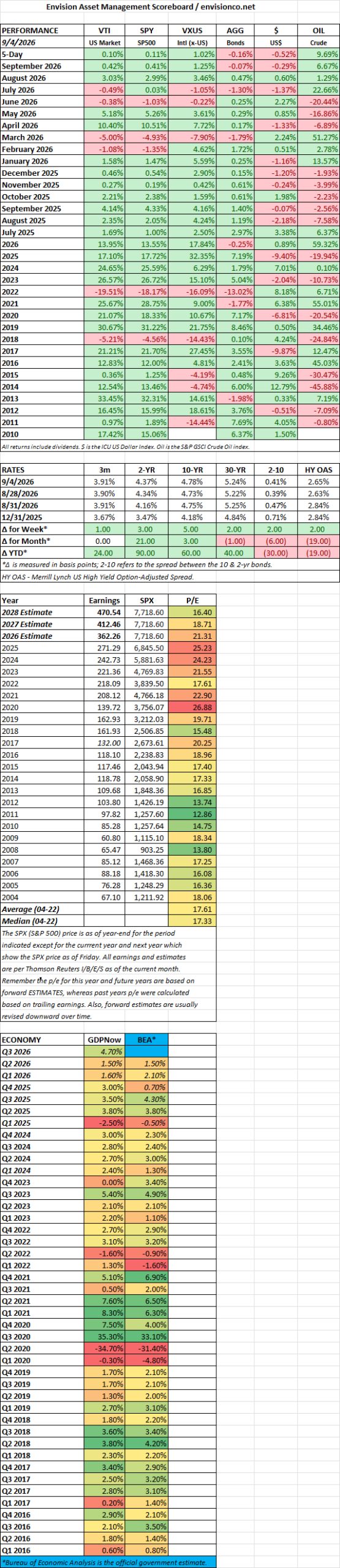
  • S&P 500: Fell 0.8%, from 7,718.60 to 7,656.98.

  • Dow Jones Industrial Average: Dropped 1.6%, from 53,414.25 to 52,573.29.

  • Nasdaq Composite: Declined 0.7%, from 26,506.99 to 26,333.04.

A Friday rebound—driven by a late pullback in crude—snapped a four-session losing streak across the major benchmarks, though it was not enough to pull them out of weekly negative territory.

International and alternative asset classes followed a similar path:

  • International Equities: Vanguard Total International Stock ETF (VXUS), serving as a broad proxy for non-U.S. markets, slipped roughly 1.4%, from $88.41 to $87.14.

  • Fixed Income: The 10-year Treasury yield rose nearly 20 basis points, climbing from 4.78% to around 4.96%–4.97% as traders priced in higher odds of a Federal Reserve rate hike at this week’s meeting.

  • Commodities: Crude oil approached triple-digit levels midweek on escalating Middle East tensions before retreating on Friday. Gold softened to finish near $4,350, down from $4,430–$4,480 the prior week.

  • Cryptocurrency: Bitcoin retreated approximately 3%, drifting from the high $79,000s into the low $77,000s.

Economic releases underscored persistent price pressures alongside a sturdy labor backdrop. Initial jobless claims remained contained at 206,000 for the week ended September 5, showing few signs of accelerating layoffs. Meanwhile, the August Consumer Price Index (CPI) showed headline prices rose 0.4% month-over-month and core CPI advanced 0.3%, reinforcing expectations that inflation will remain stubborn.

The combination of higher yields and elevated energy costs kept pressure on risk assets throughout the week. However, low unemployment claims and Friday’s late relief rally ensured that the pullback remained orderly as markets turn their focus toward the Fed’s upcoming rate decision.

SCOREBOARD

Week Ending 9/4/2026

MARKET RECAP
U.S. stocks finished mixed for the week ended September 4 after a late pullback on stronger-than-expected jobs data. The S&P 500 rose 0.1% from the prior Friday’s close of 7,711.76 to 7,718.60. The Dow Jones Industrial Average slipped 0.3%, falling from 53,559.99 to 53,414.25. The Nasdaq Composite gained 0.4%, climbing from 26,402.42 to 26,506.99. International stocks, as measured by VXUS, outperformed with a 1.0% weekly advance from $87.52 to $88.41.
The August employment report, released Friday, showed nonfarm payrolls rose by 162,000—well above forecasts—while the unemployment rate held at 4.1%. Labor-force participation increased 0.2 percentage point to 61.6%, and prior months were revised higher by a combined 55,000 jobs. Gains were concentrated in food services and local government education. Initial jobless claims for the week ended August 29 ticked up 2,000 to 206,000, remaining historically low.
The stronger labor data lifted the 10-year Treasury yield from 4.73% the previous Friday to 4.78%, as markets priced a greater chance of a September Fed rate hike.
Bitcoin rose roughly 3% on the week and traded near $80,000, while gold eased about 0.6% to around $4,430 an ounce.
Geopolitical tension remained a market driver: renewed U.S.-Iran exchanges around the Strait of Hormuz pushed oil higher and sent U.S. gasoline prices to a record Labor Day level. A stopgap funding bill was signed to keep the government operating through mid-December, and attention also turned toward the approaching midterm elections.
Overall, equities held near recent highs despite Friday’s decline, but firmer jobs numbers, higher yields, and elevated energy prices left investors focused on inflation data and the Fed’s next move.
SCOREBOARD