Unique opportunity in TIPS

There is a unique opportunity right now with TIPS bonds going out 15 to 30 years. TIPS are US Treasury bonds designed to protect investors from inflation while providing a return above inflation. Right now, the longer-dated TIPS bonds have real yields approaching 3%. This means you will get a real yield about 3% above inflation.
A close-to-3 % real yield available now is very rare. The last time you could get this was in the early 2000s and briefly around 2008.

Week Ending 8/28/2026

MARKET RECAP

U.S. stocks finished the week higher despite a modest pullback on Friday. The S&P 500 rose 0.5% from the prior Friday’s close of 7,674.37 to 7,711.76. The Dow Jones Industrial Average also gained 0.5%, closing at 53,559.99 versus 53,277.01 a week earlier. The Nasdaq Composite outperformed with an 0.8% weekly advance, ending at 26,402.42 after starting the comparison week at 26,180.45.
Strength in mega-cap technology, led by Nvidia’s better-than-expected results and outlook, offset late-week caution after Federal Reserve Chair Kevin Warsh’s Jackson Hole remarks. International equities, using VXUS as a proxy, slipped 0.2% for the week, closing Friday at $87.52 versus $87.71 the previous Friday.
The 10-year Treasury yield finished near 4.73%, little changed from about 4.74% a week earlier after moving lower midweek and then rising Friday. The 2-year yield, which is more sensitive to near-term Fed policy bets, reacted more sharply to Warsh’s speech: it jumped more than 12 basis points on Friday to about 4.35%, from roughly 4.20%–4.23% the day before, as markets raised the odds of a rate hike. Warsh said recent inflation readings were better than expected but that underlying trends had not improved enough, and that price stability remains the Fed’s predominant focus.
Bitcoin ended the week roughly flat to slightly lower, near $77,800 after trading around $78,300 the prior Friday. Gold dropped about 3.2%, falling from roughly $4,608 an ounce to about $4,456.
Initial jobless claims for the week ended August 22 came in at 203,000, down 4,000 from a revised 207,000 and below forecasts.
The week’s main policy catalyst was Warsh’s first Jackson Hole speech as chair, which revived rate-hike speculation and weighed on stocks and gold on Friday. Other developments included collapsed U.S.-Canada trade talks and new tariff threats, additional sanctions aimed at isolating Iran, and political discussion of a Venezuela oil arrangement. Markets still posted a modest weekly gain in U.S. equities, supported by earnings, but finished the period more focused on inflation and the path of policy
heading into Labor Day and the next jobs report.


Barron’s wrote about the AI Capex bubble and when it might burst. Historically, major capex cycles don’t top out until spending reaches about 25% of GDP. With US GDP currently at about $30 trillion, that would mean about $7.5 trillion in capex, and that probably won’t be reached until the beginning of the next decade. Another key point is that it takes some kind of external shock, like a policy change or monetary tightening, to trigger the collapse.

SCOREBOARD

Week Ending 08/21/2026

MARKET RECAP

U.S. equities declined for the week ending August 21, 2026, with the S&P 500 falling 1.43% to close at 7,674.37, the Dow Jones Industrial Average dropping 0.85% to 53,277.01, and the Nasdaq Composite sliding 2.05% to 26,180.45 (Friday closes versus the prior Friday). The pullback snapped multi-week winning streaks for the S&P and Nasdaq amid rising longer-term Treasury yields, higher oil prices tied to Middle East/Iran tensions, and broader risk-off sentiment, though indexes rebounded on Friday.

International stocks, proxied by VXUS, finished essentially flat with a negligible gain of about 0.01% (closing near $87.71 versus roughly $87.70 the prior Friday). The 10-year Treasury yield rose approximately 4 basis points over the week to around 4.74%, as concerns over government debt, inflation, and financing costs outweighed a mid-week intervention. Bitcoin surged roughly 24% to the mid-$78,000 range (from around $63,000), while gold advanced about 5.5–5.6% (Comex settling near $4,624).

Initial jobless claims for the week ending August 15 fell to 206,000 from a revised 212,000, remaining at historically low levels and signaling continued labor-market resilience despite softer hiring trends in recent months. Geopolitically, ongoing U.S.-Iran frictions and related oil-supply worries added to market pressure, while Treasury Secretary Scott Bessent’s announcement of increased longer-dated bond buybacks (financed by shorter-term issuance) produced only a brief dip in yields before they rebounded, with the effort widely viewed as a temporary and ultimately unsuccessful intervention against fundamental fiscal and inflation pressures.

Overall, the week highlighted investor sensitivity to rising yields and geopolitical risks, resulting in a broad equity retreat despite Friday’s partial recovery, while safe-haven and alternative assets like gold and Bitcoin outperformed.
SCOREBOARD

Week Ending 8/14/2026

MARKET RECAP

U.S. equities mixed for the week ending August 14, 2026. The S&P 500 rose from a prior-Friday close of 7,757.64 to 7,785.76, +0.36%. The Dow Jones Industrial Average fell from 54,036.93 to 53,732.41, -0.56%. The Nasdaq Composite edged higher from 26,690.62 to 26,729.16, +0.14%.
Markets showed resilience near recent highs amid mixed economic data, including cooler inflation readings offset by weaker retail sales. International stocks, tracked via the Vanguard Total International Stock ETF (VXUS), advanced modestly. VXUS closed the prior Friday at 87.21 and finished the week at 87.70, a gain of approximately +0.56%.In fixed income, the 10-year Treasury yield moved slightly higher, starting near 4.65% on August 7 and ending around 4.68–4.69% by August 14/15.
Bitcoin declined roughly 2.9%, falling from near $64,880 to about $62,980. Gold posted a modest advance of around 0.8–1%, rising from roughly $4,340–4,343 to the $4,376–4,380 area.
On the geopolitical front, developments surrounding the Strait of Hormuz and the ongoing U.S.-Iran tensions remained a focal point. Iran and Oman discussed potential safe shipping routes, while Tehran continued to condition any full reopening on U.S. concessions including lifting the naval blockade, sanctions relief, and other demands.
Additional vessel incidents were reported, and U.S. officials signaled readiness to sustain or intensify economic pressure, keeping energy markets sensitive to the situation.
Overall, the week reflected a cautious, mixed tone: major U.S. indexes finished near records with the S&P and Nasdaq higher while the Dow lagged, international equities gained slightly, yields edged up, Bitcoin softened, and gold held firm, against a backdrop of persistent Middle East uncertainties.
SCOREBOARD

Week Ending 8/6/2026

MARKET RECAP
U.S. equities delivered their strongest weekly gains since April, with the S&P 500 rising 3.58% to close at 7,757.64, the Dow Jones Industrial Average advancing 2.96% to 54,036.93, and the Nasdaq Composite climbing 5.19% to 26,690.62 (comparing Friday, August 7 closes to the prior Friday, July 31). Soft July jobs data (nonfarm payrolls falling 23,000) eased concerns about imminent Federal Reserve rate hikes, supporting risk assets amid solid earnings.

International stocks, tracked via the VXUS ETF, gained approximately 3.1% for the week, rising from a July 31 close of $84.59 to $87.21 on August 7. Global equities broadly participated in the risk-on move.
In fixed income, the 10-year Treasury yield declined from about 4.75% on July 31 to roughly 4.64–4.66% by August 7. Bitcoin advanced roughly 3.2%, moving from near $62,882 to around $64,900. Gold posted a sharp rally of about 7.2%, with Comex futures settling near $4,340.70 after ending the prior week around $4,049.
Geopolitically, tensions remain elevated in the Middle East, where Iran continues to condition any full reopening of the Strait of Hormuz on U.S. concessions including sanctions relief and an end to the naval blockade, even as technical talks with Oman advance; the Trump administration has emphasized economic pressure while pausing major new strikes. In Eastern Europe, Russia and Ukraine exchanged overnight drone and missile attacks that killed civilians on both sides, with frontline fighting and long-range strikes persisting. Domestically, U.S. midterm primary season continues.

Abdul El-Sayed’s razor-thin primary win over moderate Rep. Haley Stevens has handed the progressive left its biggest victory of the cycle and set up a high-stakes general election test against Republican Mike Rogers in a must-win Senate battleground.

Overall, the week reflected a clear risk-on tone driven by cooling labor-market signals and resilient corporate results, lifting equities, crypto, and gold while yields eased, even as geopolitical flashpoints in Iran and Ukraine, alongside the approaching midterms, continue to inject uncertainty into the broader outlook.

SCOREBOARD

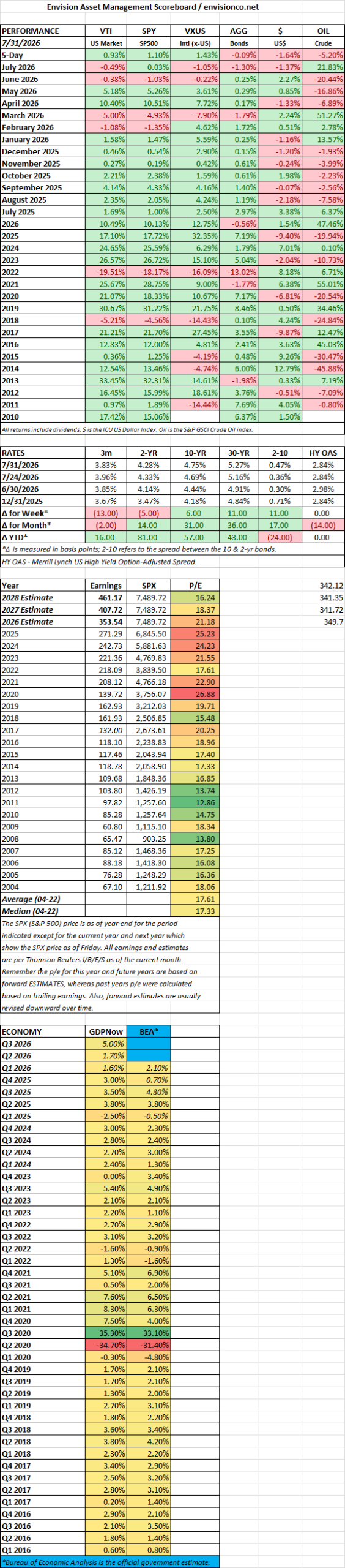
Week Ending 07/31/2026

MARKET RECAP

U.S. stocks posted solid weekly gains for the period ending July 31, 2026, with the S&P 500 rising approximately 1.05% from its prior Friday close of 7,411.98 to 7,489.72, the Dow Jones Industrial Average advancing about 1.04% from 51,947.25 to 52,485.03, and the Nasdaq Composite climbing roughly 1.59% from 24,975.82 to 25,373.85. The advance came after a choppy session that included a midweek pullback tied to the Federal Reserve’s decision to hold rates steady amid ongoing inflation concerns, followed by a rebound fueled by strong earnings from major technology names.

International stocks, tracked via the Vanguard Total International Stock ETF (VXUS) as a broad proxy, gained about 1.43% over the same Friday-to-Friday span, closing near $84.59 after starting the week around $83.40. Overseas markets showed resilience despite mixed regional results and lingering global uncertainties.
In fixed income, the 10-year U.S. Treasury yield moved higher, finishing the week near 4.75% after starting around 4.68–4.69% the prior Friday, while the 30-year yield rose from about 5.16% to 5.27%. The increases reflected renewed investor focus on inflation risks and the path of monetary policy. New Fed Chair Kevin Warsh’s post-meeting press conference on July 29 drew a sharp market reaction: equities sold off heavily that day (with the Dow dropping more than 2% and the S&P 500 falling about 1.5%), longer-term yields spiked to multi-year highs as traders questioned the Fed’s resolve on inflation, and the yield curve steepened while near-term rate-hike odds declined.
Bitcoin declined over the week, falling from levels near $64,100–$64,200 to roughly $62,880–$62,900 (a drop of around 2–3.5%), while gold prices were little changed to slightly lower, ending near $4,040–$4,050 after trading in a similar range the previous Friday.
Overall, the week delivered a modest recovery for equities after recent softness, supported by corporate results, even as higher yields, the bond market’s response to Warsh’s remarks, and softer performance in cryptocurrencies highlighted persistent caution around inflation and risk assets.

SCOREBOARD