Week Ending 7/28/2017

HIGHLIGHTS

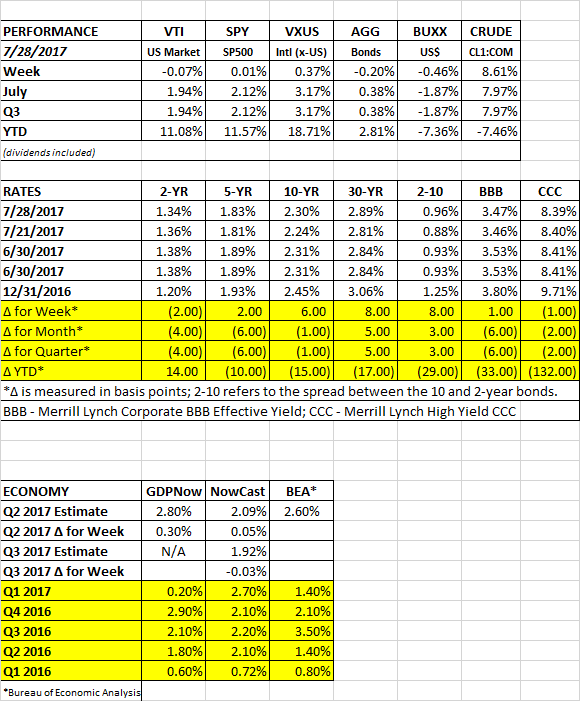
  • Equities are flat as strength in industrial’s offset weakness in tech.
  • VIX hits all-time low.
  • Q2 GDP up 2.60%.
  • Fed to begin to unwind its balance sheet sometime soon.
  • Inflation under the surface?
  • Dysfunction in Washington.

PERFORMANCE

US equities were roughly flat on the week which was quite a feat since market leaders Amazon and Google fell after they released earnings. Amazon dropped 0.6% and Google 3.6%. The market was helped by some old-time blue chips like Caterpillar (+7.04%), and Boeing (+13.7%). Caterpillar, which is a good gauge of global growth, raised its outlook for the year.

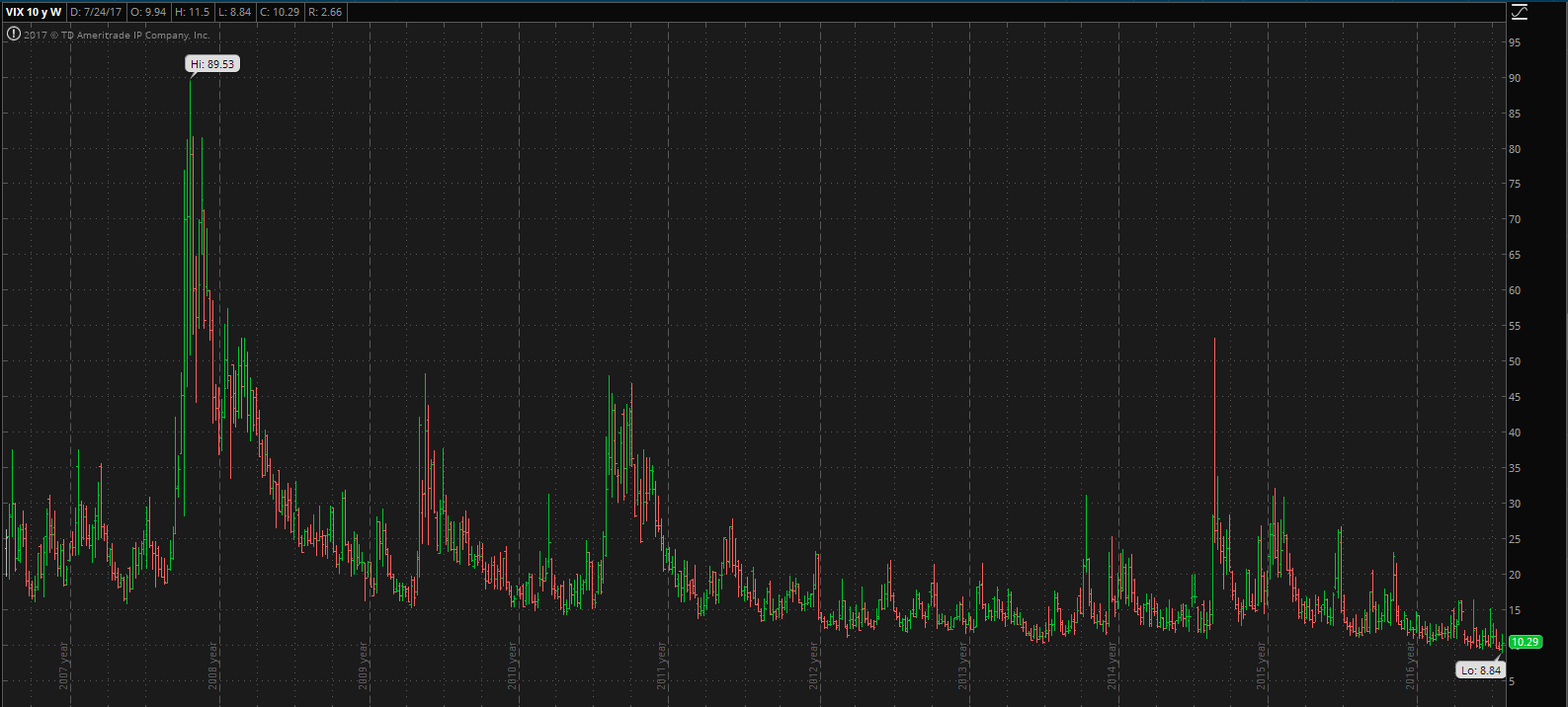
The VIX, a measure of volatility that is often called the fear index, fell to its lowest level ever on Tuesday. The current “fear” is that when volatility does break out, so many traders are short volatility related instruments, that the short covering will explode the VIX to the upside and take equities with it (but in a negative direction). However, the VIX has been declining for years now and this is not a new argument, although the all-time low is new.
Bonds declined by 0.20% as the curve steepened. The dollar was down by 0.46% and crude had a big rally.

ECONOMY

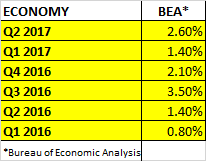
Real GDP increased by 2.6% in Q2, up from 1.2% in Q1 and better than than 1.40% in Q2 of 2016. Consumer and government expenditures were up, capex growth moderated and residential fixed investment was down.
FED TO UNWIND BALANCE SHEET SOON

The Fed announces that it will begin to unwind its balance sheet “relatively soon.” In FedSpeak, that normally means within a month or two. The unwinding process will be a slow, gradual affair that might not finish for about five years, assuming no recession.

IS INFLATION OUT THERE, SOMEWHERE?

Inflation is supposedly under control as we constantly hear that the Fed can’t reach their two percent inflation target. But numerous industrial companies, including Ingersoll-Rand, Lennox and United Technologies have been citing high commodity prices and cost pressures. Oil was up 8.6% this past week. Copper is up 14% so far this year and is at its highest level since May of 2015. The labor market also appears tight. One must wonder if there is inflation is beginning to brew just under the surface.

WASHINGTON GOES FROM BAD TO WORSE

Things have gone from bad to worse in Washington. North Korea shot off another ballistic missile that experts said could reach Chicago. Some very hard decisions have to be made and possibly soon. The conventional wisdom is that tighter economic sanctions and more political pressure are the way to go, but that hasn’t worked with North Korea in the past. Trump’s patience with China is beginning to wear thin, and his natural inclination to brand China as a trade manipulator can now come conveniently into play as an offset of the North Korea problem.

Newly installed White House Communications Director Anthony Scaramucci, brought on-board after the press secretary Sean Spicer left last week, gave an interview with the New Yorker magazine filled with profanity and went after Chief of Staff Reince Priebus and others. Scaramucci was impressive at his initial press conference and seemed like a solid and sane addition, until the interview.

Later in the week, Trump fired Priebus and replaced him with Home Security Secretary and former Marine general John Kelly. Hopefully Kelly can get the White House under control.

The Republican’s attempt to repair/replace the US healthcare system failed again. When you have a slim majority with just 52 Senators, and you are not interested in working with the Democrats (as the Democrats routinely would do with the Republicans in years past), you need to be close to perfect to pass legislation and the Republicans came up short. Maybe it is time for a radical (old-fashioned) approach as Senator McCain alluded to in his dramatic speech earlier this week, try to work together, Republicans and Democrats to come up with a solution that moves the debate and policy to the center.

One bipartisan effort that did succeed was the passing of sanctions on Russia, despite White House objections. The bill passed 419-3 in the House and 98-2 in the Senate.

The truth is, Trump has turned out to be what so many feared during the campaign. In Saturday’s Wall Street Journal, Peggy Noonan writes “He’s not strong and self-controlled, not cool and tough, not low-key and determined; he’s whiny, weepy, and self-pitying. He throws himself, sobbing, on the body politic. He’s a drama queen.”

Trump does have some good economic ideas, and he brought on some excellent advisers, but all his side acts and his crazy behavior are making it impossible to make real progress. He needs to get off Twitter, stop talking and start leading like a normal President.

SCOREBOARD
 

Week Ending 7/21/2017

PERFORMANCE

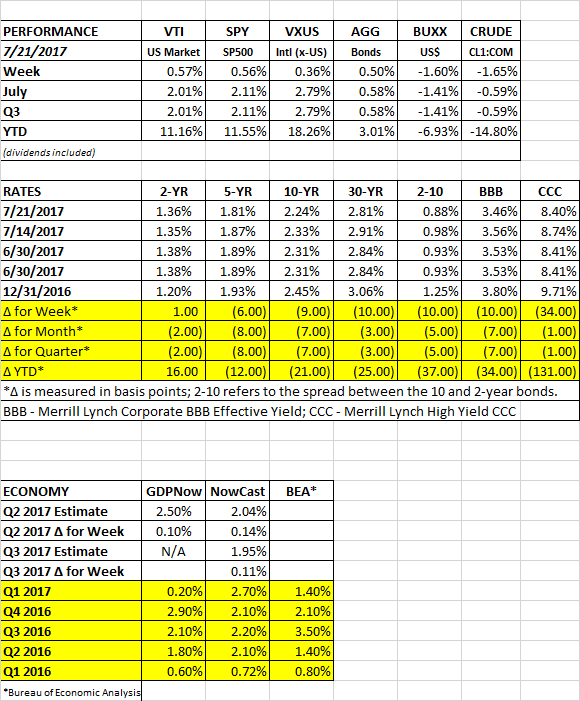
It was another good week for investors as equity and fixed income markets were generally up by about 1/2%. The US markets increased by 0.57%, international +0.36% and the bond aggregate +0.50%. The US dollar fell by 1.60% and crude dropped by 1.65%.

The markets have been helped by strong earnings, which in turn have been helped by a lower dollar. The dollar is now down about 7% on the year. A lower dollar provides a tailwind to earnings. According to Dubravko Lakos-Gujas from JP Morgan, S&P500 earnings increase by about 1% for every 2% decline in the dollar. Overall, 19% of S&P 500 companies have reported earnings this quarter, and they have come in 7.8% above estimates (per FactSet).

Interest rates generally declined but at the short-end of the curve, they increased. The 5, 10 and 30 year bonds all had lower yields. But the two-year was up by 1 basis point and the 3-month yield increased by 12 basis points. Bond investors are worried about the up-coming battle over the debt ceiling, probably sometime in October, 3-months away.

POLITICS

While the market continues to advance, the political environment continues to deteriorate. Special Counsel Robert Mueller expanded his investigation into Trump’s Russia connections, including historical personal transactions. White House Press Secretary Sean Spicer resigned and Trump criticized his attorney general. The Republicans cannot pass a healthcare bill and cannot even figure out how to take a vote on one. That was just this week.

ECONOMIC

The Conference Board’s Leading Economic Index was up by the most since December of 2014, increasing 0.6%. A strong report on building permits led the way.

Initial jobless claims fell to 233,000. Down 15,000 from last week.

SCOREBOARD

Week Ending 7/14/2017

REVIEW

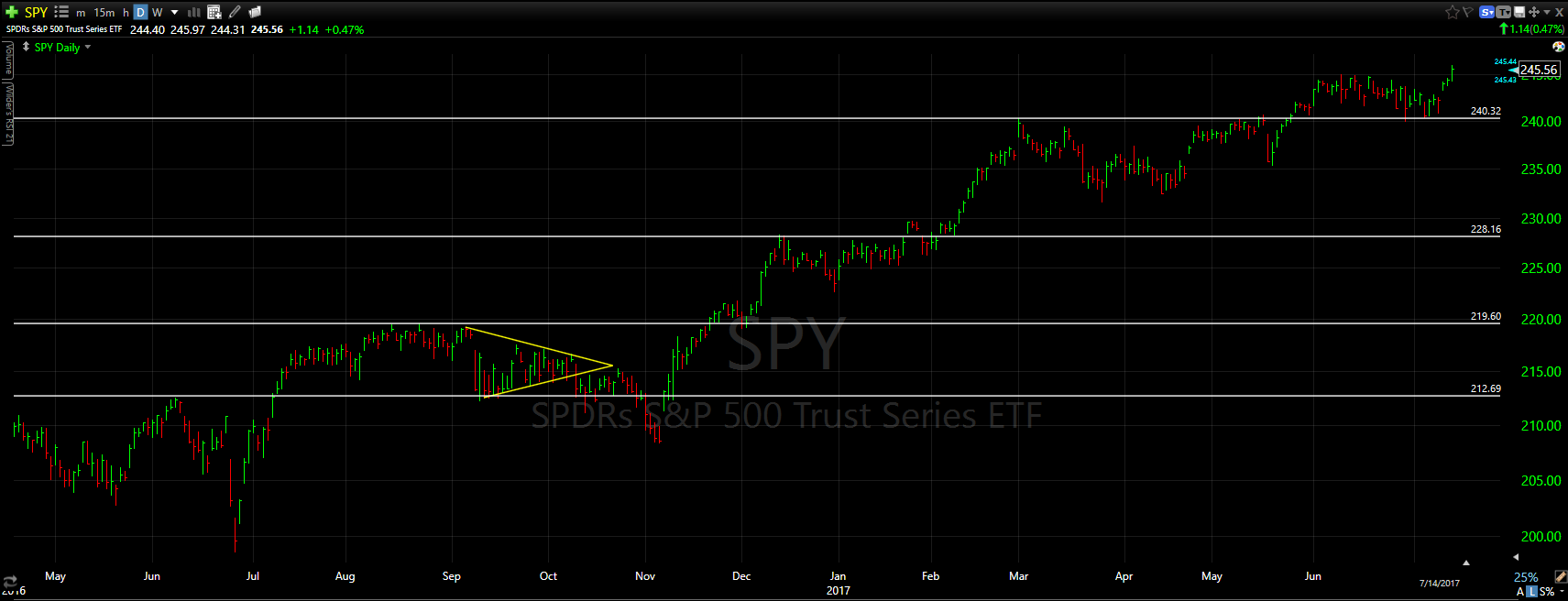
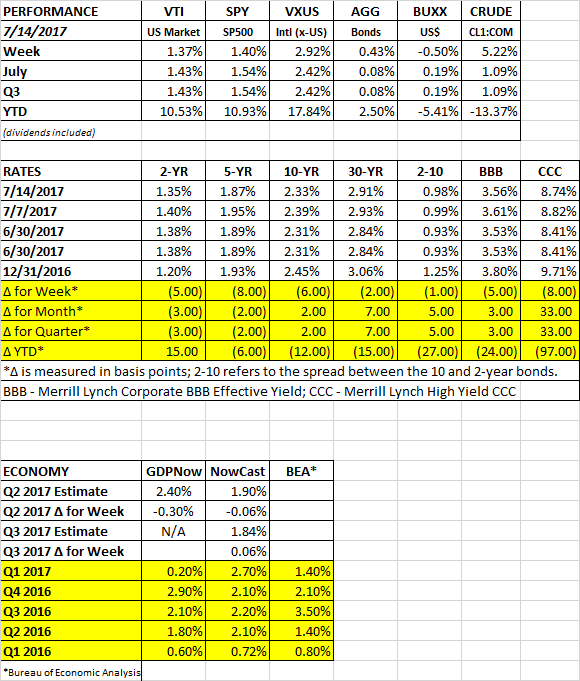
The market broke out to another high, continuing the stair-step pattern of consolidation, then another step higher. Fed Chair Janet Yellen testified before Congress and emphasized that rate hikes would be very deliberate and moderate. The market took that as good news and shot equities higher.

Bonds moved up by 0.43% as interest rates dropped on the testimony. The 10-year fell to 2.33% from 2.39%. Crude rallied by 5%.

Investors now view the probability of another interest rate hike this year as less likely. Yellen’s testimony, coupled with less than sanguine economic reports, makes it more likely that a September hike is off the table and lowers the probability of a December increase.

QUARTERLY WEBINAR

Our quarterly webinar was this weekend, click here.

SCOREBOARD

Week Ending 7/7/2017

PERFORMANCE

US equity markets were basically even, +0.06% while international markets fell by almost 1/2%. Bonds declined as interest rates continued to rise and the yield curve steepened. The dollar was up and crude was down.

INTEREST RATES

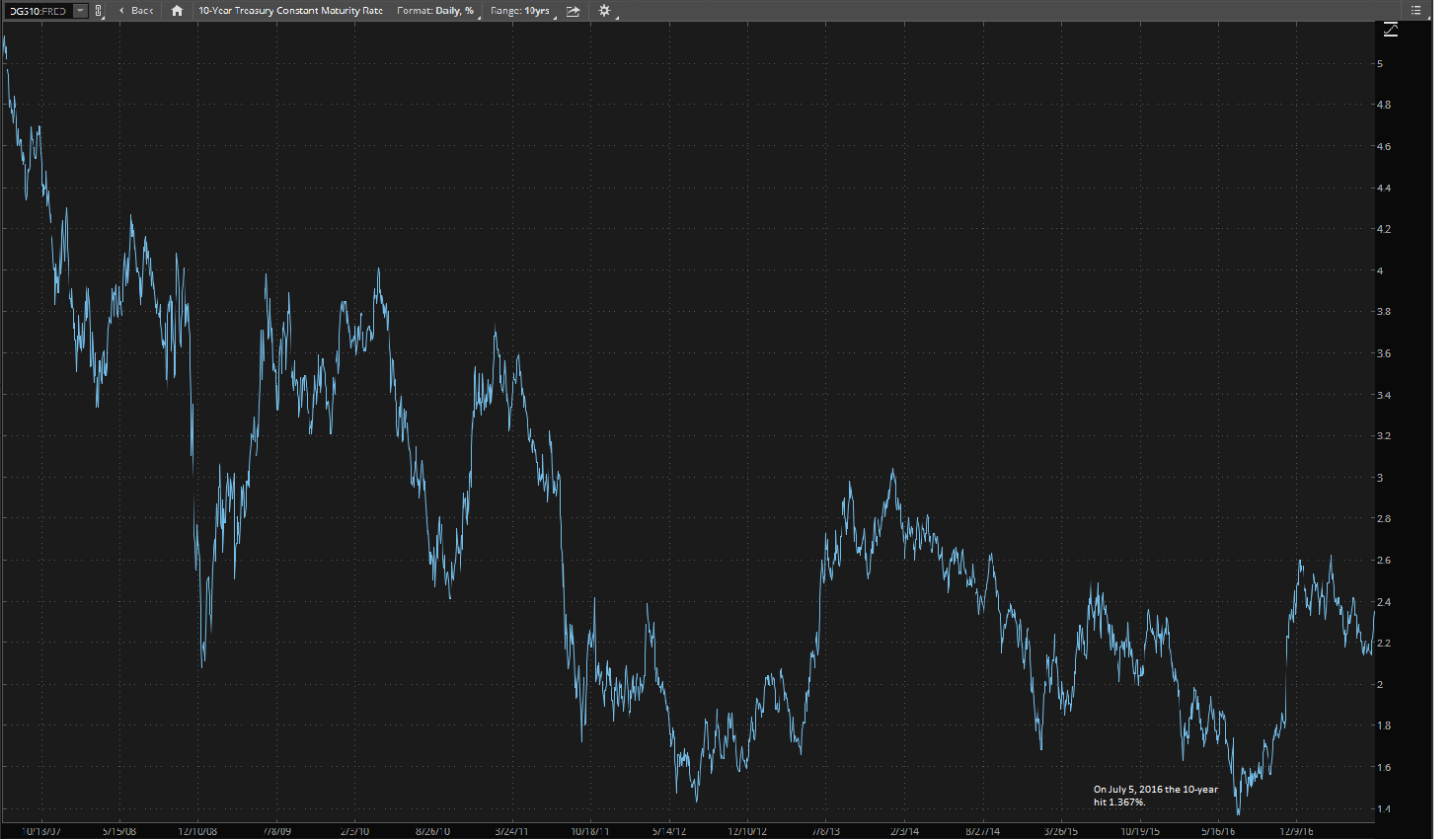
It was one year ago, on July 6, 2016, that the 10-year treasury bond hit its all time-low yield of 1.367%. One year later, we are one point higher at 2.37%. The 10-year has traded in a range between 2.1% and 2.6% since the election and we are back in the middle of that range now.

Over the last couple of weeks, consensus has tilted back towards higher rates going forward. Minutes released from the June Federal Reserve meeting showed that members want to begin reducing the balance sheet before year-end. And European Central Bank minutes indicate that there were discussions of ending their pledge to buy bonds if the economy weakened. Depending upon the rate of increase, higher interest rates at some point would likely put pressure on equities. The interplay between higher earnings and interest rate will have a lot to do to determine the direction of the equity markets.

EMPLOYMENT

The June employment report came in strong. Non-farm payrolls increased by 222,000 and the two prior months were revised higher by 47,000. The unemployment rate increased to 4.4% from 4.3% due to more entries into the workforce, which is considered a positive sign. The average workweek rose by 0.1 hours to 34.50 and average hourly earnings were 2.50% higher year over year.

SCOREBOARD

Week Ending 6/30/2017

PERFORMANCE

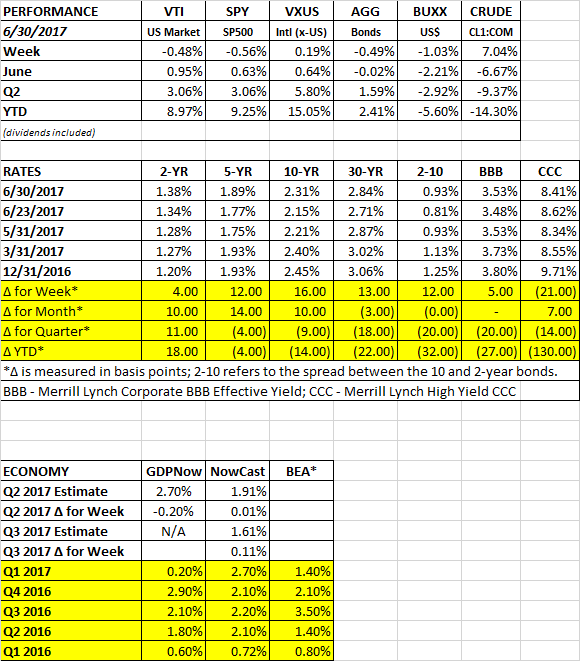
US equity markets were down by about 1/2% while international markets managed a 0.19% advance. The dollar fell and crude rallied by 7%.

Interest rates rose. The yield curve got steeper. The 10-year rose by 16 basis points. Central bankers are beginning to align themselves on the path to higher rates. The Fed has been increasing rates and have signaled more is on the way, as well as laying out the plan to reduce their bond holdings. But now some central bankers overseas might be joining the party. Mario Draghi of the ECB suggested that the bank might be close to ending its bond buying. And Mark Carney of the Bank of England suggested that a rate hike might be on the way.

EARNINGS

As the quarter ended, analysts are forecasting Q2 earnings of $31.50, down from $32.13, according to FactSet. The 2% decline is lower than the drop-in forecasts in prior quarters, which have averaged 5.9% over the last 10 years.

ECONOMY

Q1 GDP was revised up to 1.4% from 1.2%. The original estimate for Q1 real growth was 0.7%, and that was later revised up to 1.2%. GDP growth has picked up in Q2, the Atlanta Fed’s GDPNow model currently has Q2 growth at 2.7%. The first official estimate from the Commerce Department will be released on July 28.

The current economic expansion began in July of 2009 and is currently the third longest on record, surpassed only by expansions in the 1960s and the 1990s. However, the growth rate during this expansion has been sub-par, probably due to lower productivity and a decline in the labor force.

SCOREBOARD

Week Ending 6/23/2017

PERFORMANCE

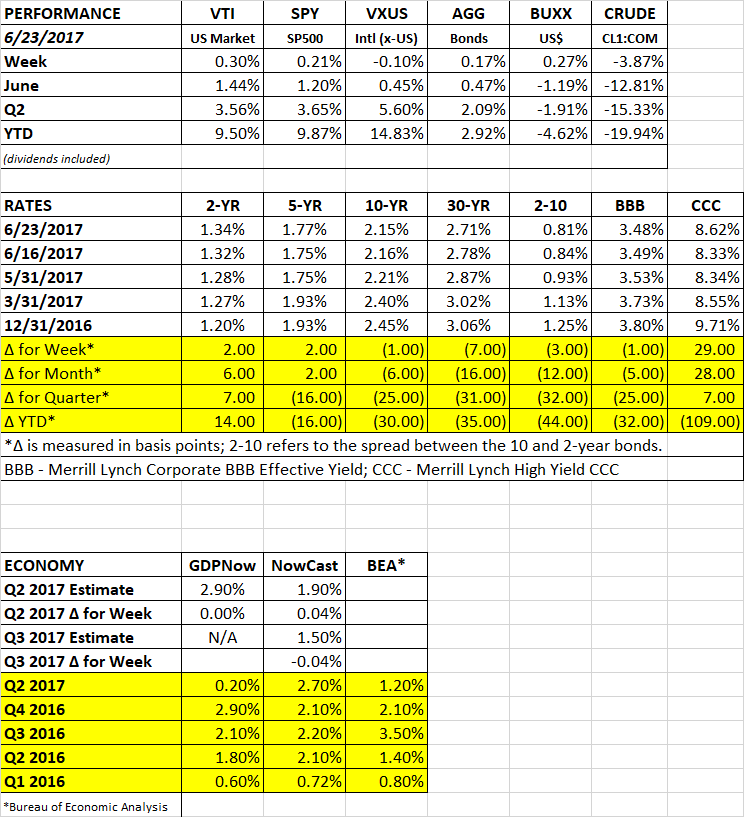
The US equity markets were up about 0.30% while international markets fell slightly, down 0.10%.  Health care had a big week, up 3.7%. A new Senate health plan would limit regulation in the sector.

The action continued to be in oil, where prices were off another 3.97%. The price of crude is now down to about $43/barrel. The consensus as recently as a couple months back was that crude would stay in the $50 range and slowly drift higher, but inventories have now been increasing for several weeks and the price has been going into reverse. There was hint that the high yield markets are starting to get nervous, the Merrill Lynch High Yield CCC Index jumped 29 basis points last week while the rest of the bond market was close to flat.

OIL

A big drop in oil prices at the beginning of 2016 contributed to the sell off at that time. But supposedly the weaker hands have gone bankrupt and the remaining companies have cleaned up their balance sheets and are in better shape. Time will tell if that turns out to be the case but it is worth watching if a divergence between high yield bonds and equities continues. More specific to the sector, oil and gas high-yield bonds are down 4% this month, according to ICE Data Services, and some of the weaker debt is down 26%.

Another knock-on effect of the lower oil prices is that it will cause the energy sector to have lower profits, and that might lower analysts projections for overall profits going forward. Investors have been counting on growing profits to power the recent market rally, but if oil continues to fall profit revisions are probably on the way.

YIELD CURVE

Investors are concerned about the flattening yield curve. A flattening yield curve normally signals slower growth. An inverted yield curve often signals recession. But before you get an inversion you start with a flattening. One argument though, is that “this time is different”, because of the suppressed yields worldwide, especially in Europe and Japan. Negative interest rates overseas have dramatically increased demand for US treasuries and thus pushed down yields further out on the curve leading to a flatter curve. Remember though that “this time is different” are often the most dangerous words in investing. The difference between the yield on the 10-year bond and the 2-year bond has flattened by 44 basis points this year and currently stands at 0.81%. For now though, the economy appears to be continuing to move along at the slow motion rate we have become accustomed to.

SCOREBOARD