Week Ending 10/2/2020

HIGHLIGHTS

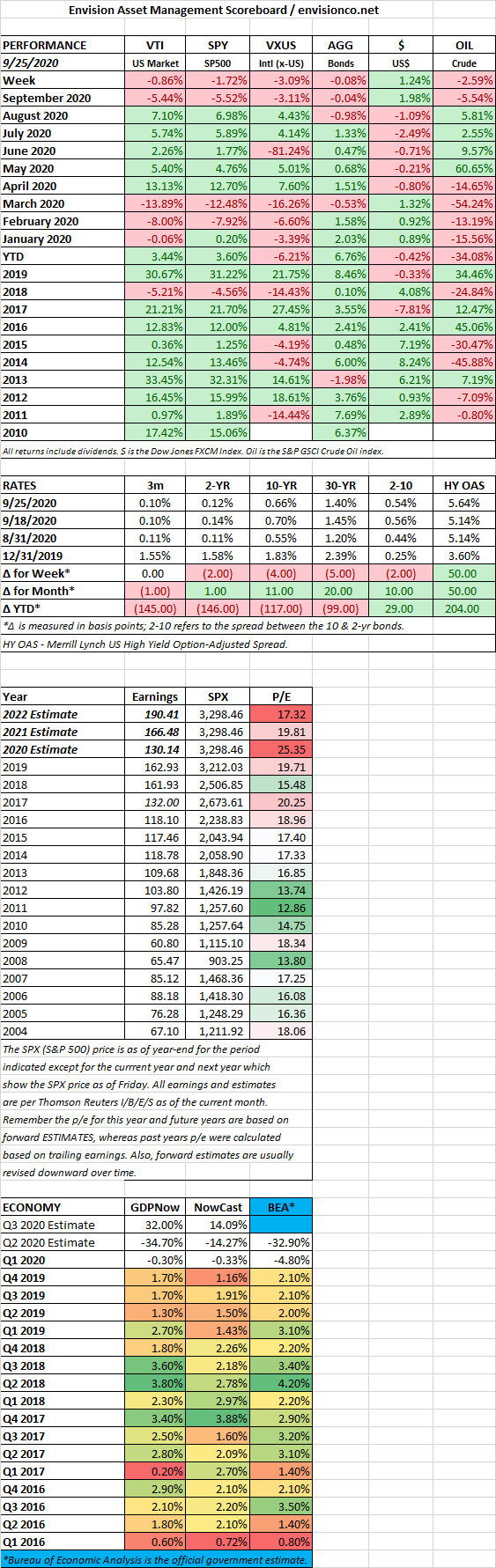
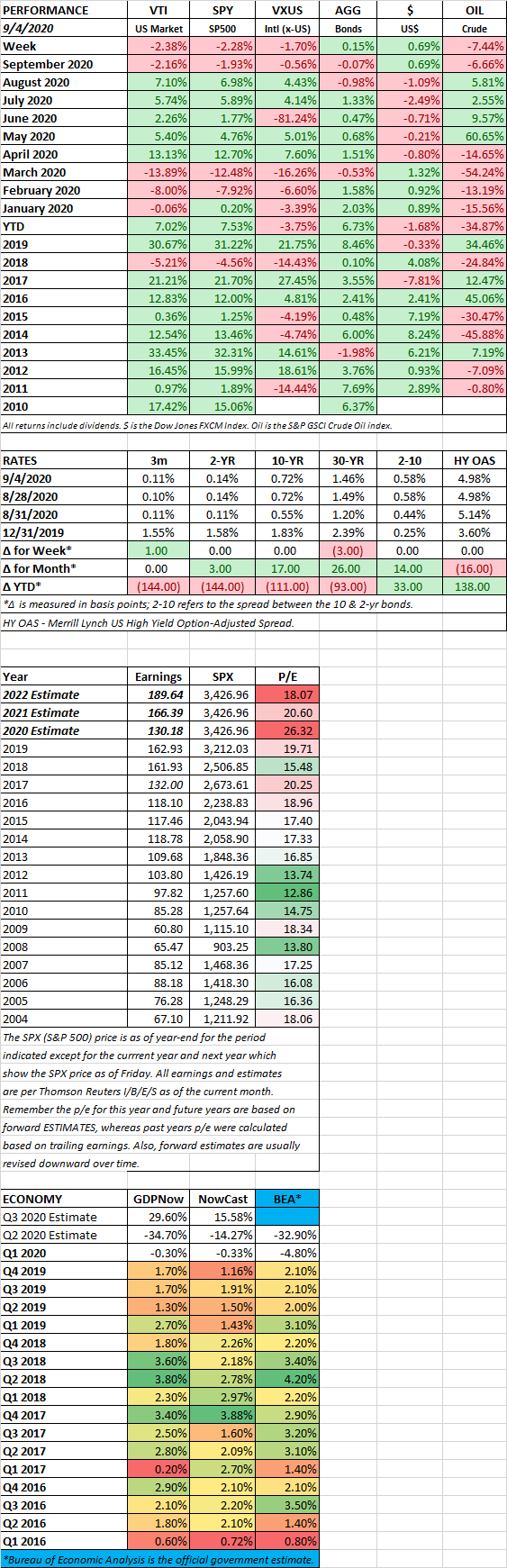
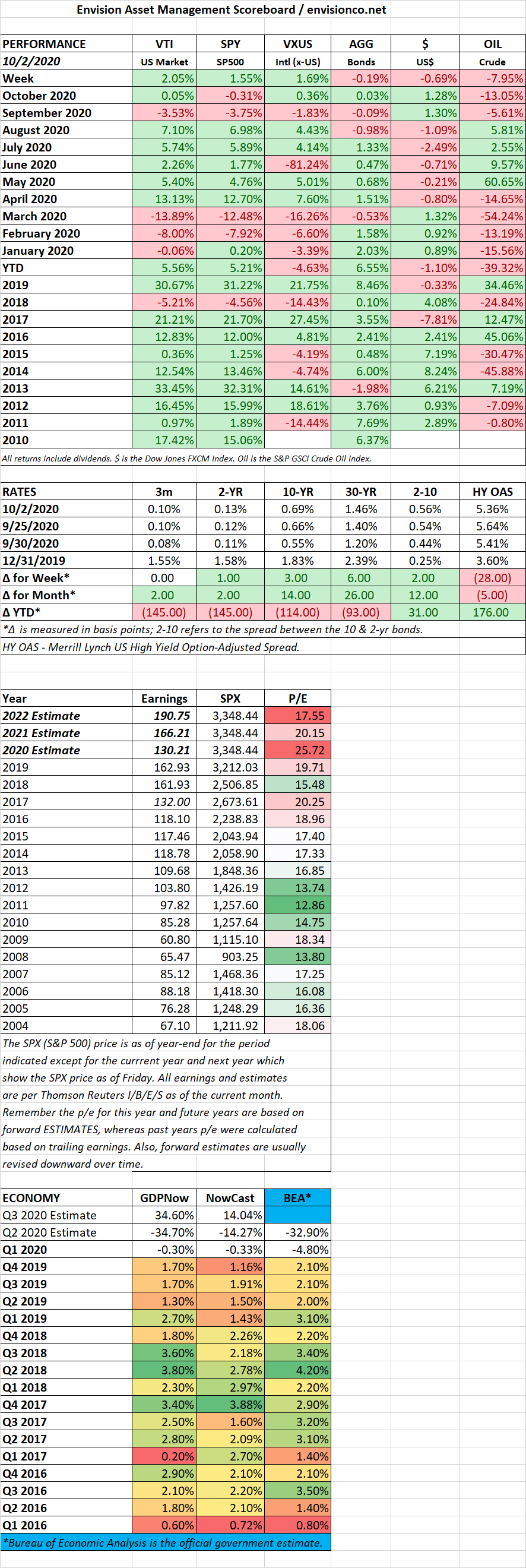
  • US and international stocks were up by 2.05% and 1.69% but oil falls hard (-7.95%).
  • The first debate marks a new low in presidential politics.
  • Trump tests positive for Covid.
  • Payrolls increase by 660k but that was short of estimates.
  • Consumer confidence jumps higher.
  • This will be a record year for retail store closings.
  • More layoffs announced.
  • A dreary long-term forecast by the CBO

MARKET RECAP

US stocks were up by 2.05% and international stocks were 1.69% higher on hopes for a stimulus bill. Oil slumped by 7.95% on fears of a slowing economy.

Trump and Biden faced off in the first Presidential debate on Tuesday and let’s just say there was nothing presidential about it. It was a new low in presidential politics as Trump just talked over and through the moderator and Biden. Then on Friday, it was announced that Trump had tested positive for Covid. Analysts seem to think this increases the odds of a stimulus bill.

Payrolls were up by 661,000 in September. Leisure and hospitality began to come back to life, adding 318,000. Construction was also strong, plus 26,000. But the total number was 200,000 lower than the consensus estimates. The unemployment rate fell to 7.9% from 8.4% last month, but a lot of that was driven by the fact that 700,000 people left the workforce. Payrolls are still 10.7 million less than the February numbers.

The Conference Board reported that consumer confidence jumped to 101.8 in September from 86.3 in August. It was the biggest increase since April of 2003 and brought the index to the highest level since March. Consumer confidence had dropped in the two previous months due to Covid outbreaks in several states like Florida and California.

A record number of retail stores are closing and will set a record by year-end. Through mid-August, more than 10,000 stores have either closed or there have been announcements that they will close, and that number could shoot up to 25,000 by year-end according to market-research firm Coresight Research. That tops the 9,500 from last year. Six thousand of those closings were due to bankruptcies. That translates into 130 million square feet of space. More than half of that is due to JC Penny, Stein Mart, Bed Bath & Beyond, and Pier I Imports.

US household income fell by 2.7% in August due to a drop in unemployment benefits. Despite the drop, household spending was up by 1% in August, down from 9% in May, 7% in June, and 2% in July. Initial jobless claims fell by 36,000 to 837,000 for the week ending September 26. American Airlines and United plan to proceed with 32,000 job cuts, other job cuts announced were 3,800 by Allstate and 28,000 by Disney.

The long-term growth forecast for the US, released last week by the Congressional Budget Office, is dreary at best. The CBO projects economic growth to average 1.6% over the next three decades. The lowest number since the 1930s. The slow-growth is a result of demographics, productivity, and national debt. Covid has impacted birth rates this year and probably going forward. That, combined with less immigration, and already falling birth rates, means less young Americans to help grow the economy in the future. Productivity is projected to slow due to less business investment and an older population. Exploding national debt will crowd out private investment. The CBO projects that in 2049 debt will be 189% of GDP, from 79% last year.

SCOREBOARD
Week Ending 9/25/2020

HIGHLIGHTS

  • The US was off by 0.86% and international markets by 3.09%.
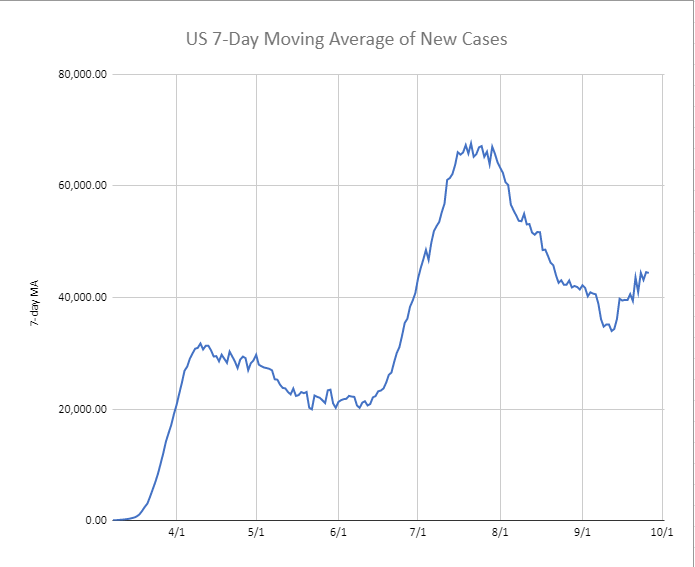
  • Covid numbers are increasing in Europe to the point of possible lockdowns.
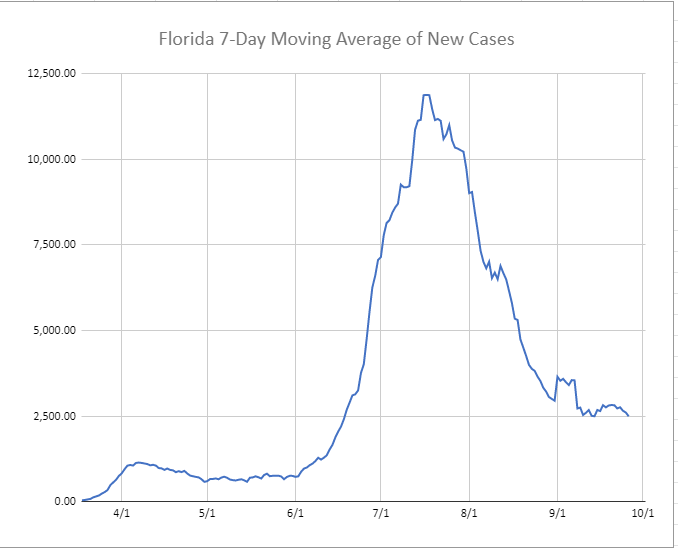
  • US numbers are also up but Florida remains flat.
  • This will likely be a record year for IPOs.
  • The economy continues to improve at a slower rate.
  • Trump does not commit to a peaceful transfer of power.

MARKET RECAP

Stocks declined for the fourth consecutive week as the US market was off by 0.86% and international markets fell by 3.09%. Worries about rising coronavirus numbers and the subsequent economic impact, high valuations, as well as a volatile presidential race, have impacted prices. However, some of the tech stocks that were leading the decline rebounded this week, Amazon was up by 4.8% and Apple finished 5.1% higher. Fed Chair Powell has called on Congress to provide additional fiscal assistance to the economy. Estimated growth for Q4 will come down markedly if Washington cannot agree on a deal.

International stocks had a big fall, down by 3.09%, as Covid numbers continue to spike substantially higher in Europe and pressure increased to take aggressive steps to slow the spread. Numbers are also increasing in parts of the US. The Midwest appears to be getting the surge in cases that had previously hit other parts of the country. But even New York, which has been well under control since July, reported more than 1,000 new cases on Friday. Numbers in Florida have stayed flat recently at substantially lower levels from the peak, but will be getting a test soon as Florida Governor Ron Desantis has lifted all restrictions in the state.

Initial public offerings are setting up for the biggest year since 2000, having already raised $95 billion so far this year, almost matching the 2014 number and there are still three months to go.

The economy is improving, although not at the rate that many had hoped. However, there are some pockets of strength. Durable goods orders were up for the fourth consecutive month, increasing by 0.4%. New orders for nondefense capital goods excluding aircraft were up by 1.8%. Andrew Hunter, an economist at Capital Economics, said “business equipment investment staged a V-shaped recovery in the third quarter.”

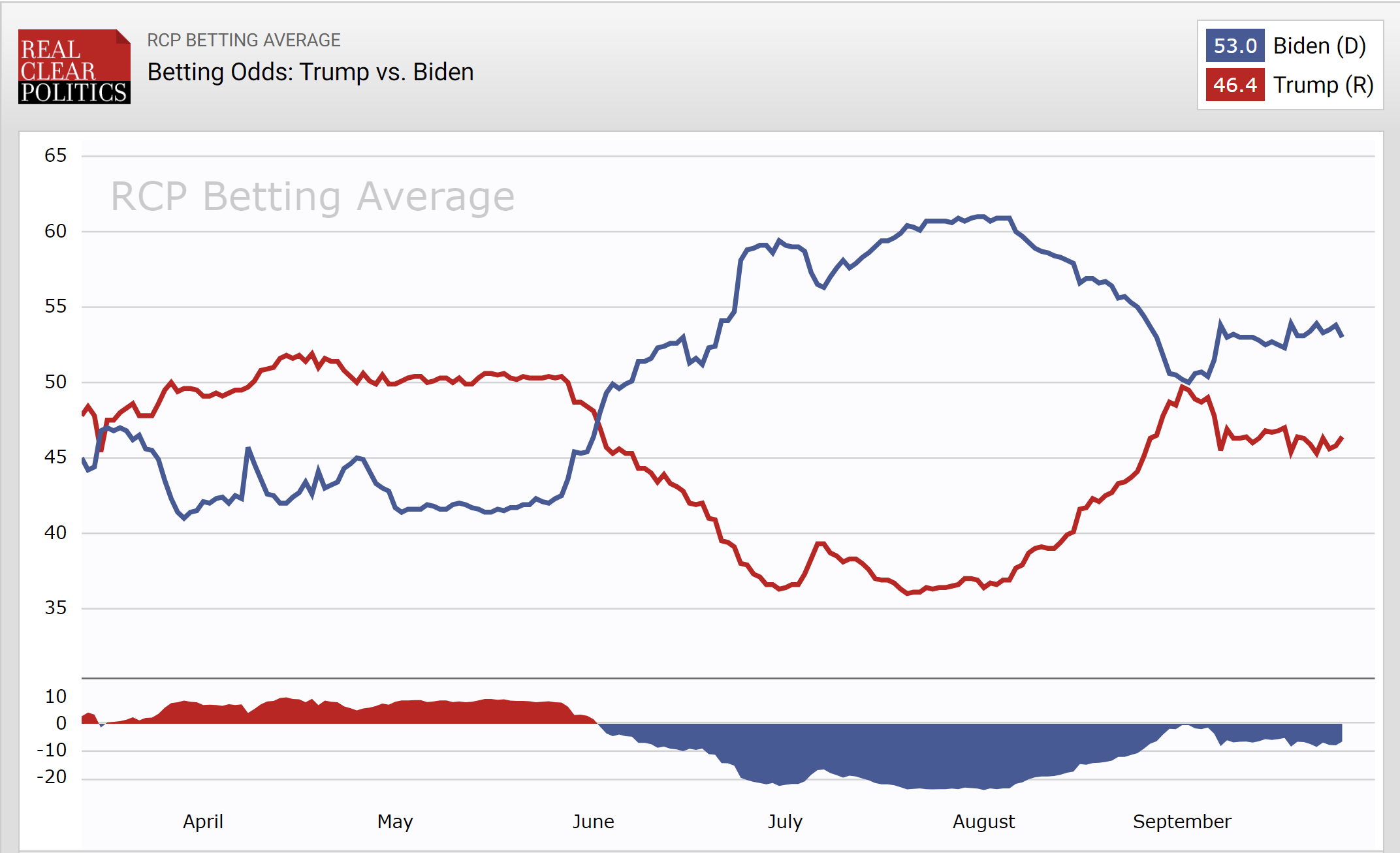
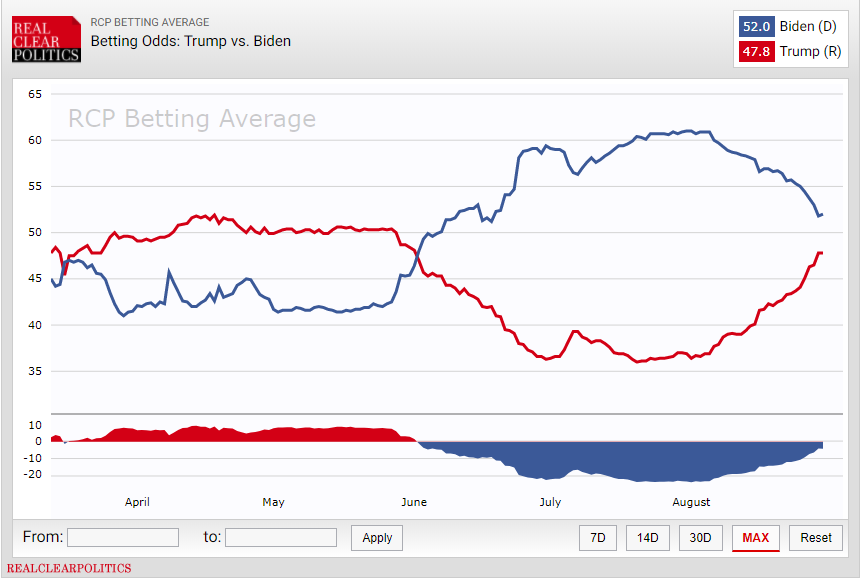
Trump said he would not commit to a peaceful transfer of power. “Well, we’re going to have to see what happens,” Trump said. Basically threatening to usurp one of the most hallowed traditions of the United States. Another reason why he is unfit to be President. The betting odds still favor Biden.

SCOREBOARD

Week Ending 9/18/2020

MARKET RECAP

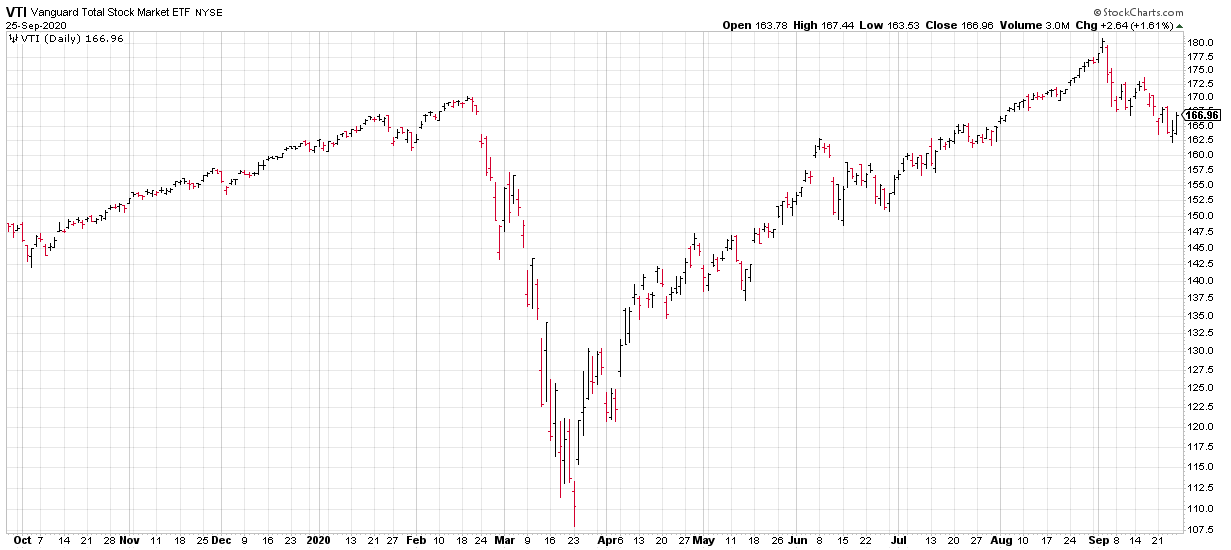
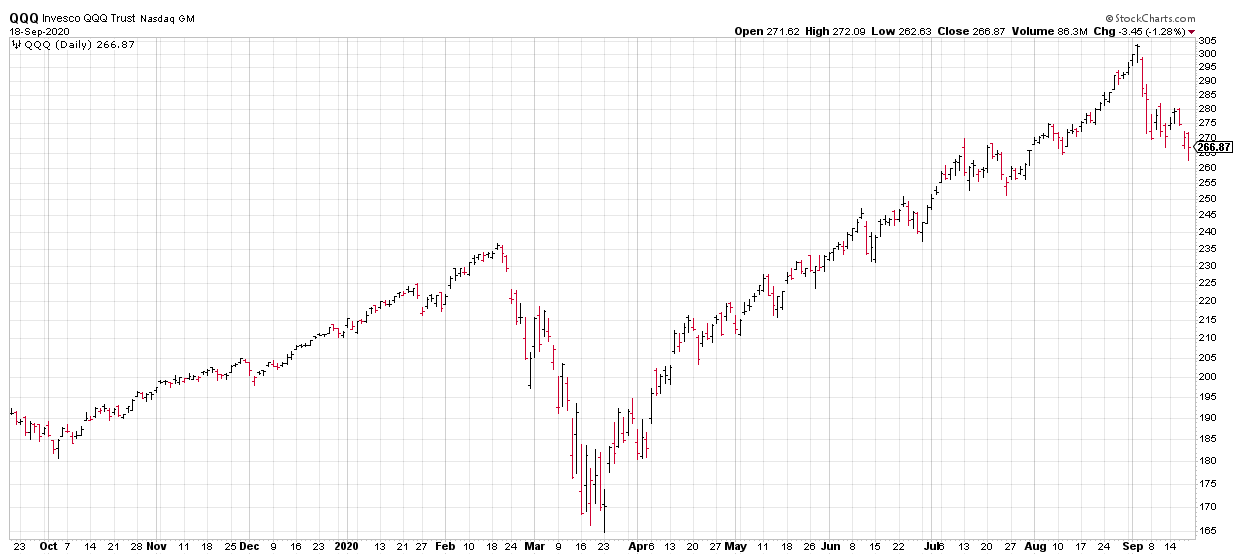
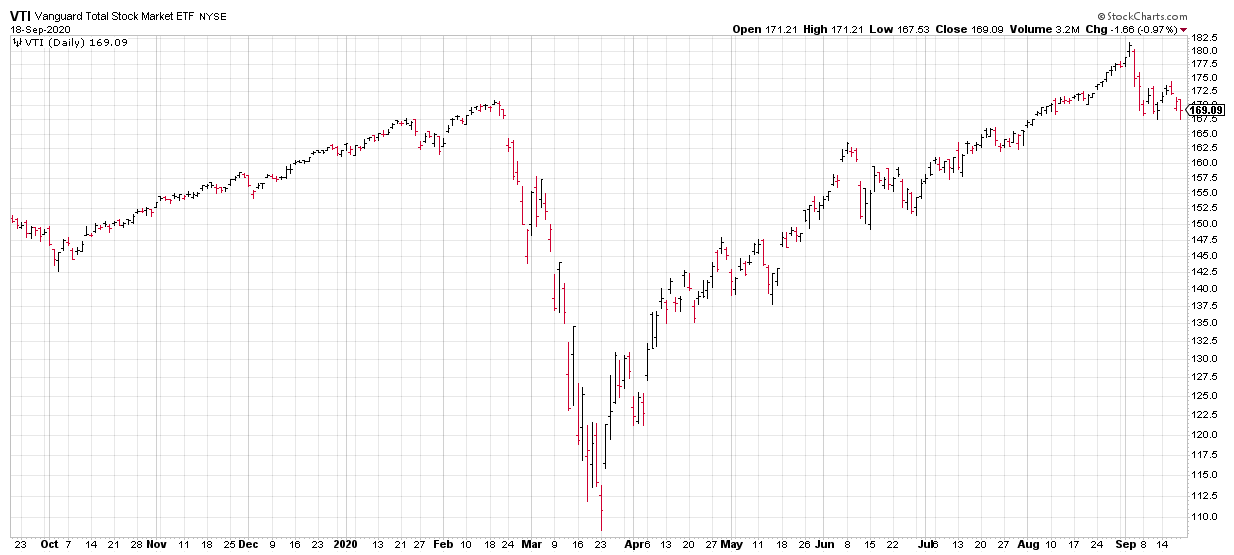
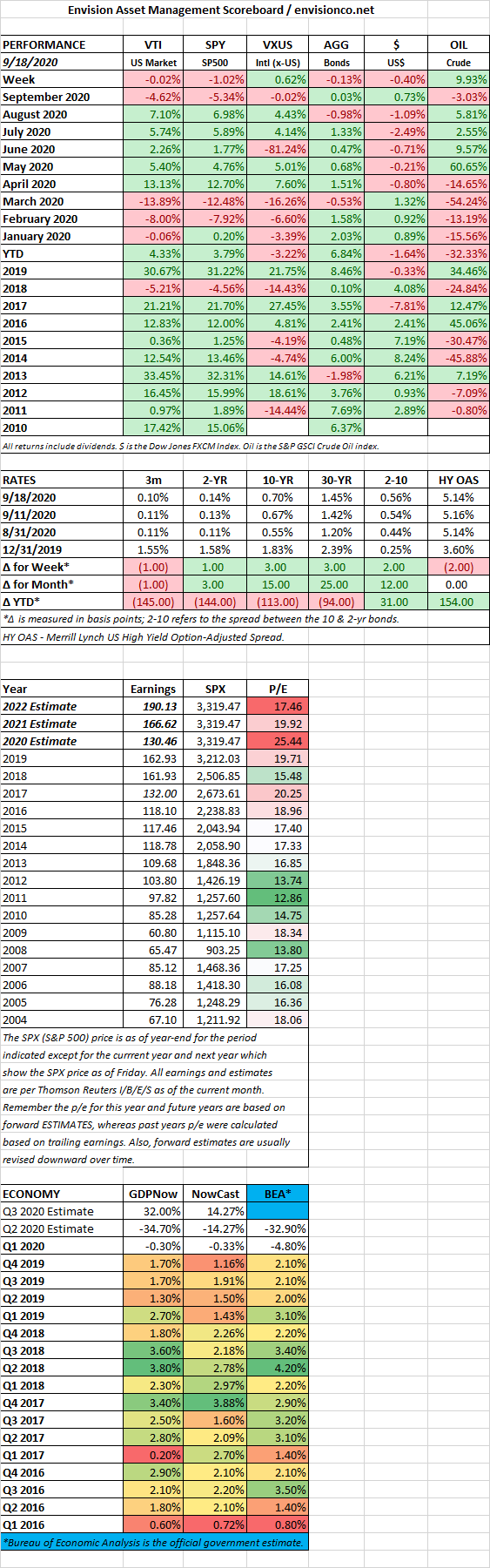
Stocks fell for the third straight week as technology stocks continued their fall from grace. Amazon dropped 5.2%, Facebook 5.3%, Apple was down 4.6% and Google lost 4%. Since the September 2nd closing high, the overall US market as measured by the VTI is down 6.7% and the Nasdaq as measured by QQQ is down 11.9%.

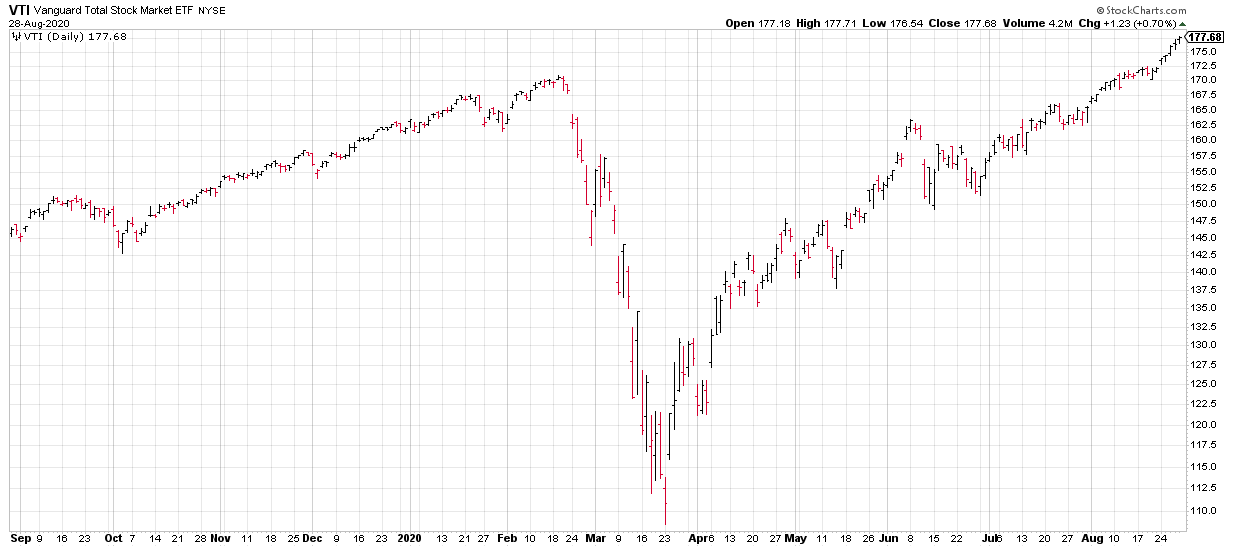
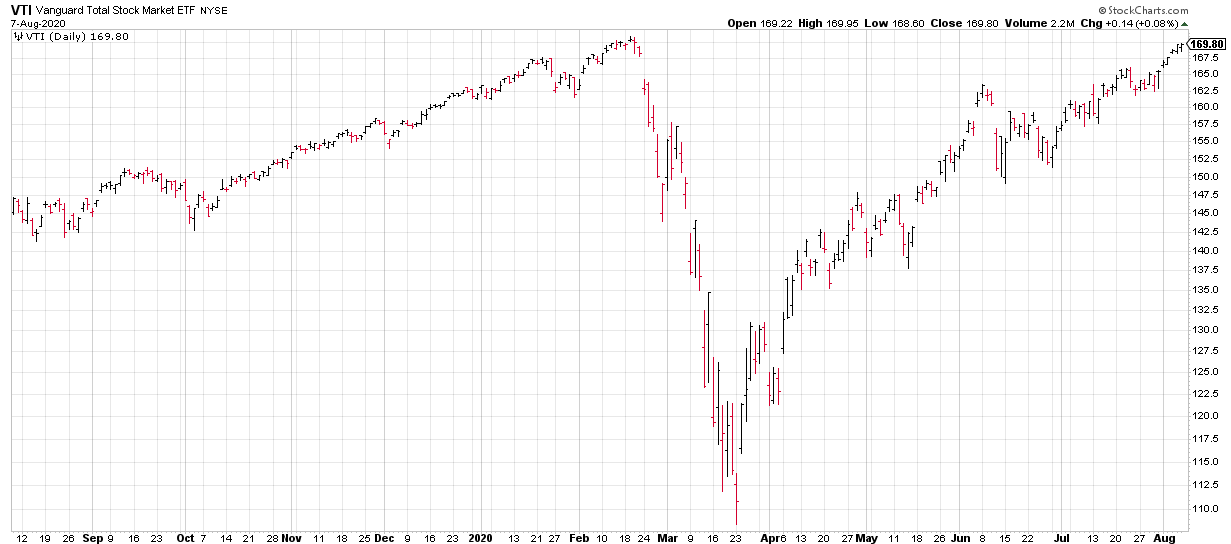
The VTI (total US stock market) hit a new low on Monday, rallied slightly during the week, and then touched the low again on Friday before bouncing to close off the low. The Qs (Nasdaq 100) was not so fortunate, breaking down to a new low on Friday, in what might indicate further downside.

Despite the recent fall, there are still signs of excess in the market. Snowflake (SNOW) went public in what was the biggest initial public offering of a software company ever. Priced at $120, the stock soared to $245 in the initial trade, giving the company a market value of $68 billion or 110 times revenue.

The Fed said during the week that the economic outlook is highly uncertain and said they would keep interest rates at close to zero for three more years and would continue to buy $120 billion of agency mortgage-backed securities and treasuries each month. The Fed also updated their guidance and said the Fed would need to see evidence of a tight labor market and that inflation will “moderately exceed 2% for some time” before considering raising rates. Paul Volker must be rolling over in his grave.

US retail sales increased for the fourth straight month but the pace was slower than earlier in the summer. August sales were up by 0.6% over July and were above pre-pandemic levels. The retail sector has recovered well, unlike other parts of the US economy, which still trail pre-pandemic numbers. Meanwhile, in China, retail sales have rebounded to pre-pandemic levels. Q2 growth was up 3.2% compared to a 6.8% decline in Q1. China has had the pandemic more or less under control since its initial outbreak.

Mortgage data firm Black Knight Inc. says about one million homeowners are behind on their mortgages and could be in danger of losing their homes when restrictions on evictions and foreclosures expire.

Initial claims for unemployment fell by 33,000 to 860,000 last week.

SCOREBOARD


Week Ending 9/11/2020

MARKET RECAP

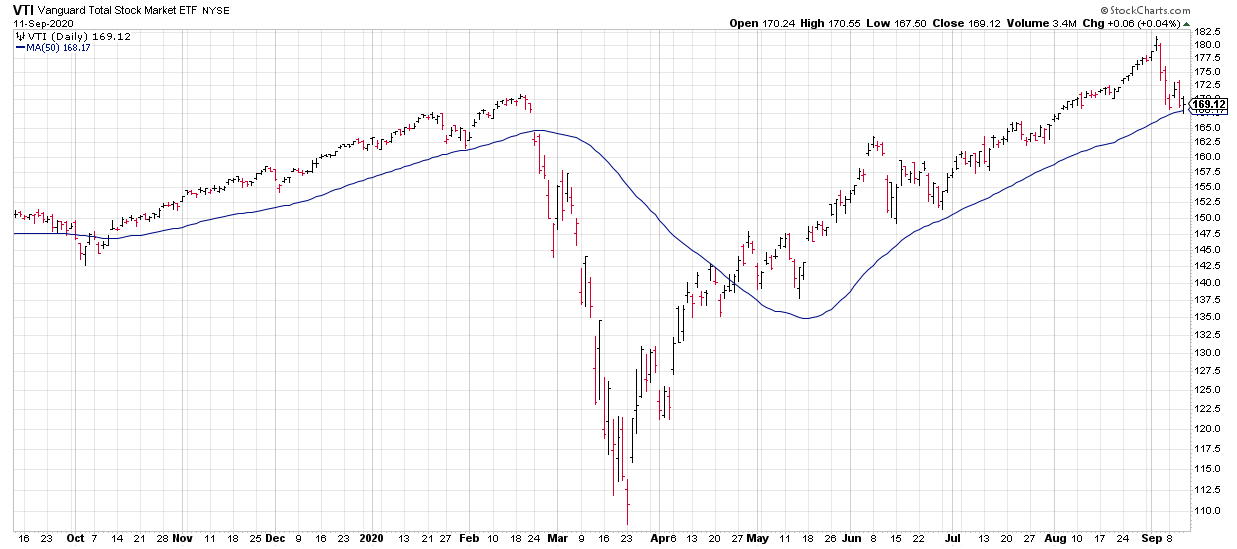
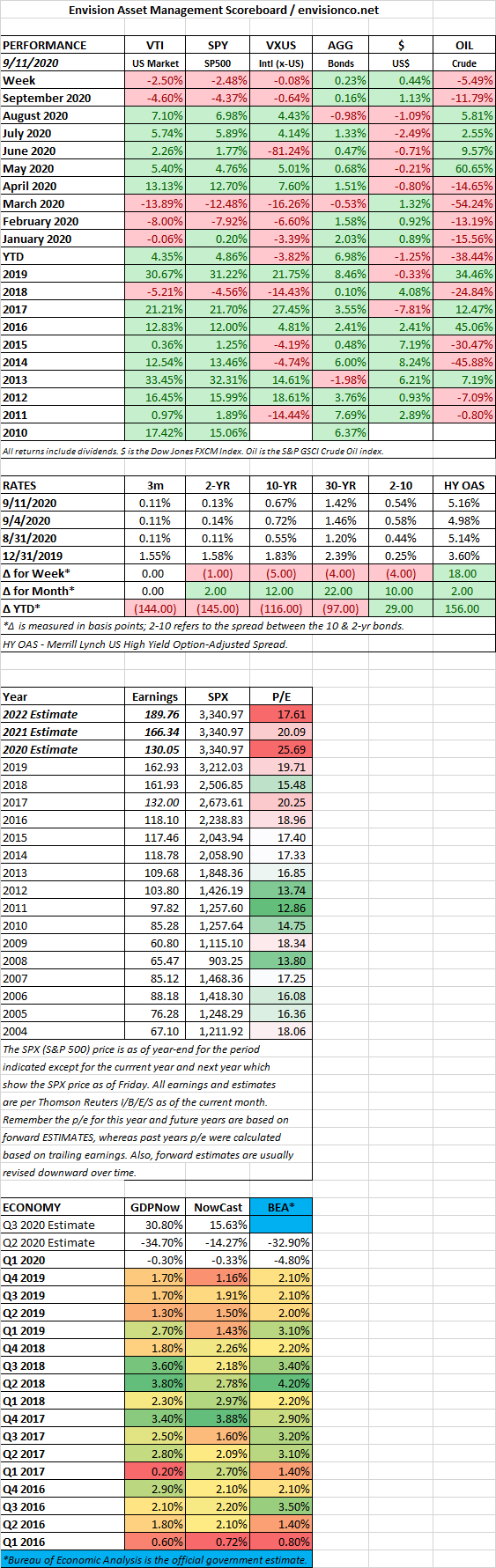
For the week, US stocks fell by 2.5% while the Nasdaq composite was off by 4.1%. The VTI (the total US stock market) has sustained some technical damage, and is barely above its 50-day moving average, after recovering from earlier in the day on Friday when it fell below. A break below the 50-day straight from here, or a failed rally to new highs followed by a break below the 50-day, could signal a bigger drop ahead.

Tech stocks have been up and down all week in volatile trading. The Nasdaq 100 had a 3% span from high to low on Friday and is down 11% since September 2. That decline was after a 58% run from late March. Apple is down 16% from its high but is still up almost 100% since its March 23 low. Tesla dropped by 21% after it was not selected to join the S&P 500. The overall US market is down 6.8% from September 2 closing price.

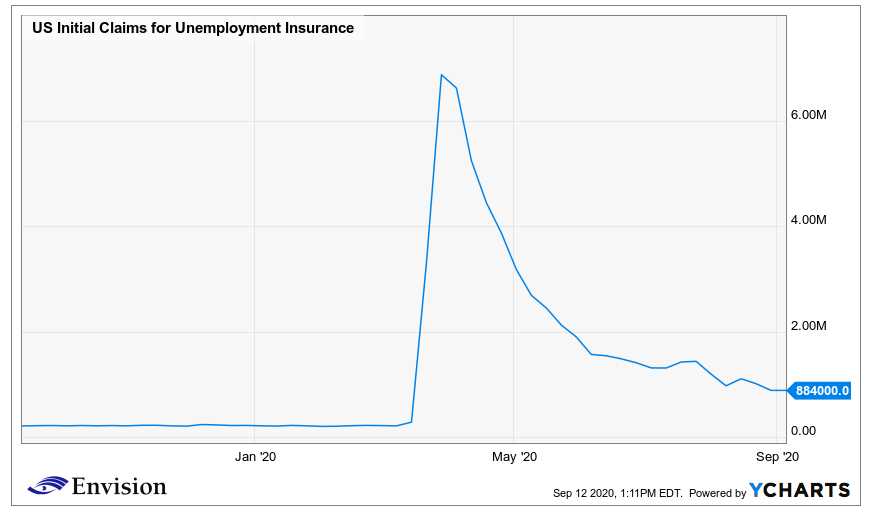
The easy gains in economic output coming off Q2 are beginning to slow down. The Federal Reserve Bank of Atlanta estimates the US will expand by 7% in Q3, up from a 9.1% contraction in Q2. But they are only looking for a Q4 expansion of 1.25%. Unemployment claims came in at 884,000 last week. The pace of the decline is beginning to flatten out at a level that still exceeds the prepandemic record or 695,000. The number of job postings is at levels 20% below last year according to Indeed.com. Washington’s inability to agree on a new stimulus package and restrictions that still remain on many businesses such as restaurants and bars in parts of the country are also holding back the economy.

SCOREBOARD

Week Ending 9/4/2020

MARKET RECAP

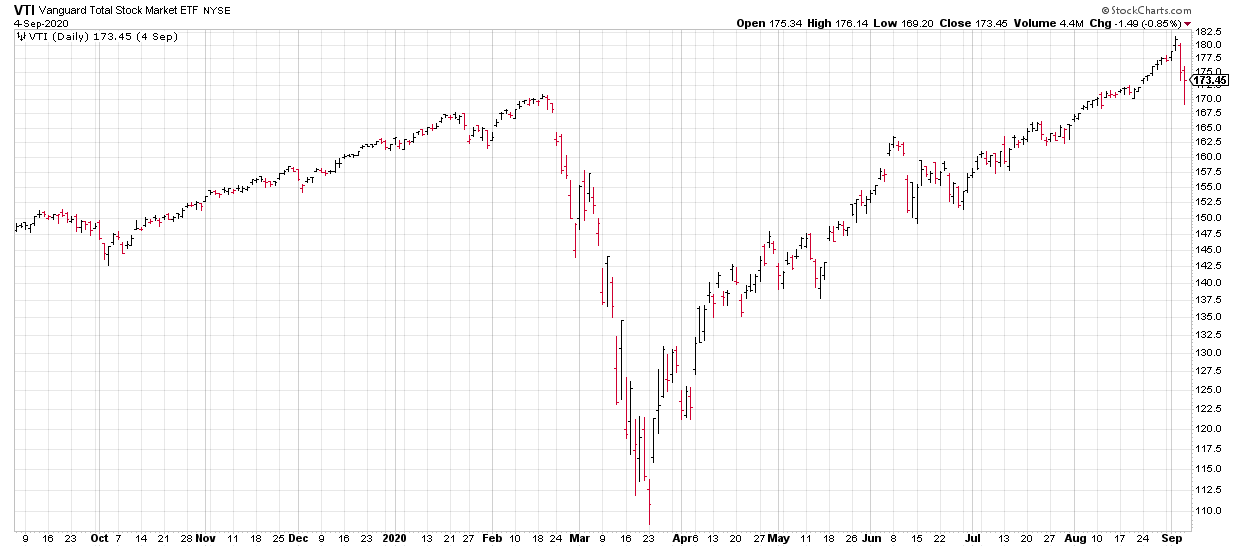
US stocks fell by 2.38% and international stocks were down by 1.70%. The decline ended five consecutive weeks of gains. The S&P 500 is up 35% since April, it best run since 1938. The big hit was on Thursday and Friday when the market fell by 4.3% or $1.7 trillion in market cap. From the Wednesday high to the Friday low, the decline was 6.9%. However, the decline was just a small dent in the market rally, but a big fall like that can sometimes be a signal that more is on the way.

Unemployment fell to 8.4% in August from 10.2% in July as employers added 1.4 million jobs in August. It was a very strong employment report but doesn’t factor in recently announced layoffs that are on the way (see our commentary last week).

US debt has now reached the highest level since WWII. Federal debt held by the public will exceed 100% of US gross domestic product, putting the US in the same position as only a few countries around the world, including some economic “powers” like Italy and Greece. The last time US debt exceeded the GDP was in 1946 after years of financing WWII. The borrowing though has not slowed down investors, who still are happy to purchase treasuries that yield almost nothing. With ultralow interest rates, the government can get away with this, for now. Under the assumption that the US does not deal with the debt issue, it won’t be a problem until it becomes a problem, that being when the market pushes interest rates higher, or the government is forced to suppress interest rates even more than they are now leading to all kinds of unintended consequences. That may be a year from now or fifty years from now.

SCOREBOARD

Week Ending 8/28/2020

MARKET RECAP

The market was up every day as US stocks put in their best week since early July, advancing by 3.17% while international markets were up by 2.09%. Equities were helped by Federal Reserve Chairman Jerome Powell, who indicated he would let inflation run higher for longer, and keep interest rates low. All we can say is be careful what you wish for. The Fed’s game plan should be good for gold and bad for the dollar, gold was up by 1.4% and the dollar was down by 1% for the week.

The Dow Jones Industrial Average made some changes, adding Salesforce, Amgen, and Honeywell and dropping Exxon, Raytheon, and Pfizer.

Consumer spending was up by 1.9% in July, down from 6.2% in June and 8.6% in May.

As businesses realized that a return to normalcy is not around the country, a second wave of layoffs is beginning. Companies that have announced layoffs are Salesforce (1,000), United Airlines (possibly 53,000 workers will be affected), MGM Resorts (18,000), and American Airlines (17,500).

BankruptcyData.com reported that a record 45 US companies with assets greater than $1 billion have filed for Chapter 11 bankruptcy, exceeding the 38 by this time in 2009. “We are in the first innings of this bankruptcy cycle,” said Ben Schlafman, COO at the website, “It will spread far across industries as we get deeper into the crisis. It’s going to be a bumpy ride.”

While the market goes higher and higher with no end in sight, Liz Ann Sonders, chief investment strategist at Charles Schwab, wrote on Twitter that the put-to-call ratios measured by 5, 10, an 30-day moving averages are now at the lowest levels since 1999-2000.

The Republicans nominated Trump so the race is now on. Biden has been comfortably leading in every poll and this is his election to lose, but the Republicans see an opening and will try to take advantage of the violence and riots in the cities, and the lack of a forceful Democratic response, as the reason to give Trump another four years. This angle gives Trump at least some hope, as the betting odds have narrowed in recent days but still give Biden a 52 to 48 edge according to Real Clear Politics.

SCOREBOARD


Week Ending 8/21/2020

MARKET RECAP

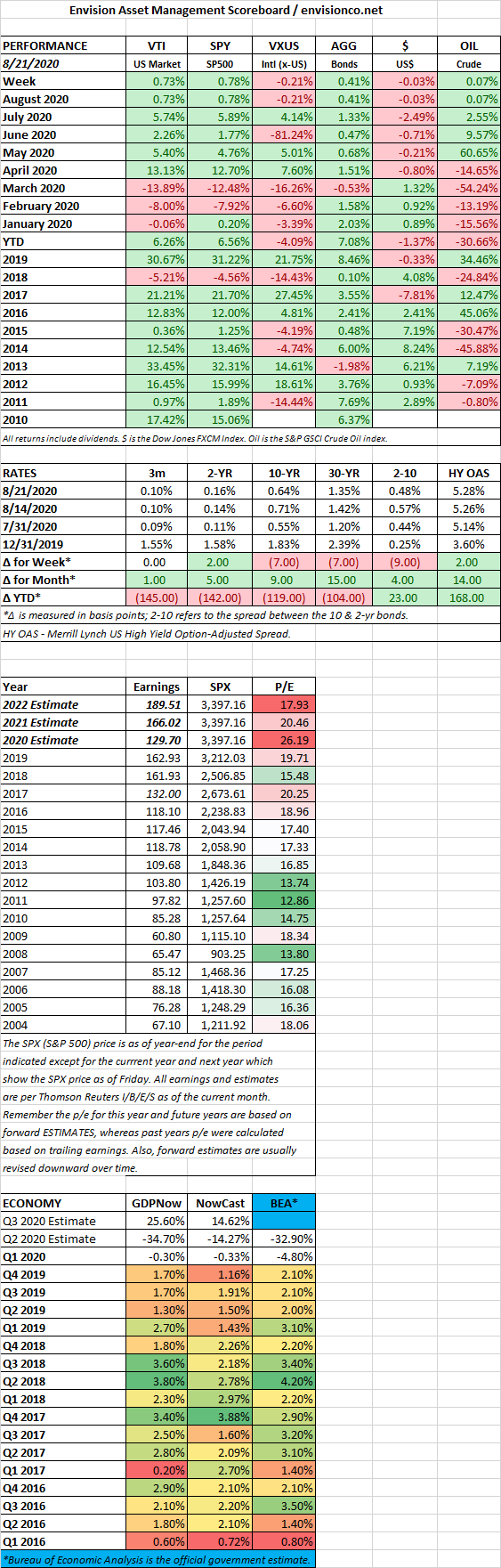
The S&P 500 completed the most improbable of comebacks by hitting a new high on Tuesday and then closing on Friday at another high, up by 0.73% for the week. A combination of massive government stimulus and hopes for a quick recovery brought the benchmark to a new record from being down 35% on March 23. The previous peak, on February 19, to the new peak Tuesday, was only 126 trading days, making it the fast recovery from a bear market ever.

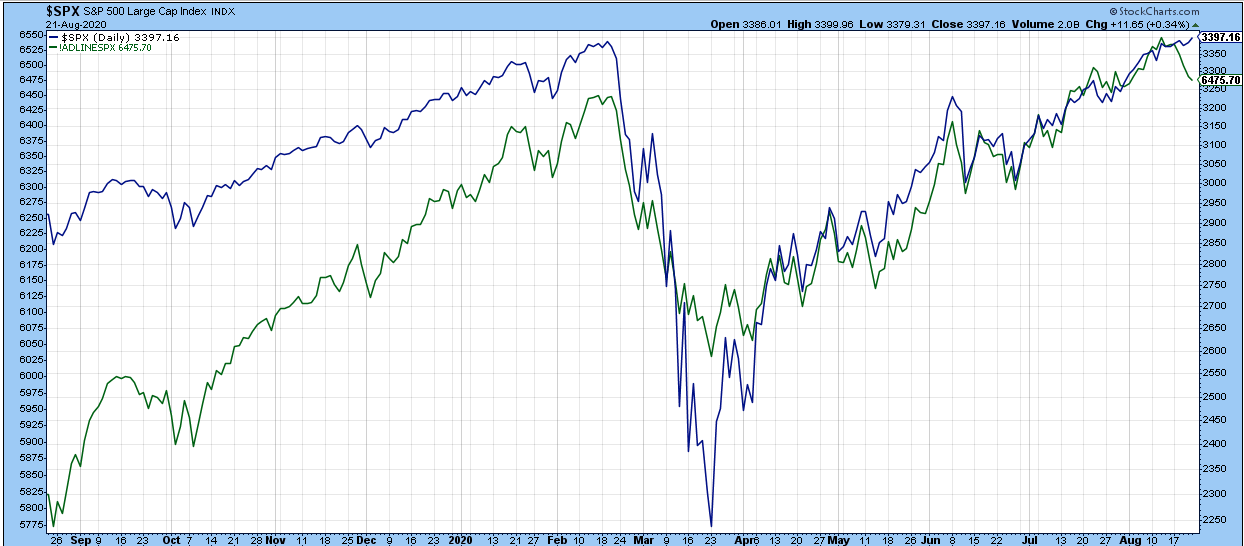
One possible note of worry is the negative divergence in the advance-decline line of the S&P (the green line) versus the index (the blue line), indicating the rally is being propelled by fewer and fewer stocks. Traditionally, that is considered a warning sign. But the divergence may not be long enough to mean anything at this time.

Tech stocks have led the way during the market comeback, the Nasdaq is up 26.1% this year. And Apple and Tesla have led tech. Apple is up 71% for the year and was up 8% this past week., its market cap now exceeds $2 trillion. Tesla was up 24% for the week. 24% for the week, which is crazy and is now up 800% over the past year. Tesla is valued at about $1 million per vehicle delivered. Compare that to GM which is valued at $10,000 per vehicle delivered.

Both Apple and Tesla apparently are being helped by stock splits planned for later in the month. Apple is set to split 4-for-1 and Tesla 5-for-1. Nevermind that a stock split does not confer any new value in the shares, but that doesn’t seem to matter. This feels like one of those moments in history when historians look back and say this was a signal of an out of control mania.

Or maybe it isn’t. Tesla obviously has many fans including Gary Black, former CEO of Janus Capital Group, Black argues Tesla only sells at 65x 2022 earnings in line with Amazon (53x), Lululemon (58x), ServiceNow (63x) and Salesforce (58x), all companies with a lower growth potential than Tesla. As for Apple, Dan Ives of Wedbush Securities says that “We still believe many on the Street are underestimating the massive pent-up demand around this supercycle for Apple [iphones]”.

Despite the rally, many investors think it makes no sense at all, at least in comparison to the fundamentals, and attribute the higher prices to a Fed gone wild with stimulus, historically low-interest rates, an expected Covid vaccine, and a hoped-for fast recovering economy.

At least one area of the economy is booming, which is housing. The Home Builders’ housing index came in at 78 in August, matching the highest reading in the index’s 35-year history. Low-interest rates and a shift to suburban living are driving the index higher.  Housing starts were up by 23% in July, the best monthly advance since October of 2016. Revenue at Home Depot was up by 23% and at Lowes by 30% in Q2.

The strong housing reports ran counter to most of the other economic measures last week. Weekly jobless claims rose back above one million, and the Fed indexes that measure manufacturing activity in New York and Philadelphia both came in lower than expected.

COVID

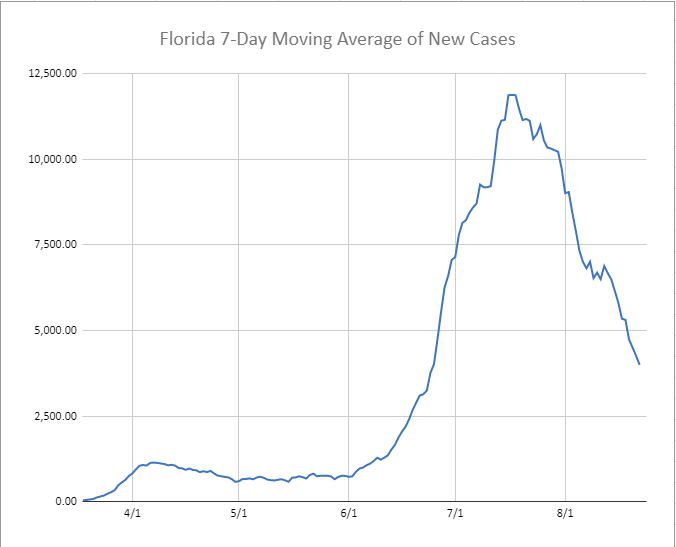
Covid numbers continue to decline in the US and hotspots like Florida, at least for now, and are following a bell chart pattern. Past pandemics have seen a second surge in cases in the fall and early winter, but for now, the trends are good.

ELECTION

The Democrats made it official and nominated Joe Biden for President and Kamala Harris for Vice President. The Republicans are up next.

SCOREBOARD

Week Ending 8/7/2020

MARKET RECAP

Stocks advanced around the world with the US up by 2.59% and international stocks by 2.23%. Bonds were flat.

Employers added 1.763 million jobs and the unemployment rate fell to 10.2% in July, showing that the economy continues to improve, however, the rate of job improvement has slowed. In May, 2.7 million jobs were added and in June, there were an additional 4.8 million jobs. Overall, total jobs are down 13 million from February. 30 million people are still receiving jobless benefits.

The IMF projects that the economy in Latin America will fall by 9.4% this year, the worst decline ever, and it will take until 2023 to recover to pre-pandemic levels. That compares to 3% for developing countries and 8% for the US. Millions who climbed out of poverty are threatened. The United Nations said the number of poor people could rise by 45 million to 230 million, and the number of extremely poor can increase by 28 million to 96 million.

Trump is exerting pressure on Tik Tok, a social media platform owned by a Chinese company, to sell itself to Microsoft or be closed down. Chinese state media describe it as a “smash and grab”. On Monday, Trump then insisted that the US government be given a percentage of the sale price! Then on Friday, Trump issued an Executive Orders that seeks to prevent Americans from using the platform, effective in 45-days. You just cannot make this up.

Lord & Taylor filed for bankruptcy. L&T is the oldest US department store at 194 years.

SCOREBOARD

Week Ending 7/31/2020

MARKET RECAP

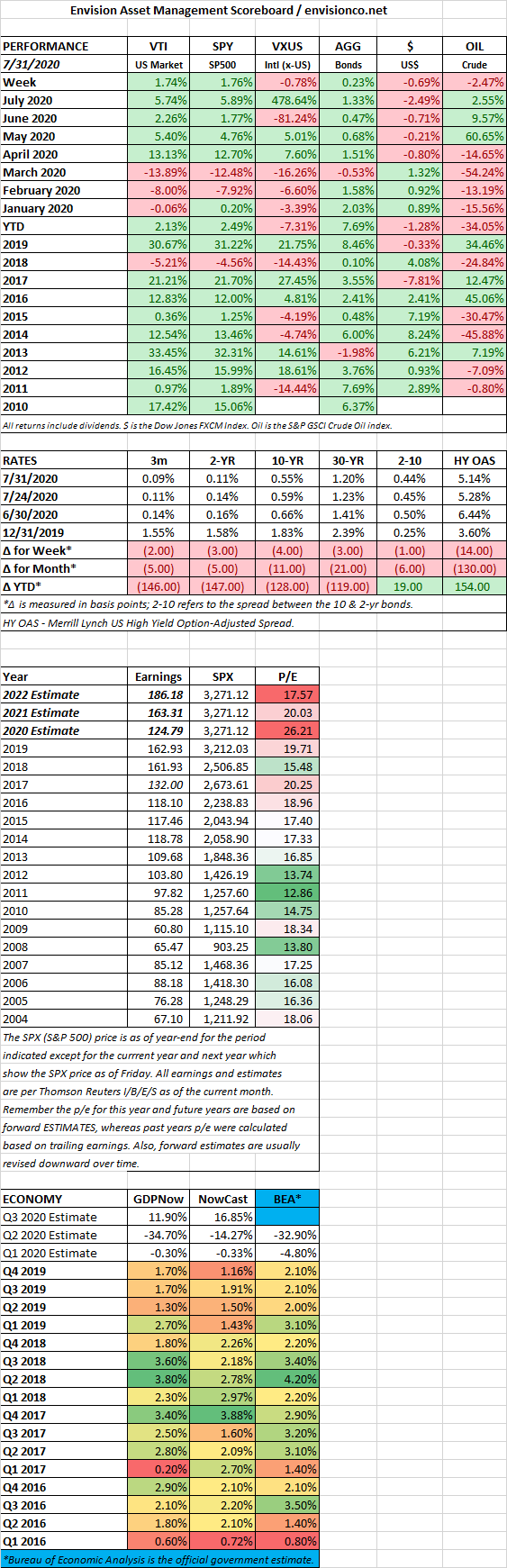
US equities were up by 1.74% while international stocks fell by 0.78%. Second-quarter GDP fell by a seasonally adjusted 32.9%. It was the biggest drop since World War II when the government started to record the numbers. The number reflects an annualized rate and assumes that the huge decline in output will continue for the year, which will likely not happen. Nevertheless, it shows just how huge a hit the economy took by essentially shutting down for a couple of months. And that was with massive stimulus. Joseph Carson, the former chief economist for AllianceBernstein, estimates that the Federal Reserve and the US government put close to $5 trillion dollars into the economy, roughly matching the nominal GDP of $4.85 trillion. But even with that, GDP fell dramatically. Clearly showing how important a normally functioning economy, with healthy businesses, is to the success of the country. But the 33% decline in the US appears to be better than what happened in Europe, preliminary GDP numbers show Germany with a 35% decline and the other Eurozone majors each declining by more than 40%.

The unemployment numbers are showing that the spike in Covid cases is starting to slow the economy again. The number of initial claims for unemployment increased for the second straight week, up by 12,000 to 1.43 million, and the number of people receiving unemployment increased by 867,000 to $17 million, that increase ended a downward trend that had started in March.

Kodak, which most people probably thought went out of business 10 or more years ago, is still around and popped up on traders’ radar this week. The company filed for bankruptcy in 2012 and has had negative cash flow every year since. The company was selling for $2 per share on Wednesday when it announced that the federal government would loan them $765 million for the manufacture of generic drug ingredients. The Robin Hood investors jumped on it and the stock popped to as high as $60 on Thursday. Another example of the frothiness in this market.

SCOREBOARD