MARKET RECAP
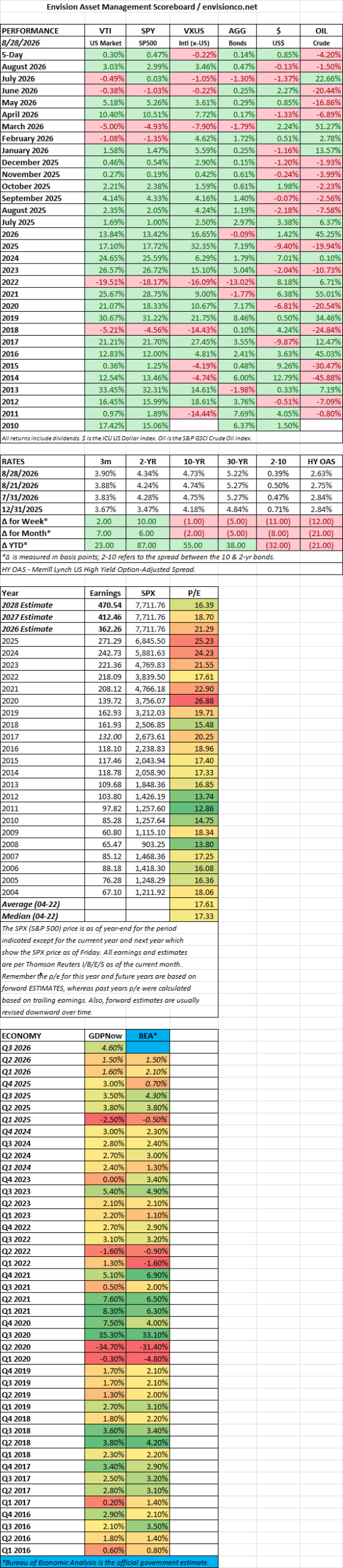
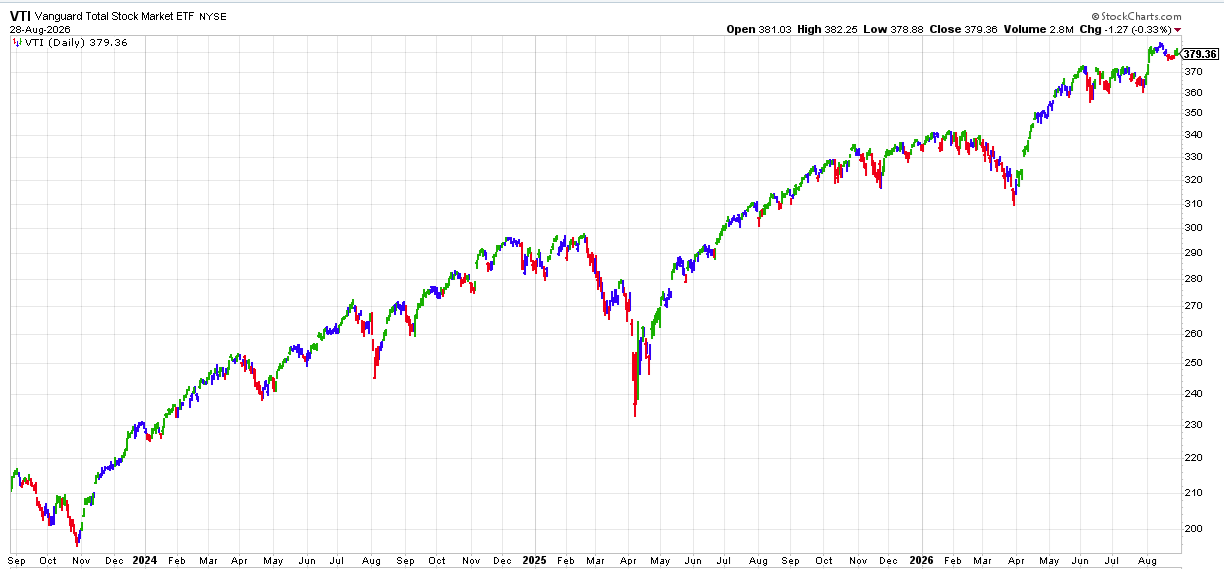
U.S. stocks finished the week higher despite a modest pullback on Friday. The S&P 500 rose 0.5% from the prior Friday’s close of 7,674.37 to 7,711.76. The Dow Jones Industrial Average also gained 0.5%, closing at 53,559.99 versus 53,277.01 a week earlier. The Nasdaq Composite outperformed with an 0.8% weekly advance, ending at 26,402.42 after starting the comparison week at 26,180.45.
Strength in mega-cap technology, led by Nvidia’s better-than-expected results and outlook, offset late-week caution after Federal Reserve Chair Kevin Warsh’s Jackson Hole remarks. International equities, using VXUS as a proxy, slipped 0.2% for the week, closing Friday at $87.52 versus $87.71 the previous Friday.
The 10-year Treasury yield finished near 4.73%, little changed from about 4.74% a week earlier after moving lower midweek and then rising Friday. The 2-year yield, which is more sensitive to near-term Fed policy bets, reacted more sharply to Warsh’s speech: it jumped more than 12 basis points on Friday to about 4.35%, from roughly 4.20%–4.23% the day before, as markets raised the odds of a rate hike. Warsh said recent inflation readings were better than expected but that underlying trends had not improved enough, and that price stability remains the Fed’s predominant focus.
Bitcoin ended the week roughly flat to slightly lower, near $77,800 after trading around $78,300 the prior Friday. Gold dropped about 3.2%, falling from roughly $4,608 an ounce to about $4,456.
Initial jobless claims for the week ended August 22 came in at 203,000, down 4,000 from a revised 207,000 and below forecasts.
The week’s main policy catalyst was Warsh’s first Jackson Hole speech as chair, which revived rate-hike speculation and weighed on stocks and gold on Friday. Other developments included collapsed U.S.-Canada trade talks and new tariff threats, additional sanctions aimed at isolating Iran, and political discussion of a Venezuela oil arrangement. Markets still posted a modest weekly gain in U.S. equities, supported by earnings, but finished the period more focused on inflation and the path of policy
heading into Labor Day and the next jobs report.
Barron’s wrote about the AI Capex bubble and when it might burst. Historically, major capex cycles don’t top out until spending reaches about 25% of GDP. With US GDP currently at about $30 trillion, that would mean about $7.5 trillion in capex, and that probably won’t be reached until the beginning of the next decade. Another key point is that it takes some kind of external shock, like a policy change or monetary tightening, to trigger the collapse.
SCOREBOARD