Week Ending 8/3/2018

HIGHLIGHTS

  • US stocks increase by 0.72% but international stocks fall by 0.81%.
  • Another strong payroll report.
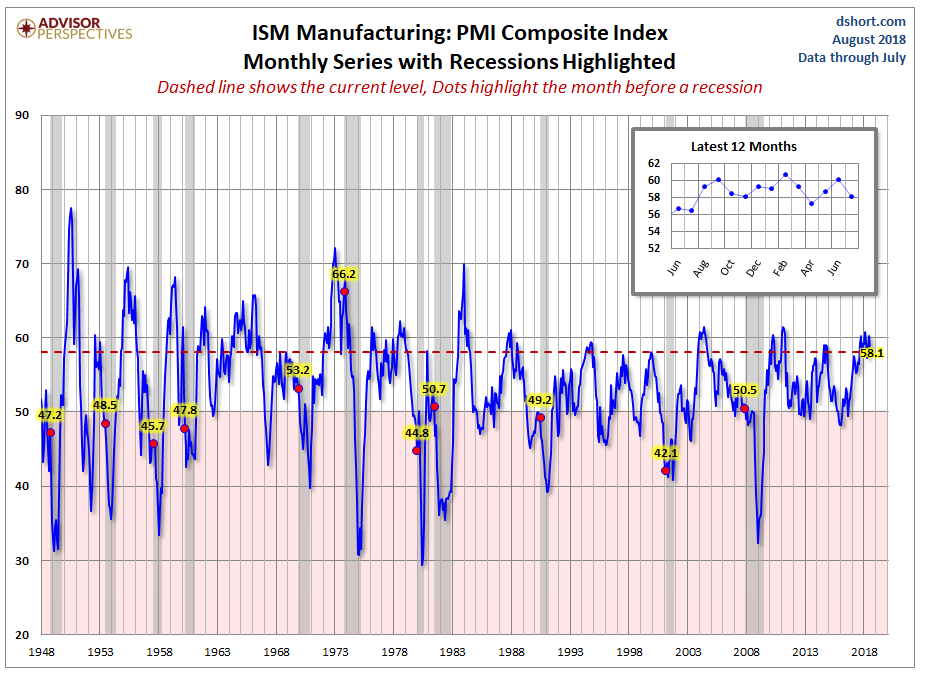
  • The ISM Manufacturers Index falls by the most in two years and hits a 3-month low, but the level is still high.
  • More tariff threats between the US and China.
  • The price to sales ratio is approaching highs last reached around 2000.
  • Apple becomes the first company to be valued at $1 trillion.

MARKET PERFORMANCE

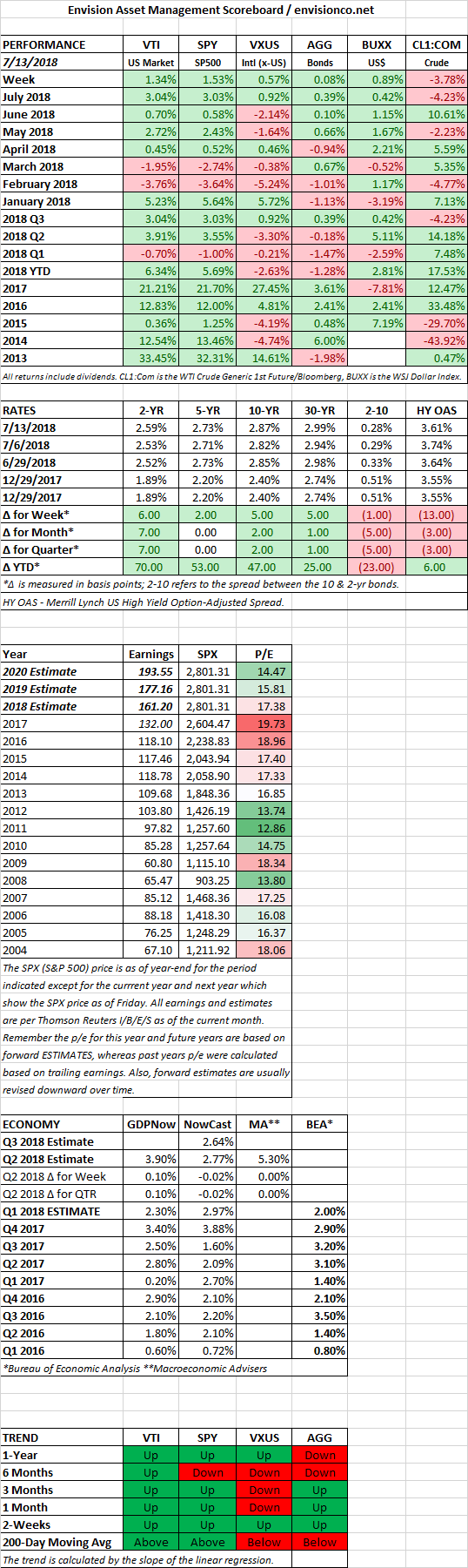
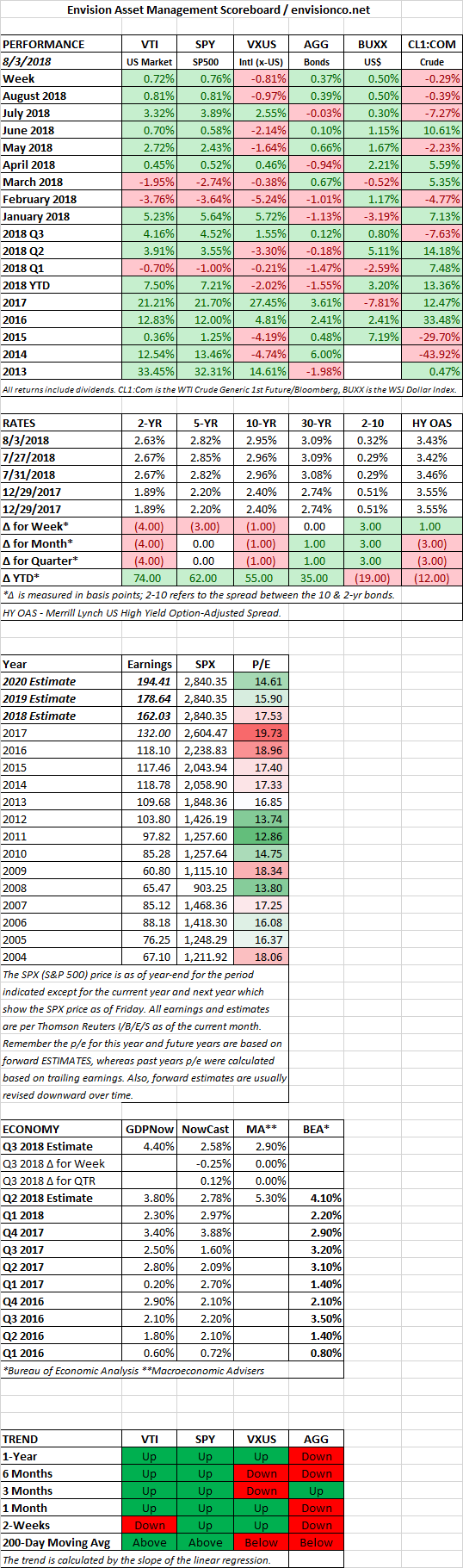
US and international markets split ways again, with the US up by about 0.72% and international markets down by 0.81%. There was the normal back and forth on tariff threats with China, but the market does not seem so concerned. A solid payroll report showed that the labor market continues to be tight. The only kink in the armor of the strong US economy was a fall in the ISM Manufacturing Index to a 3-month low. But the reading of 58.1 is still extremely strong. Apple won the race to the $1 trillion valuation, hitting the mark on Thursday.

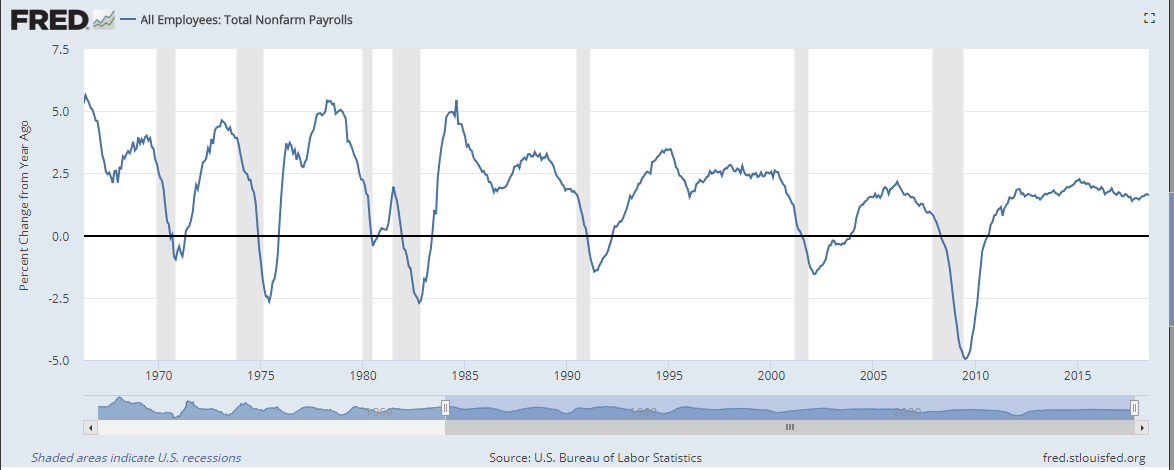
PAYROLL

Nonfarm payrolls increased by 157,000 and the two preceding months were revised up by a total of 59,000. So far, the tariffs do not seem to have impacted hiring. Average hourly earnings were up 2.7% compared to last year. One factor holding down bigger increases in average earnings is that employers have been hiring less educated, lower paid workers to fill job positions. A related factor is an increase in jobs for the 25 to 34-year old’s, they are replacing older, higher paid employees as they begin to retire. The unemployment rate dropped to 3.9%. Overall, the labor market continues to be strong.
ISM

The ISM Manufacturing Index fell by 2.1 points in July, the most in almost two years, to 58.1. The reading was a three-month low and indicates some moderation in factory activity. Despite the decline, the overall level of 58.1 is still a very strong number and indicates continued growth for Q3 although probably weaker than Q2.

The report stated that “respondents are again overwhelmingly concerned about how tariff-related activity, including reciprocal tariffs, will continue to affect their business.”
TRADE

The back and forth that trade wars are known for continued this week. The White House threatened to increase tariffs to 25% on $200 billion of Chinese goods from the previously announced amount of 10%. China responded on Friday saying that it would increase tariffs up to 25% on $60 billion of US products. These tariffs are supposed to go into effect in September. The Chinese yuan is down 7% versus the dollar over the last two months. That will help the Chinese deal with the higher tariffs.

If Chinese exports are hurt by the trade war, the government might be inclined to stimulate the economy by taking on more debt. The problem is that China is close to being maxed out on debt. Pushing China over the edge into a full-blown debt crisis would likely lead to problems throughout the global economic system.

VALUATION

There are lots of metrics out there showing that the market is overvalued, and some showing it is fairly valued, but here is one that indicates the market is way overvalued. Price to sales on the S&P 500 is at about 2.2, near the highest level since 2000.

APPLE

On Thursday Apple became the first company to reach a valuation of $1 trillion. Apple trades just under the S&P 500 index multiple, selling at 15.8 forward earnings.

SCOREBOARD
Week Ending 7/27/2018

HIGHLIGHTS

  • Good news on the trade front with the European Commission.
  • Stocks advance 1% around the world.
  • $12 billion in tariff relief for farmers.
  • Home sales continue to fall.

MARKET RECAP

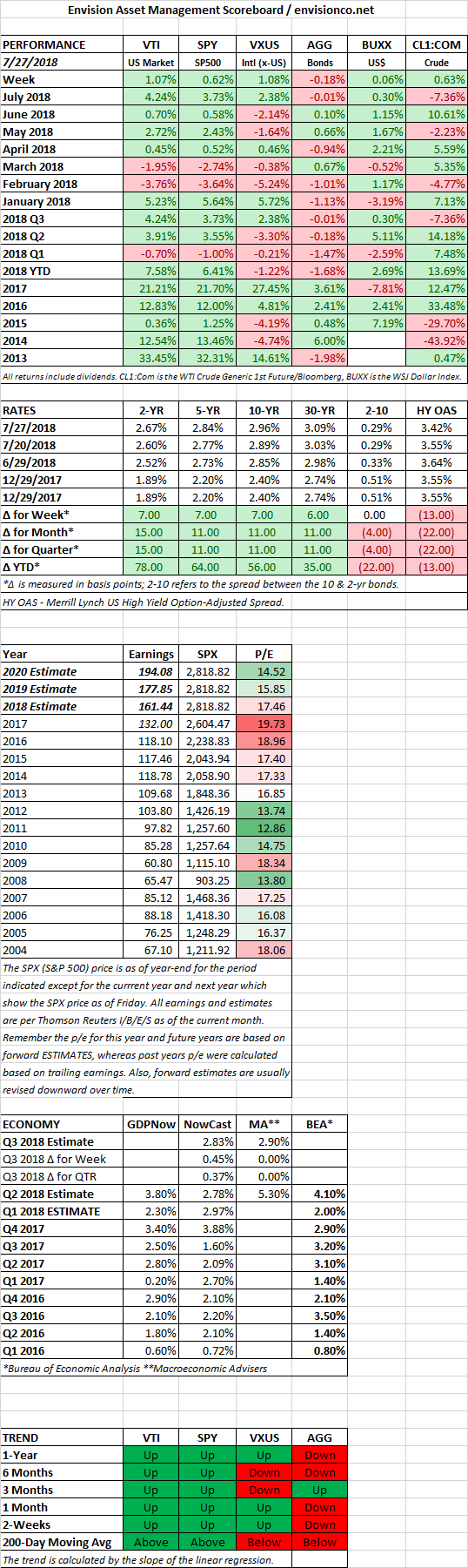
There was a hint of good news on the trade front this week. European Commission president Jean-Claude Juncker met with Trump and they agreed to work on an agreement with no tariffs and no subsidies (read more below). That, and generally favorable earnings, along with a solid 4.1% estimated increase in Q2 GDP, advanced stocks by 1.07% in the US and 1.08% outside the US. Bonds fell by 0.18%, as yields were up across the curve by about 7 basis points.

TRADE

Prior to his meeting with European Commission President Jean-Claude Juncker, Trump tweeted “I have an idea for them. Both the U.S. and the E.U. drop all Tariffs, Barriers, and Subsidies! That would finally be called Free Market and Fair Trade! Hope they do it, we are ready – but they won’t.”

The White House team went into the meeting looking to negotiate, chief economic advisor Larry Kudlow said before the meeting, “I just say, keep an open mind—you might be surprised by the outcome of this meeting.”

Surprised we were, the parties agreed to work towards zero tariffs and the removal of all trade barriers for non-auto industrial goods. The EU would increase its purchases of soybeans (very soon) and would import large quantities of natural gas. The two parties would work together to reform the World Trade Organization and to end the theft of intellectual property, forced technology transfers, government subsidies and the selling of products below cost. If all this happens we give Trump and his team major credit. A world with free, or freer trade, will improve economic outcomes across the globe.

The jump to work a deal with the Europeans might have been pushed along by increasing political heat here in the US. The initial impact of the tariffs is starting to be felt. Earlier in the week, the Trump administration said it would provide $12 billion in support to farmers impacted by the trade war. The costs of tariffs are also showing up on some company conference calls, as executives worry about higher costs and lower sales.

HOME SALES

Existing home sales fell for the third consecutive month and are now down 2.2% year over year. Higher costs are holding back prospective buyers. Prices of existing homes are up 5.2%, and mortgage rates on a 30-year fixed, while still historically low, have increased to 4.54% from 3.92% a year ago. New home sales were down 5.3% in June.

FACEBOOK/TWITTER

Facebook shares fell by 19%, losing $120 billion in market value, as the company projected slower revenue growth going forward.  Twitter dropped by 21% after reporting a drop in users. However, most of the drop in users were “fake” or “fraudulent” accounts, apparently, investors would rather Twitter have kept those fake accounts!

SCOREBOARD

Week Ending 7/20/2018

HIGHLIGHTS

  • Solid earnings helped US equities to a small gain of 0.1%. International stocks were up 0.37%.
  • Powell comments on free trade and then Trump fires back on interest rates.
  • Higher US trade deficits might be on the way.
  • Currency valuations are now in the spotlight as the yuan is falling.

MARKET RECAP

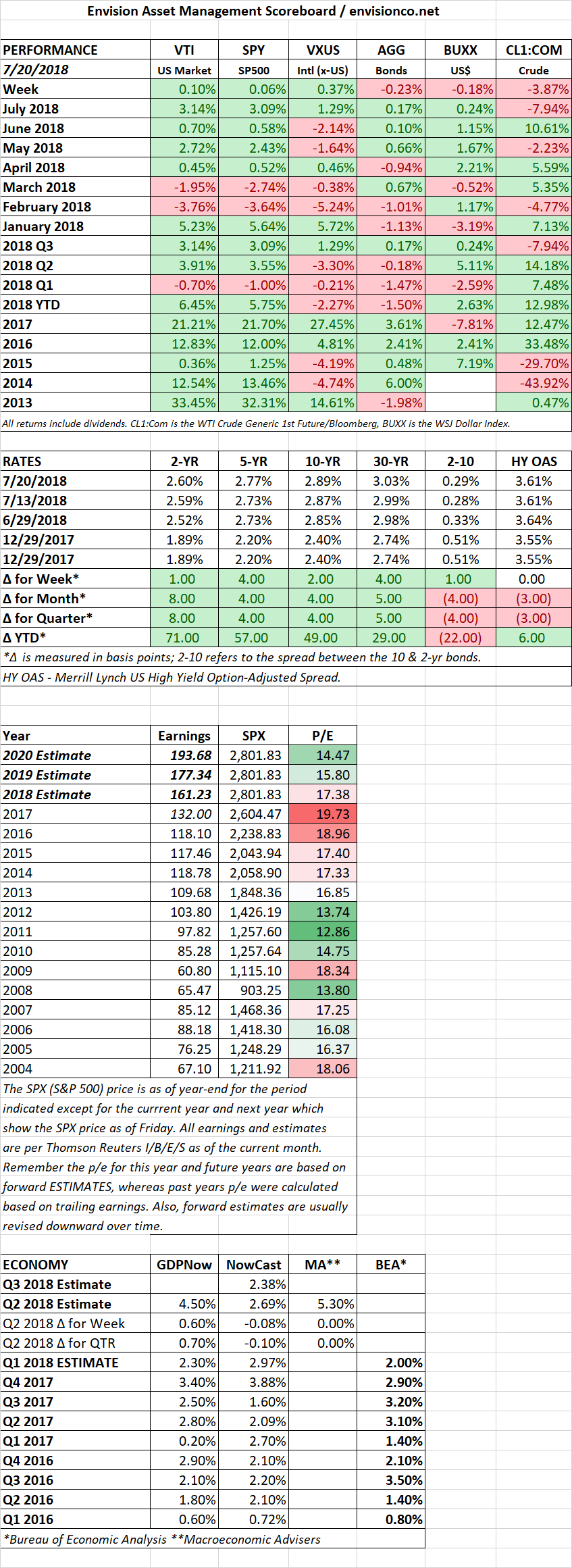
Strong corporate earnings helped offset trade and currency concerns as  US equities managed a small gain of 0.1%. International stocks did better, up 0.37%. Of the 75 S&P 500 companies that reported earnings, 71 beat forecasts. Looking forward, analysts are still revising earnings forecasts higher for 2018, 2019 and 2020. And those strong earnings are powering this market, at least for now, despite concerns about the trade war. Earnings projections have been revised up over the last quarter (13-weeks) by 1.92%, 1.90%, and 1.58% respectively, per Thomson Reuters.

FED CHAIRMAN POWELL ON TRADE

In Congressional testimony, Fed Chairman Jerome Powell said the following regarding tariffs, “In general, countries that have remained open to trade that haven’t erected barriers including tariffs have grown faster, they’ve had higher incomes, higher productivity. And countries that have, you know, gone in a more protectionist direction have—have done worse.”

Trump then criticized Powell, saying that raising short-term interest rates will hurt the US economic expansion. Traditionally, presidents have refrained from speaking about monetary policy. If Trump is worried about hurting the economic expansion, he should first look at this trade policies, but conveniently, he is setting up Powell to be the fall guy if the economy begins to slow.

CURRENCY WAR NEXT?

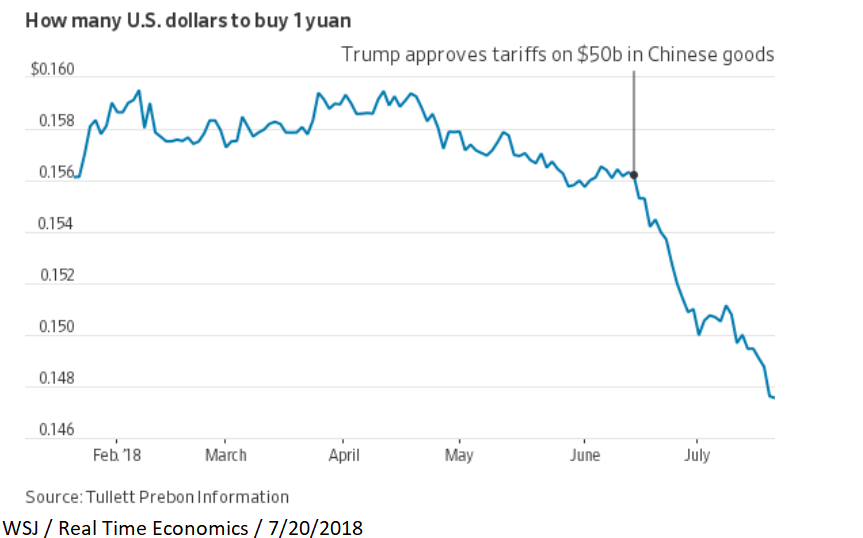
As we wrote a couple weeks back, “beware the law of unintended consequences.” Here are a couple to start –  a higher US trade deficit and currency wars. Rising US interest rates, the beginning of the trade war, and slowing Chinese growth have been pushing the value of the Chinese yuan down. Over the last month, the yuan has fallen about 5% against the dollar. The weaker yuan offsets some of the impact of U.S. tariffs by making Chinese goods cheaper in the U.S. and U.S. goods more expensive in China., the result might be a higher trade deficit with China. The exact opposite of the intended impact of the U.S. tariff policy.

As the yuan has dropped, there was little sign that China’s central bank intervened to help halt or slow the slide, so Trump accused China as well as Europe of “manipulating their currencies and interest rates lower.” Jens Nordvig, a currency strategist at Exante Data said, “The real risk is we have a broad-based unraveling of global trade and currency cooperation, and that is not going to be pretty.”  Nordvig fears the trade war will shift to a currency war.

SCOREBOARD

Week Ending 7/13/2018

HIGHLIGHTS

  • Stocks advance around the world.
  • The S&P 500 breaks through its March and June highs, now 2.5% from the top.
  • The White House proposes more tariffs on China.
  • Consumer Confidence declines.
  • Inflation increases at the fastest pace in six years.

MARKET RECAP

It was another up week around the world, and another week of tariffs. The White House said it would add 10% tariffs on $200 billion in Chinese products. The tariffs won’t take effect for two months. Supposedly the recently enacted tariffs and the threat of the new tariffs are intended to open up markets, but the administration has yet to clearly state what their objectives are, and one must wonder if they even know. The market did fall about 1/2% on the news, but otherwise, stocks were up every day last week.

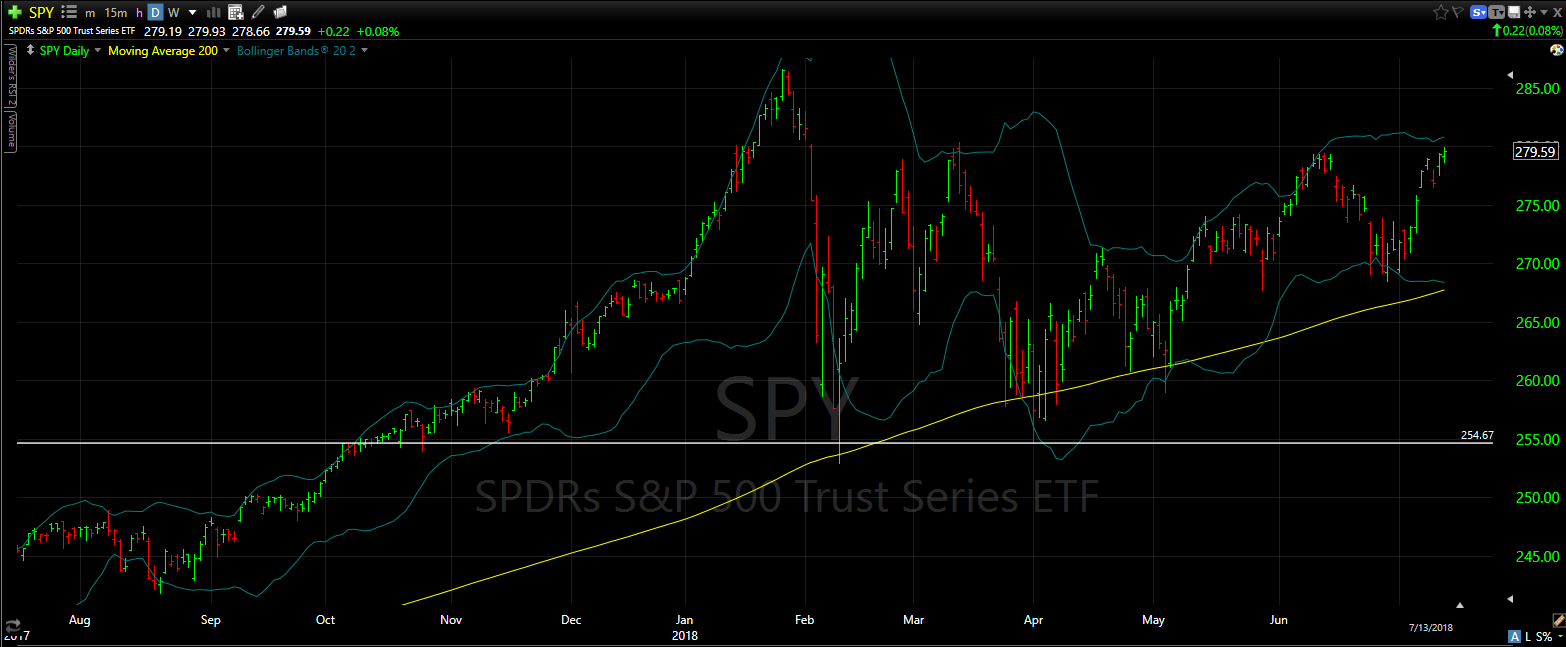
US equities were up 1.34% and international markets advanced by 0.57%. The S&P 500 cleared its March and June highs and is now 2.5% off the January 26 all-time high price. Interest rates increased by about 5 basis points. The spread between the 2 and the 10-year Treasury’s fell to 28 basis points (down 1 bp).

CONSUMER CONFIDENCE

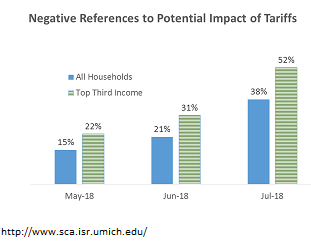
The market is going one way, but consumer confidence is going the other. The University of Michigan’s Consumer Sentiment Survey declined. Chief Economist Richard Curtin said “The darkening cloud on the horizon, however, is due to rising concerns about the potential negative impact of tariffs on the domestic economy. Negative concerns about the impact of tariffs have recently accelerated, rising from 15% in May, to 21% in June, and 38% in July (see the chart). Among those in the top third of the income distribution (who account for half of consumer spending), 52% negatively mentioned the impact of tariffs on the economy in early July. The primary concerns expressed by consumers were a decline in the future pace of economic growth and an uptick in inflation.”

INFLATION

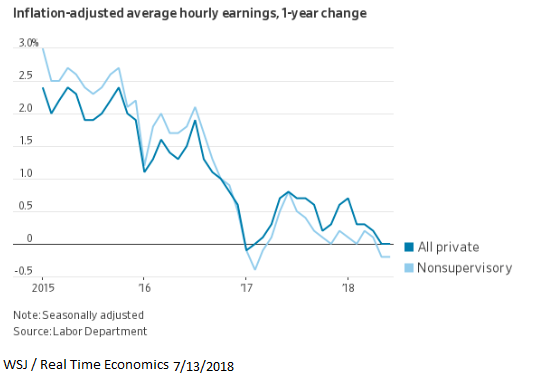
Inflation rose to the highest rate in six years. The Consumer Price Index was up 2.9% year over year. Inflation is now rising faster than average hourly wage growth, meaning earnings are not keeping up with the cost of living.

SCOREBOARD

Week Ending 7/6/2018

HIGHLIGHTS

  • Markets move up around the world.
  • Make it official, the trade war is now underway.
  • Strong jobs report as 213,000 are added to payrolls.
  • Workers are leaving their jobs at the fast pace in 17 years, confident that they can find better work elsewhere.

MARKET RECAP

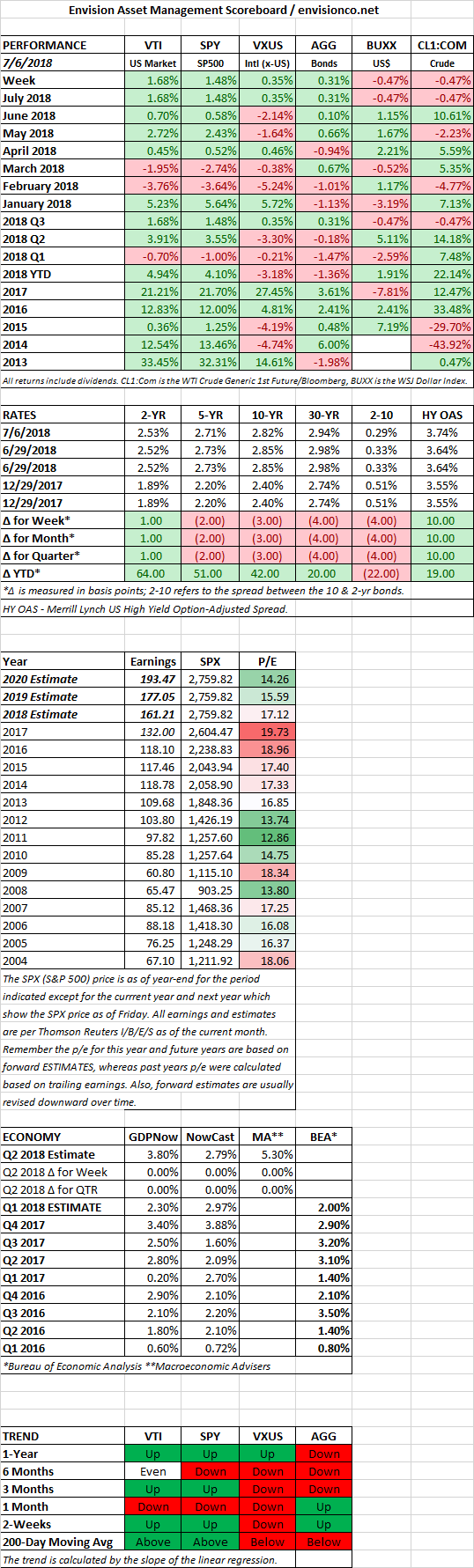
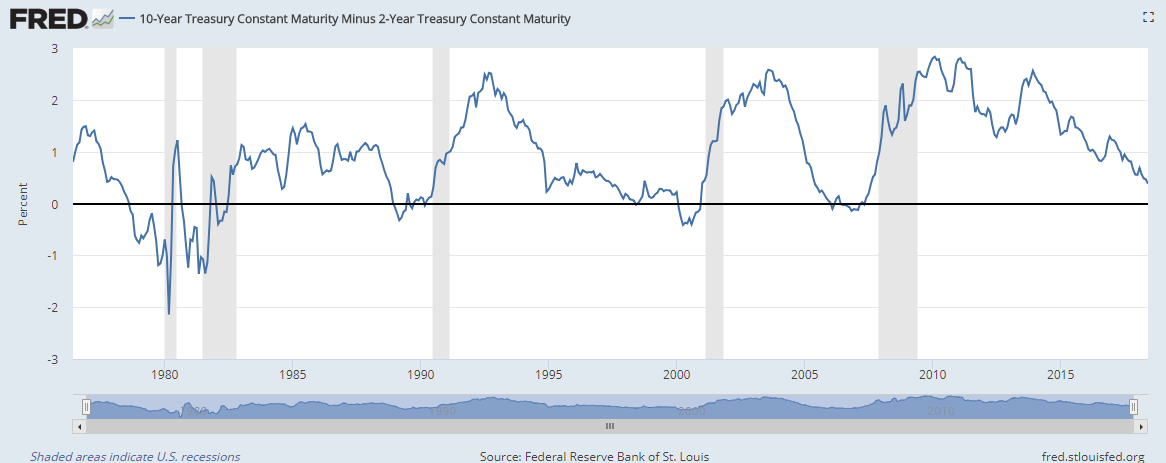
The “official” start of the trade war apparently was not a concern to investors, as stocks rallied around the world this week. US equities were up by 1.68% and international stocks advanced by 0.35%. Bonds were up by 0.31% and oil fell by 0.47%. A strong US economy buoyed by a solid jobs report was enough to move stocks higher. The 2-10 yield curve narrowed to 28 basis points, the smallest gap since 2007.

TRADE WAR

You can say that the trade war is now official as the US imposed $34 billion in tariffs on imported Chinese machinery, auto parts, and medical devices. China said it will respond in kind on soybeans and sport-utility vehicles. Oxford Economics estimates that the $50 billion in tariffs will reduce growth by 0.1% in each country. Add on another round of $200 billion and knock off 0.3% in 2019. But there are likely to be add-on effects from reduced confidence, slowing investment, less efficient supply chains, etc.

The US and Canada imposed tariffs on beef and farm goods. The European Union threatened tariffs on $300 billion in products if the US imposes automotive tariffs. Trump talks about exiting the World Trade Organization.

For now, though, markets are mixed on the ultimate outcome, many believe it will all work out in the end with limited short-term damage and longer-term benefits. Trump is counting on a strong US economy to give him greater leverage and to force concessions from trading partners.

The tariffs are not enough to do real damage, at least not yet. But what happens if countries go back and forth and each side raises the stakes and the trade war dramatically is amplified. At a minimum, what might a much deeper trade war lead to? For one, you would get higher prices. Higher prices might lead to a more aggressive Fed meaning higher interest rates. And remember, these increased prices and interest rates would not be due to a stronger economy, we are talking about self-inflicted wounds. Higher prices will reduce demand for products and higher interest rates will hurt debt-heavy companies, both might lead to job cuts. Higher inflation, higher interest rates, job cuts…that sounds like the end of an expansion. Beware the Law of Unintended Consequences.

JOB MARKET

Employers added 213,000 jobs in June. Unemployment rose to 4.0% from 3.8% but that was due to 601,000 new entries into the workforce. That is considered good news. Given the strong job market, and theoretically greater demand for workers than supply, the new entries should soon find work and further help an already solid economy. Average hourly earnings rose 0.2% and 2.7% year over year, indicating that labor costs are still under control.

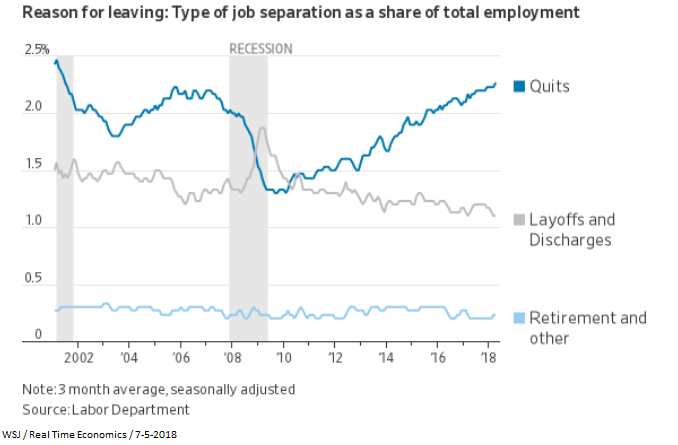
In a sign indicative of a tight job market, workers are now leaving their current jobs at the fast rate in 17 years, a signal that they feel confident in the ability to find more satisfying work at a higher pay.

SCOREBOARD

Week Ending 6/29/2018

HIGHLIGHTS

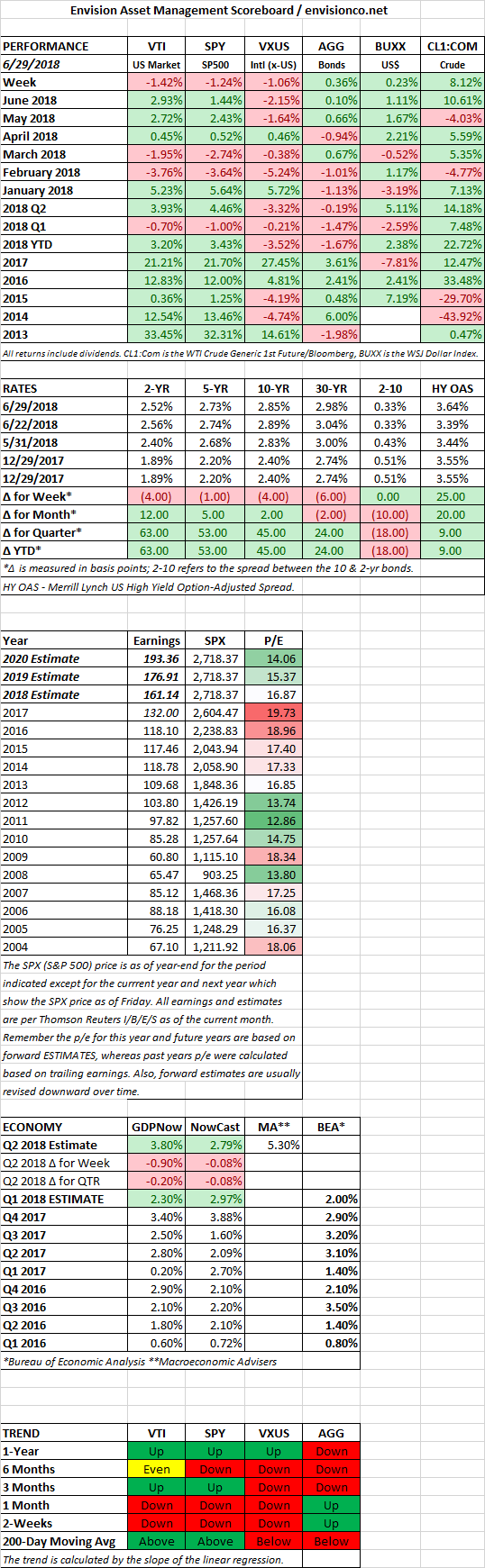
  • Stock fall by 1.42% in the US but are up by 3.2% for the first half of the year while international stocks are down by 1.06% for the week and down 3.52% year-to-date.
  • Interest rates fall while the yield curve has flattened over the last 2-weeks.
  • Q1 GDP revised down to 2% but Q2 is looking much stronger.
  • Oil prices surge by 8%.
  • The Barron’s cover story this week calls for the end of the bull market in 2020.
  • The Bank of England warns about growing risk in debt markets.

MARKET RECAP

The market tumbled on Monday as trade tensions flared up again. There were reports that Chinese companies would not be allowed to invest in the US. Treasury Secretary Mnuchin called it “fake news”, and then White House trade adviser Peter Navarro suggested that it is a possibility, although it would be aimed at any country that tries to steal US technology.

For the week overall, stocks fell in the US by 1.42% and it was another down week for international equities, falling 1.06%. For the first half of the year, US stocks were up 3.20% (including dividends) while markets outside the US were down by 3.52%.

Interest rates fell during the week and the bond market rallied by 0.36%. The yield curve remained steady for the week, at 33 basis points. Its lowest point of the year. An inverted yield curve, where the short-term rate is higher than the long-term, has preceded recent recessions, usually by about 6 to 24 months. The curve has not inverted yet, but it is moving in that direction.

Q1 GDP

Q1 GDP was revised down to 2% from 2.2%. However, expected growth for Q2 is significantly higher, the Atlanta Fed’s GDP model is now estimating growth of 3.8% annualized.

Jobless claims increased for the first time in five weeks, up to 9,000 to 227,000. The number of claims is still close to the lowest level since 1973.

OIL

Oil prices surged by about 8% for the week helped by a US effort to close markets for Iranian oil. A barrel of WTI crude closed at $74.15, the highest price of the year. A run-up in oil prices has sometimes been associated with the ending stage of a bull market. But there is an argument to be made that this recent spike has more to do with political issues, such as Iran, than fundamentals, and thus might be temporary in nature.

BARRON’S

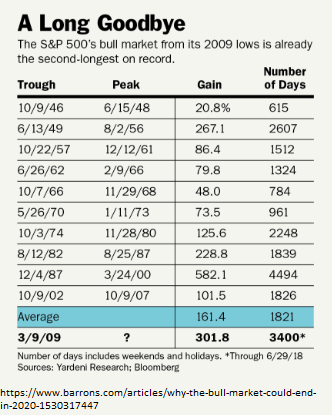
The Barron’s cover story this week calls for the end of the bull market in 2020. The article cites the fading of the tax cuts stimulus, higher interest rates (in the US and Europe), a smaller Fed balance sheet and slower growth in corporate profits. Of course, there could be factors that change the timing. For example, a trade war could accelerate the end of the bull market, and adjustments to the Fed’s interest rate path could lengthen it. Respected market strategist Ed Yardeni says that “The bull market will last as long as the economy expands. I don’t know anything today that leads me to put a time frame on when this bull market ends.”

BOE

The Bank of England warned about growing risk in global debt markets. The Bank says that it sees areas of risk ranging from US corporate debt to risky loans in Britain to foreign currency lending in emerging markets.

BOE Governor Mark Carney said, “The recent tightening in global financial conditions could be a precursor to a much more substantial snapback in world interest rates and more challenging bank, corporate and sovereign funding conditions,” he added that growing protectionism “could sap some of the current strength of the global economy.”

The Bank said that US corporate borrowers may struggle to repay loans if rates rise or global growth stalls.

SCOREBOARD

Week Ending 6/22/2018

HIGHLIGHTS

  • Markets fall in the US by 0.76% and 1.44% around the world.
  • “Second-order” effects from the trade war likely to be more damaging than the actual tariffs.
  • Earnings estimates for 2018, 2019 and 2020 fall across the board for the first time this quarter.
  • Consumers will soon start to feel the pain.
  • The Fed unwind to ramp up next quarter by $30 billion.

MARKET RECAP

The last few weeks, the market has been essentially ignoring the trade war talks. But that started to change this week. On Tuesday, Trump announced that he wanted to add another $200 billion on Chinese imports and hinted at more tariffs on European autos. That was enough to get investors to realize that maybe something not so good is going on here. US stocks fell by 0.76% for the week and international markets dropped by 1.44%. The Dow fell 2% and has been down in 8 of the last 9 sessions.

Nancy Lazar, from Cornerstone Macro, comments in this week’s Barron’s, that second-order effects could be more significant to the economy than the actual tariffs. “Second-order effects, more difficult to quantify, would include a hit to business confidence, headwinds from a stronger dollar, and supply-chain disruptions, including a loss of competitiveness of U.S. exporters who rely on imported components.”

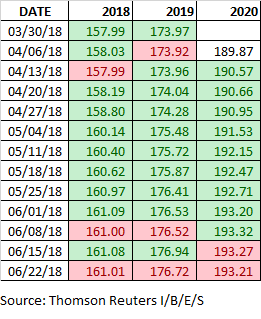
All of this seems to be seeping into earnings estimates. For the first time this quarter, estimates from Thomson Reuters for the SP500 for 2018, 2019 and 2020 fell across the board (see the table below). The threat is that Trump may be overplaying his hand and creating self-induced pain across economies here and around the world.

The higher tariffs will wipe out a portion of the benefits of tax cuts, so what the US can end up with is slower economic growth than would be otherwise, with much higher deficits. Not the ideal combination.

The hope would be that somehow all of this leads to a world of lower tariffs across the board and more free trade, which would be a boost to global economies.

CONSUMERS AND FARMERS

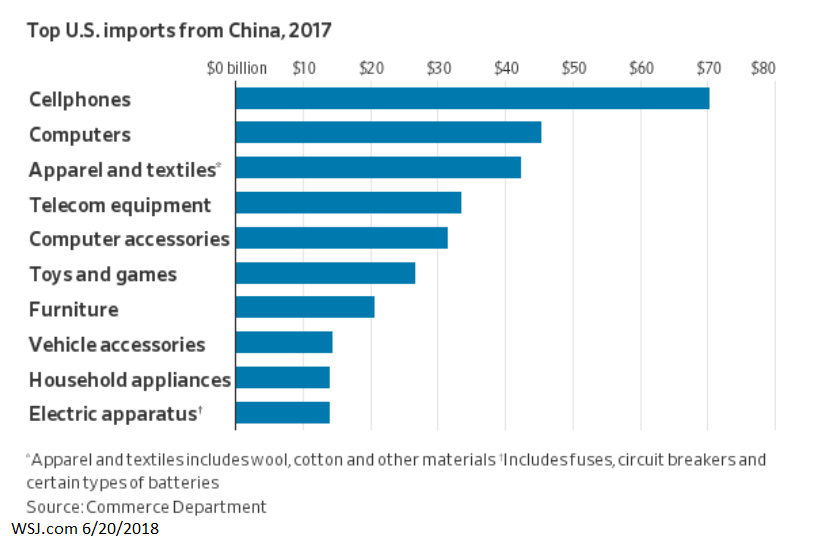
US consumers have been immune from the trade war so far, but that will soon start to change. Trump’s new proposal to put tariffs on $200 billion in Chinese imports will hit a wide range of retail products. The original set of tariffs on Chinese imports impacts businesses, but the latest round will cost retailers or their customers.

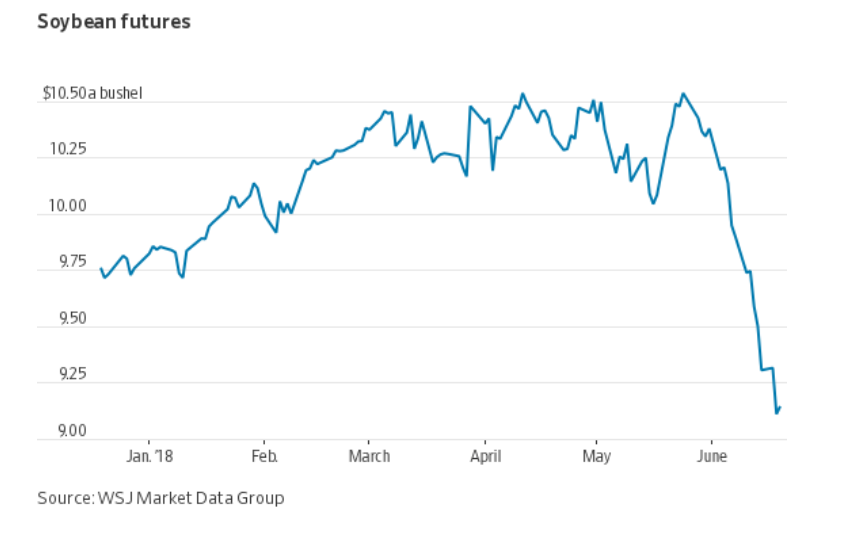
Farmers are also feeling the pain. Chinese tariffs on agriculture are putting downward pressure on crop prices. Soybeans fell to their lowest prices in two years. Grain and livestock are also down in price.

FED UNWIND

The Fed unwinding of its balance sheet is going to increase, from $90 billion in the current quarter to $120 billion next quarter. That means another $30 billion out of the financial system.

SCOREBOARD

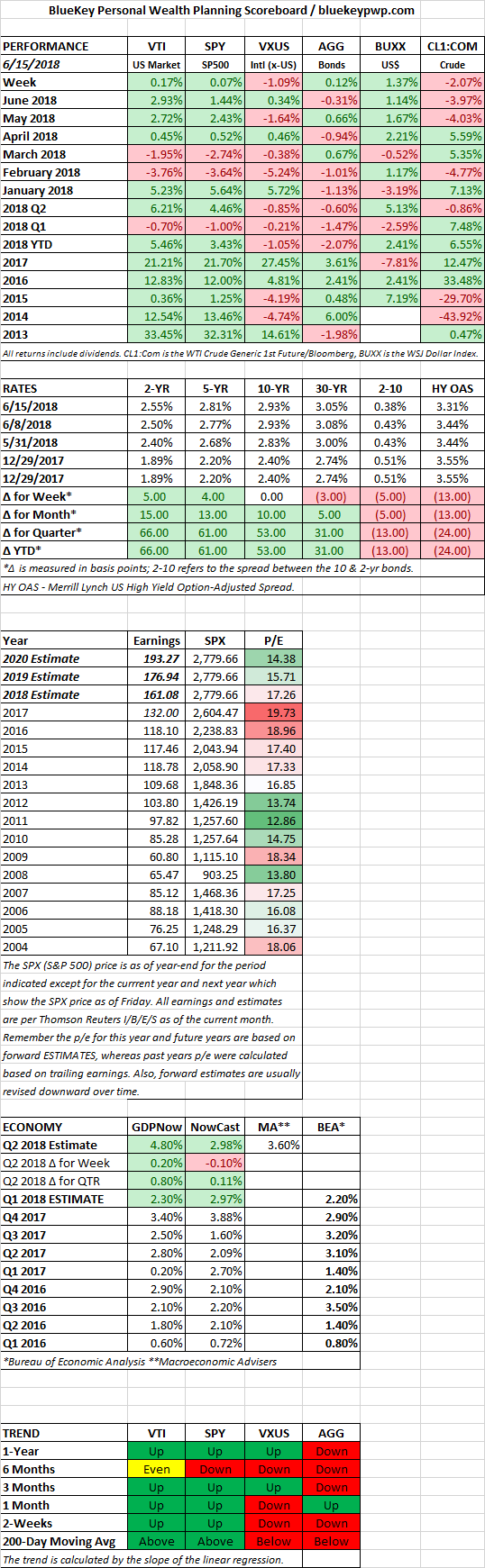
Week Ending 6/15/2018

HIGHLIGHTS

  • US stocks were up 0.17% while international equities fell by 1.09%.
  • The US economy is moving forward while international economies are improving at a slower rate.
  • The Fed increased rates by .0.25% and is projecting four increases this year.
  • The ECB will end its bond-buying program in December.
  • The trade war heats up.

MARKET RECAP

US markets increased by 0.17% while international equities dropped by 1.09%. Investors have simply ignored all of the trade war tariffs (see below), under the theory that it is just rhetoric that eventually will be settled. Bonds were up by 0.12% and the dollar advanced by 1.37%. Trump met with North Korean dictator Kim Jong-un. There was no official agreement but a promise by North Korea to “denuclearize.”

GLOBAL SPLIT

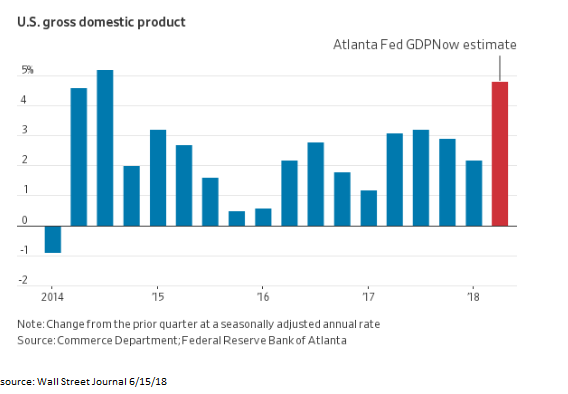
Last year the key economic words were “global synchronization”, as in growth around the world. But now, the signs of a split are becoming more clear. The US, powered by deregulation, tax cuts, and low unemployment, is picking up steam, while growth rates around the world are beginning to slow. Retail sales increased by the most in six months in May. The Atlanta Fed’s GDPNow model now is forecasting Q2 growth of 4.8%, which would be the most in almost four years. But this might be as good as it gets, the IMF sees US growth slowing in future years.

Meanwhile, the Euro is losing ground against the dollar. On Thursday, the Euro dropped by the most since the Brexit vote. Germany reported that factory orders dropped 2.5% in April, and eurozone growth came in at 0.4% in Q1, down from 0.7% in Q4 of 2017. Economists are not quite ready to write off Europe, many believe this is a temporary stall and that growth will resume.

FED/ECB/BOJ

The Fed increased rates by 25 basis points to a target range on the fed funds rate between 1.75% and 2.00%. That move was already baked in the cards and was not a surprise. The more significant news was that the Fed pulled forward its timeline on projected rate increases in the future. It is now more likely that we get four rate hikes this year, three in 2019 and one in 2020. Previously, it was three for this year, three in 2019 and two in 2020. So one hike was added this year and one was taken away in 2020.

The ECB announced they would end their bond-buying program in December. But the Bank also said they would wait at least until the summer of 2019 before raising the deposit rate, currently at -0.4%.

The Bank of Japan kept its short-term interest rate at -0.1%.

TRADE WAR RISK

The market has basically been ignoring the risk of a trade war, even though the rhetoric that is being tossed around is like nothing ever seen in recent times. Trump went after Canadian Prime Minister Justin Trudeau via Twitter. Canada has announced tariffs of almost $13 billion on US products. Mexico has added tariffs of $3 billion, and the EU is looking at about $7.5 billion. While these numbers, in percentage terms, are small, they will all negatively impact the value chain, and begin to hurt businesses at the margin. Trump should take the high road, and the smart road, and propose the worldwide elimination of all tariffs, with no restrictions on trade anywhere (other than for legitimate security reasons).

SCOREBOARD

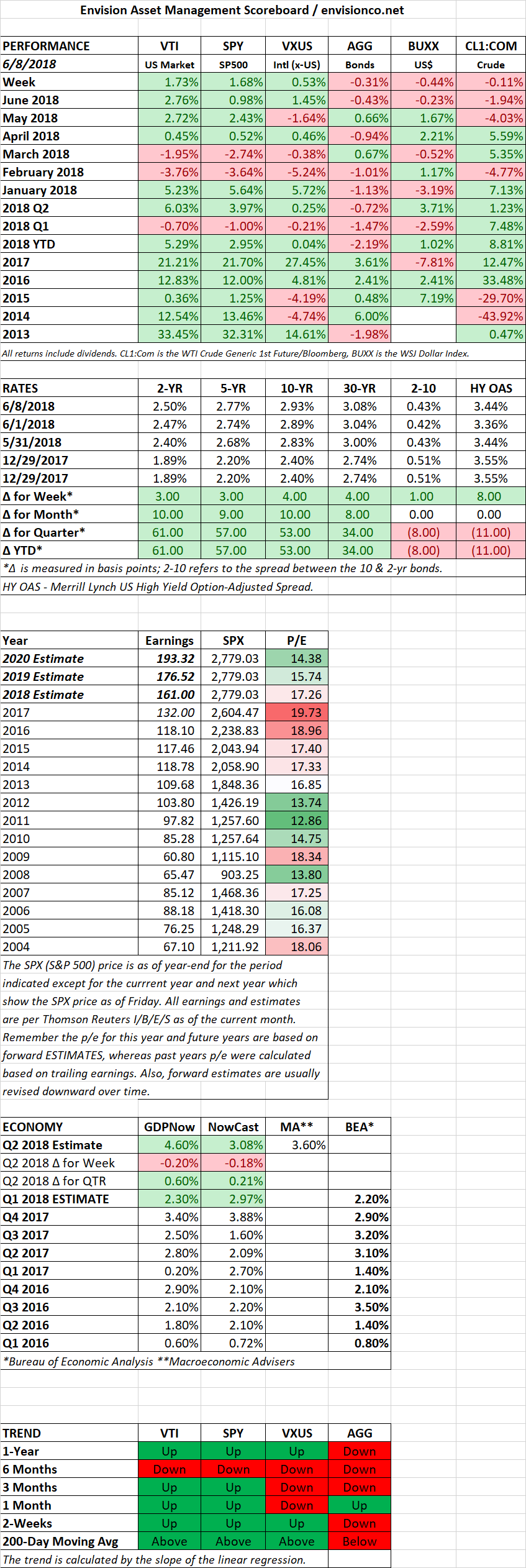
Week Ending 6/8/2018

HIGHLIGHTS

  • US stocks were up 1.7% and the NASDAQ Composite hits a record. International equities advance by 0.53%.
  • The world’s major central banks to meet this week.
  • Declining currency values and debt problems are hurting emerging markets.
  • Congress considering trying to take some power away from Trump regarding tariffs.
  • Household wealth hits a record.
  • The strong US job market has more openings than job seekers.

MARKET RECAP

US stocks advanced by about 1.7% and international equities managed a gain of 0.53%. The tech-heavy NASDAQ Composite index hit a new record, now up 23% over the last year. The US has been outperforming international markets of late on a strong economy, threats of a trade war, European populism, and falling currencies in emerging markets.

Interest rates were up slightly and bonds fell by 0.31%. The dollar declined by 0.44% and oil was off by 0.11%.

FED/ECB/BOJ

The Fed meets this to discuss interest rates. The odds favor another 0.25% hike. Investors will be more focused on the outlook for further hikes down the line. There is a current deviation between what the Fed has been forecasting for rates in 2019 and 2020 and what the market thinks will happen. The Fed is forecasting higher, the markets are expecting lower.

The European Central Bank (ECB) meets on Thursday. The ECB has continued injecting funds into the bond market, while the Fed has been withdrawing funds. If the ECB announces that they will begin to pull back on their bond purchases, markets might suffer.

The Bank of Japan meets on Friday but is expected to continue their quantitative easing.

EMERGING MARKETS 

Emerging equity markets were about even this week, but are still down about 11.5% from their January peak. The sell-off might be creating bargains in some value-oriented emerging market equity funds, they are now selling at a forward p/e of around 10.

Some of the fear in emerging markets is the spillover effect of the Fed’s balance sheet unwind. The balance sheet continues to shrink, down about $19 billion over the last four weeks, helping to put upward pressure on interest rates, which hurts countries that have debt denominated in dollars. Higher US interest rates also can impact emerging market currencies. This week, Argentina secured a $50 billion credit line from the IMF, the largest ever. The Argentine Peso sank to new lows on the news. Turkey is also having problems keeping their currency afloat. Inflation is running at 12%. This week, Moodys downgraded all of the Turkey banks due to higher costs of funding.

Other emerging market countries such as Brazil and South Africa are also having problems.

Congress Considering Ramping Down Trump’s Trade Power

There is starting to be some talk in Congress about what they can do to tamper down Trump’s tariffs. Senators Corker and Toomey are proposing legislation to limit the President’s ability to use the 1962 Trade Expansion Act to impose tariffs based on national security concerns. Senator John Cornyn, Republican Senator from Texas said, “I would hate to see this great, booming economy, as a result of the policies of this administration, be squandered by a trade war.”

One early consequence of Trump’s tariffs is lumber. Last November the administration imposed tariffs of about 20% on Canadian lumber. Due to huge demand, lumber imports from Canada are actually up, but the prices are up way in excess of the tariff, about 45%. Somewhere in that 45% is a big tariff, and new homeowners, not Canadian producers, are paying for it.

Another problem is that tariffs often miss their target. The tariffs encourage companies to figure out a way to avoid the hit. Chinese companies have shifted importing goods into the US from their factories in countries that are not being impacted by the “trade war”, such as Malaysia and Serbia.

Job Openings are Greater than Job Seekers

There are more jobs available in the US right now than people seeking work. Employers are going to have to loosen hiring standards, increase wages or automate (get by with fewer workers). Either way, in the short run wage inflation, is likely to go up putting pressure on the Fed to keep pace.

HOUSEHOLD WEALTH HITS NEW RECORD

Americans’ are now worth more than $100 trillion for the first time, up 1% from the previous quarter. The milestone was set early this year helped by rising home prices. A volatile first quarter in the equity markets slowed the rate of increase.

COPPER PRICES CLOSE TO FOUR-YEAR HIGH

Copper prices are approaching a four-year high on a combination of threats to production and global growth. Labor talks between BHP Billiton and miners in Chile could slow or halt production at the world’s largest copper mine. And India has ordered a mine to be closed in that country. Economic growth around the world and more specifically in China, have also pushed up prices. The World Bank is looking for 3.1% growth this year around the globe and recent reports show solid activity in China, which consumes about half of the world’s copper.

SCOREBOARD

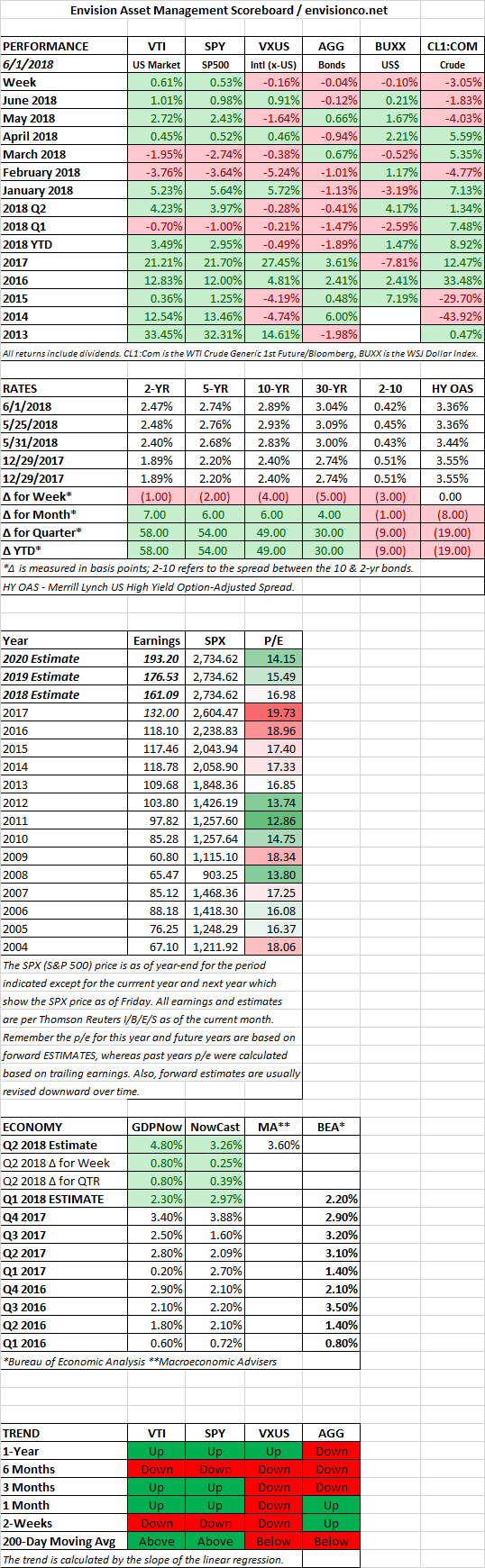
Week Ending 6/1/2018

HIGHLIGHTS

  • US stocks are up by 0.61% but international markets continue to decline.
  • Italian politics and higher trade tensions troubled the markets.
  • Another strong jobs report.

MARKET RECAP

US markets were up by 0.61% but international markets continued to decline, down by 0.16% for the week, now down 1/2% for the year and the trend, as measured over 6-months, 3 months, 1 month and 2-weeks are all down.

It was a news-filled week. The threat of Italy leaving the eurozone knocked equity markets down on Tuesday and sent bonds higher. Except for Italian bonds, which sold off. The trade war with China, which was supposed to have been on hold, was put back on, as the Trump administration proposed 25% tariffs on Chinese tech imports. But apparently going after China was not enough, Trump imposed tariffs on steel and aluminum imports from allies Canada, Europe, and Mexico. All threatened to retaliate against the US.

JOBS

Nonfarm payroll increased by 223,000 in May, beating the estimate of 190,000. The unemployment rate fell to 3.8%. Average hourly earnings were up 0.3% for the month and 2.7% year over year. The average workweek remained steady at 34.5 hours. The labor force participation rate dropped by 0.1% to 62.7%.

ITALY

Stocks tumbled on Tuesday on worries that Italy might exit the euro currency union. The idea is that by introducing a new, less expensive currency, Italy would be more competitive on world markets and exports would increase. But such a move would be costly and complex. First, Italy would have to pay back its existing debts, inflation might skyrocket and uncertainty would stall the economy.

TARIFFS

Trump imposed tariffs on US allies like Canada, Mexico, and Europe, prompting promises of swift retaliation. Though the impact in the near future will not be severe, if these tariffs are not rescinded and they become part of the long-term landscape, it will be another handicap for the US economy down the road. The US Chamber of Commerce says the tariffs will threaten up to 2.6 million jobs.

SCOREBOARD