Week Ending 6/1/2018

HIGHLIGHTS

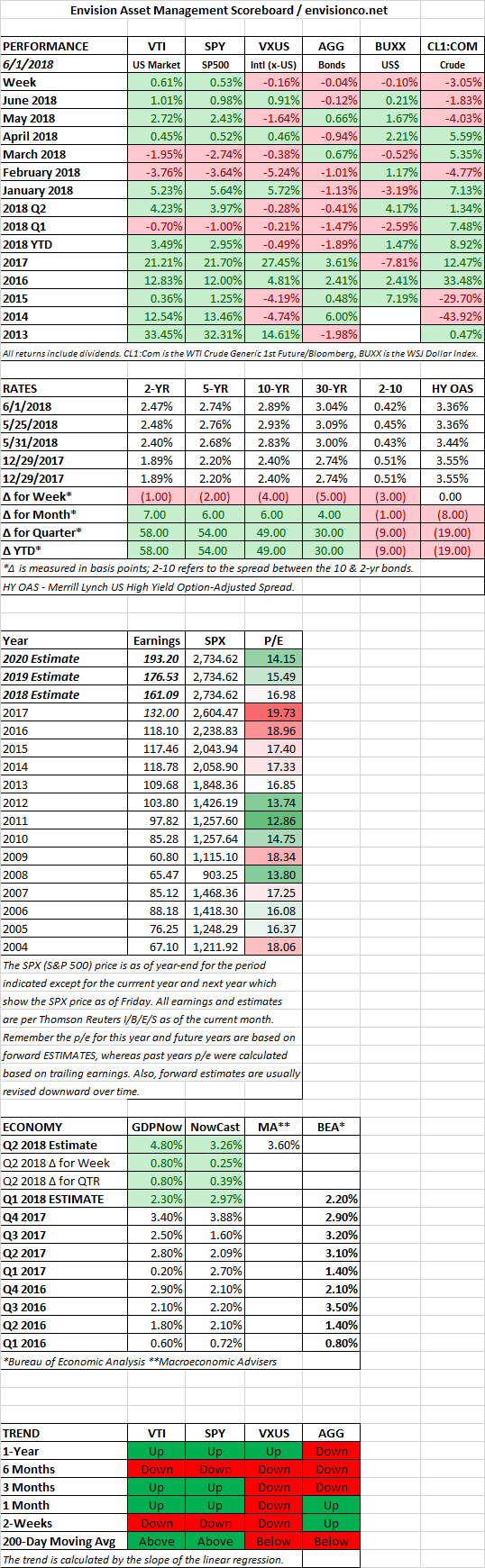
  • US stocks are up by 0.61% but international markets continue to decline.
  • Italian politics and higher trade tensions troubled the markets.
  • Another strong jobs report.

MARKET RECAP

US markets were up by 0.61% but international markets continued to decline, down by 0.16% for the week, now down 1/2% for the year and the trend, as measured over 6-months, 3 months, 1 month and 2-weeks are all down.

It was a news-filled week. The threat of Italy leaving the eurozone knocked equity markets down on Tuesday and sent bonds higher. Except for Italian bonds, which sold off. The trade war with China, which was supposed to have been on hold, was put back on, as the Trump administration proposed 25% tariffs on Chinese tech imports. But apparently going after China was not enough, Trump imposed tariffs on steel and aluminum imports from allies Canada, Europe, and Mexico. All threatened to retaliate against the US.

JOBS

Nonfarm payroll increased by 223,000 in May, beating the estimate of 190,000. The unemployment rate fell to 3.8%. Average hourly earnings were up 0.3% for the month and 2.7% year over year. The average workweek remained steady at 34.5 hours. The labor force participation rate dropped by 0.1% to 62.7%.

ITALY

Stocks tumbled on Tuesday on worries that Italy might exit the euro currency union. The idea is that by introducing a new, less expensive currency, Italy would be more competitive on world markets and exports would increase. But such a move would be costly and complex. First, Italy would have to pay back its existing debts, inflation might skyrocket and uncertainty would stall the economy.

TARIFFS

Trump imposed tariffs on US allies like Canada, Mexico, and Europe, prompting promises of swift retaliation. Though the impact in the near future will not be severe, if these tariffs are not rescinded and they become part of the long-term landscape, it will be another handicap for the US economy down the road. The US Chamber of Commerce says the tariffs will threaten up to 2.6 million jobs.

SCOREBOARD

Week Ending 5/25/2018

HIGHLIGHTS

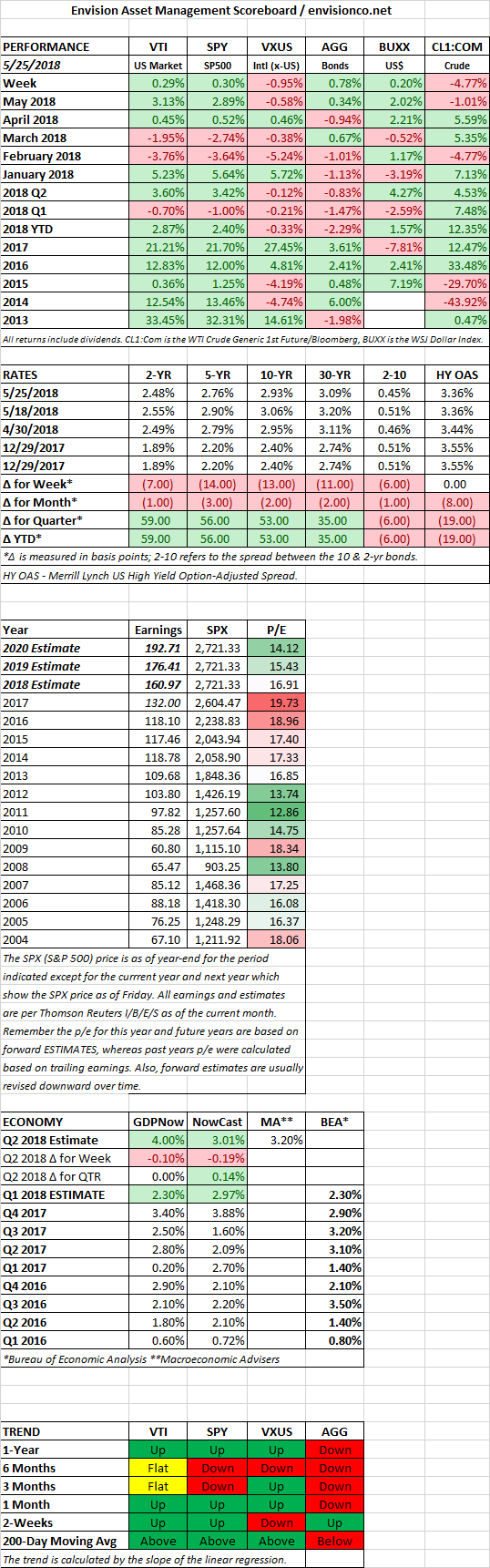
  • Stocks advance by 0.30% in the US but fall outside the US by 0.95%.
  • The trade war with China is “put on hold”.
  • Trump cancels the summit with North Korea.
  • Anti-establishment parties to govern in Italy.
  • The ruling party in Spain is involved in a kickback scheme.
  • Trump considering tariffs on automobiles in the name of national security.
  • Treasury yields fall.
  • Oil prices have a big drop.

MARKET RECAP

It started out as a good week on Monday, as the market rallied on news that the possible trade war with China would be put on hold. But as the week wore on, stocks drifted slowly lower but did manage a small gain for the week. The US market was up by 0.30% but outside the US, equities fell again, down 0.95%. Trump canceling his summit with North Korea, the rise of anti-establishment parties in Italy and a kickback scheme involving the ruling party in Spain held stocks back. Not to mention, the Trump administration, out of nowhere, said it was now considering tariffs on imported automobiles in the name of national security!

Interest rates in the US declined, partly on the safe-haven trade, falling oil prices, Trump’s auto-tariff proposals, and Fed minutes showing that interest-rate increases would remain gradual. The yield on the 10-year Treasury dropped by 13 basis points to 2.93%. It was the biggest one week decline since April of 2017. The spread between the 10-year and the 2-year Treasury is now 45 basis points (the April low was 41 basis points).

Oil prices fell sharply, down 4.77% on the week, and most of that on Friday, as Russia and Saudi Arabia reached a deal to increase oil production.

SCOREBOARD


Week Ending 5/18/2018

HIGHLIGHTS

  • US stocks were down by 0.26% and international stocks fell by 1.01%.
  • Bonds dropped by 0.53% as the 10-year yield hits a 7-year high.
  • The Leading Economic Index improves.
  • Capex soars in Q1.
  • NAFTA talks appear stalled.

MARKET RECAP

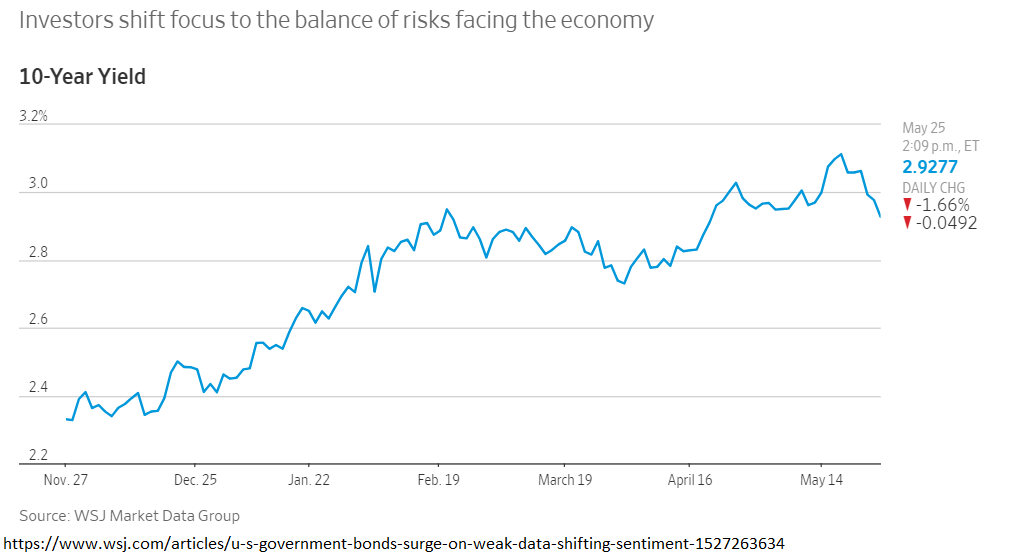
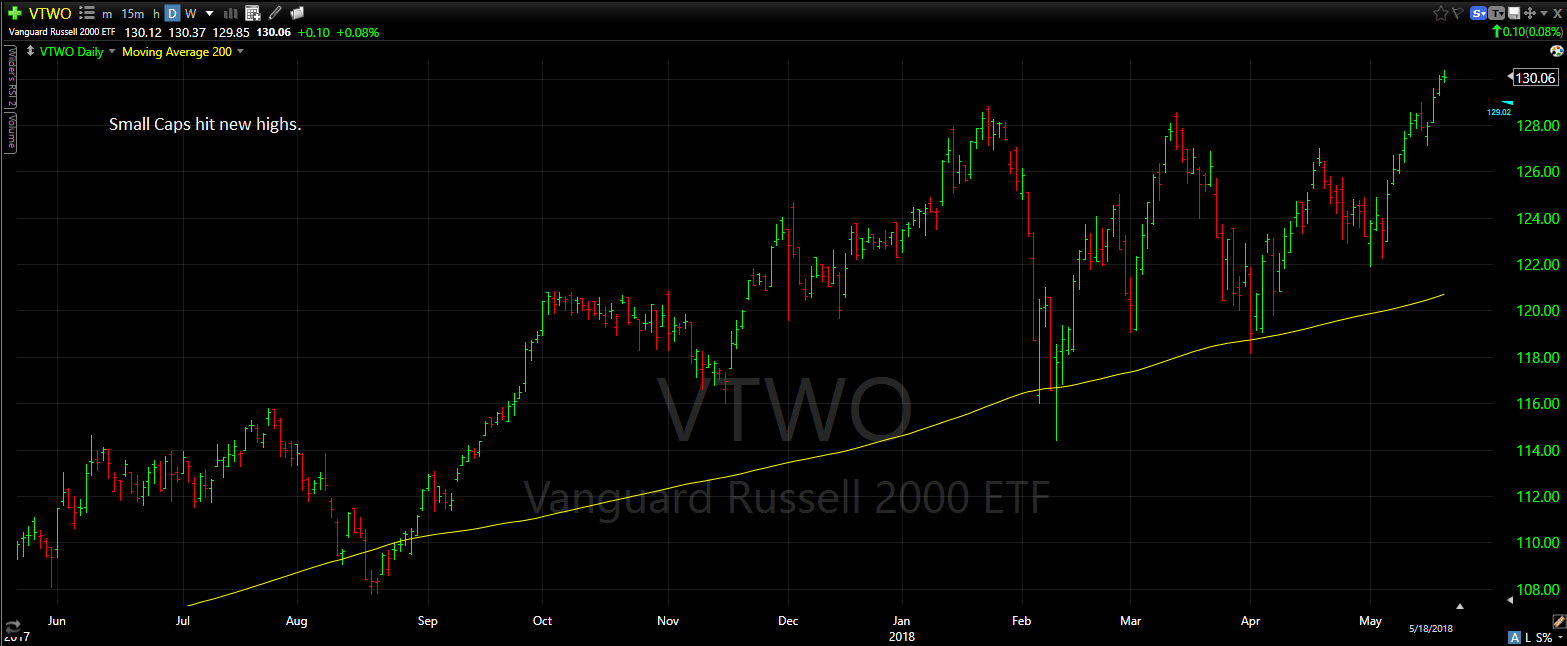
Stocks in the US fell by 0.26% and by 1.01% outside the US. Higher interest rates worried the markets as the 10-year yields hit a 7-year high, causing the bond market to drop by 0.53%. Increased yields reduce the present value of a future stream of cash flows, resulting in a theoretically lower stock market value, all other things considered. But the offset to that are the “other things”, such as a decent economy, improving earnings, buybacks, etc. Small caps, for one, don’t seem concerned, the Russell 2000 Index hit new highs this past week.

But trade continues to be a worry. Slight progress was reported on talks with China, but that has yet to be resolved. At the same time, NAFTA negotiations missed an important deadline and appear to be stalled.

LEADING ECONOMIC INDEX

The Conference Board’s Leading Economic Index was up by 0.4% in April, March was also revised up to 0.4% from 0.3%. Eight of ten components made positive contributions. “April’s increase and continued uptrend in the U.S. LEI suggest solid growth should continue in the second half of 2018. However, the LEI’s six-month growth rate has recently moderated, suggesting growth is unlikely to accelerate,” said Ataman Ozyildirim, Director of Business Cycles and Growth Research at The Conference Board.

As shown in the chart below, the LEI, which represents future growth. is increasing faster than the Coincident Index (CEI), which represents current growth, a positive sign.

10-YEAR YIELDS

The yield on the 10-year Treasury note hit its highest level in seven years on Tuesday in response to positive economic news. Consumer spending was up in April for the second straight month and a NY Fed manufacturing survey had better than expected results. The higher yields are carrying over to mortgage rates. The average rate for a 30-year fixed rate mortgage rose to 4.61% from 3.99% in January and 3.31% at its low in 2012. Higher mortgage rates might encourage homeowners to stay in their current homes instead of trading up. Higher rates will also make some homes less affordable for prospective buyers.

CAPEX SOARS

Helped by tax cuts, deregulation, and repatriation, investment in capital (capex) such as factories and equipment were up 24% to $166 billion in the first quarter, after an extended period of subpar investments. Although capex is considered good for long-term economic growth, studies suggest that shares of companies with large capital investments underperform the market. However, there are always exceptions, Amazon being perhaps the best example.

NAFTA

Trade negotiators missed a deadline to wrap up a North American Free Trade Agreement deal this week. Despite President Trump’s claims, NAFTA has been a big boost to economic growth in North America and failing to renew the agreement would be an economic negative.

SCOREBOARD

Week Ending 5/11/2018

HIGHLIGHTS

  • US equities were up by 2.5%.
  • Mild CPI report.
  • There are more job openings than unemployed, first time ever.
  • Oil prices continue to rise.
  • But there are signs that growth is beginning to slow globally.

MARKET RECAP

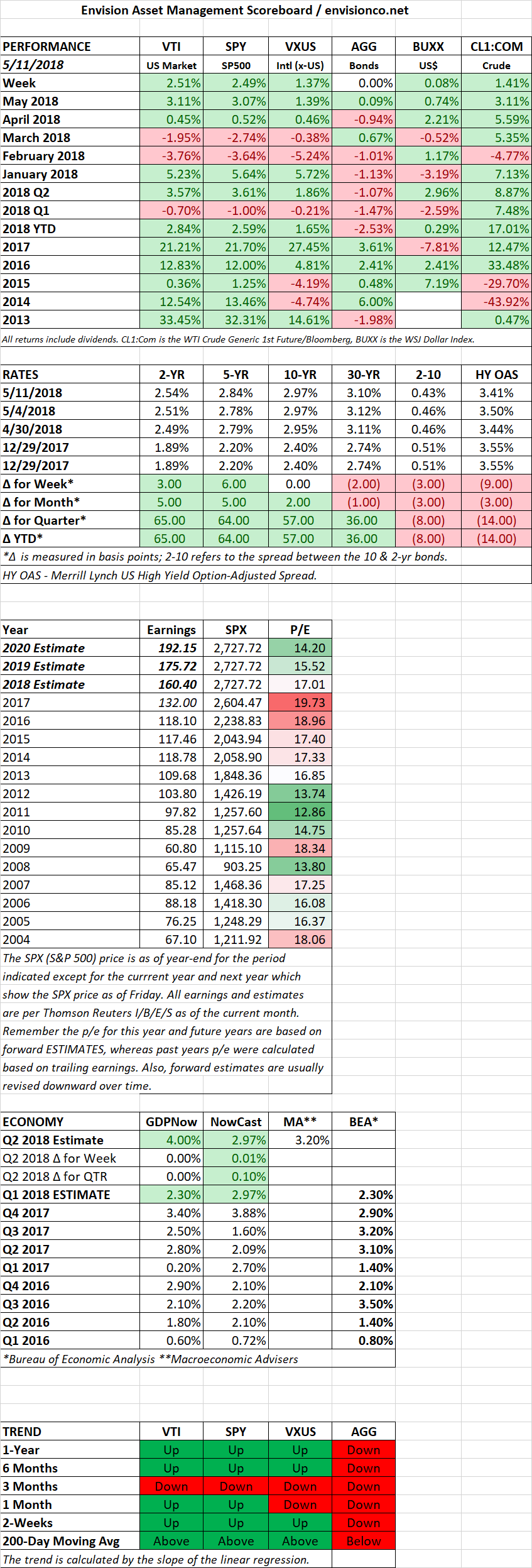
It was almost like the good old days (of 2017), the market shrugged off negative news and marched steadily higher. US equities were up 2.5% and international stocks were up 1.4%. US stocks are now up 2.8% for the year. Bonds were flat.

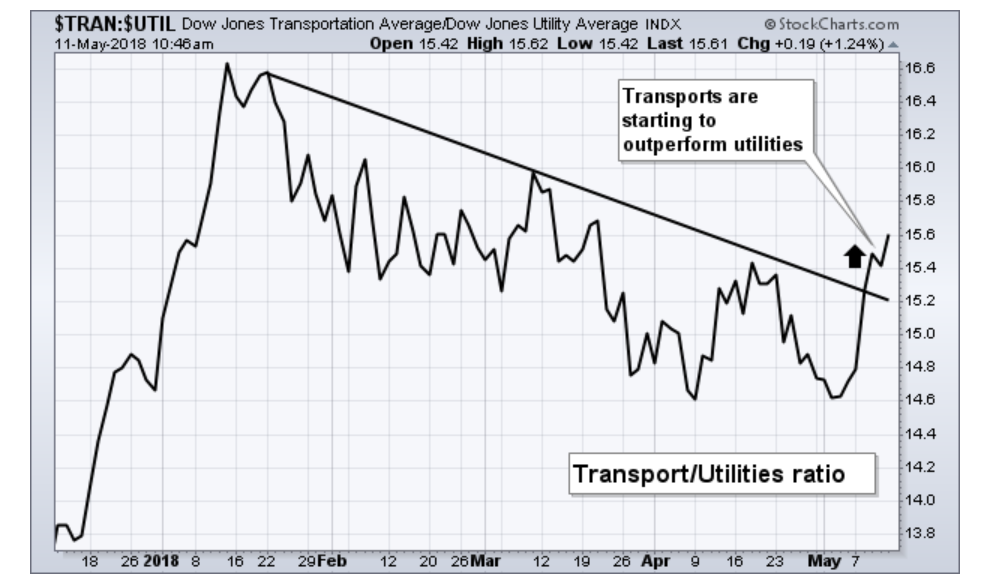
The chart below, from John Murphy at Stockcharts.com, shows that economically sensitive transports have recently been outperforming utilities, a positive technical sign.

Financials have also broken out of a recent consolidation range to the upside. Markets were helped by a mild CPI report. The index was up by 0.2% in April and the core CPI increased by only 0.1%. Total CPI is now up 2.5% year over year and the core is at 2.1%.

JOBS

The Labor Department reported that there were a record 6.6 million job openings in March. That is enough so that theoretically, every unemployed person could have a job, the first time that has ever happened. Of course, skill and location mismatches make that impossible. But it is an indication of a continued strong job market.

OIL PRICES ON THE RISE

Oil prices have continued to rise, outpacing analyst estimates, as production cuts by OPEC have reduced inventory levels and Mideast tensions increase. Prices broke the $70 barrier.

SIGNS OF SLOWING GLOBAL GROWTH

Capital Economics estimates that export growth in China fell 2% in April, the largest drop in nine months. Copper prices are down 6% year to date, copper is a bell weather for growth in Asia. And purchasing managers’ indexes for manufacturing, while still in expansionary mode, have declined from peak levels in the US, Europe, China, Japan and South Korea.

SCOREBOARD

Week Ending 5/4/2018

HIGHLIGHTS

  • A Friday rally save the markets from a deep decline, falling just 0.27% for the week.
  • Unemployment drops to 3.9%.
  • Tariffs aimed at some trading partners postponed for one month.
  • An unusual conference call for Tesla does not add to confidence.
  • Inflation hits the Fed’s target.

MARKET RECAP

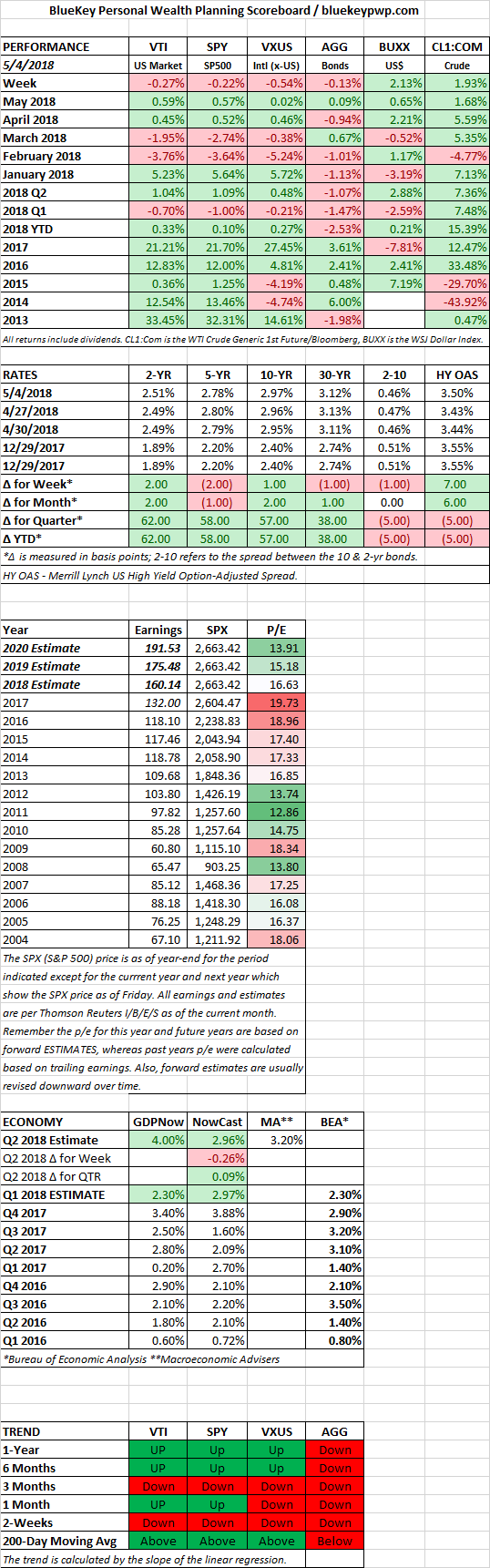
A strong Friday rally, +1.29%, saved the equity markets, turning what would have been a bad week into a small decline, just 0.27% in the US and 0.54% outside the US. At the Thursday low, the market was down 2.67% for the week and below the 200-day moving average. Stocks have now bounced off the 200-day three times. And at least so far, each successive test formed a higher low. By no means are we ready to call an “all-clear”, but so far, so good.

EMPLOYMENT

Unemployment fell to 3.9%, the lowest level since December 2000. Employers added 164,000 jobs. It was the 91st consecutive month of job growth, the longest streak on record. Average hourly pay was up by 2.6% year over year.

TARIFFS

The White House will delay a decision on tariffs targeted at the European Union, Canada, and Mexico for one month. A US delegating went to China to see if the countries can come to an agreement.

TESLA

In one of the more bizarre conference calls of all time, Elon Musk cut off legitimate analyst questions in a condescending manner, leading to speculation that the company is beginning to feel the heat from its cash drain. Pressure is mounting on the automaker as Moody’s estimates Tesla will need to raise another $2 billion to cover the 2018 cash burn and to refund convertibles that mature over the next two years. Tesla bonds are now trading as “junk” level.

INFLATION

The PCE Price Index rose 2%, year over year, hitting the Fed’s inflation target. This suggests that the Fed will remain on the path of increasing interest rates.

SCOREBOARD

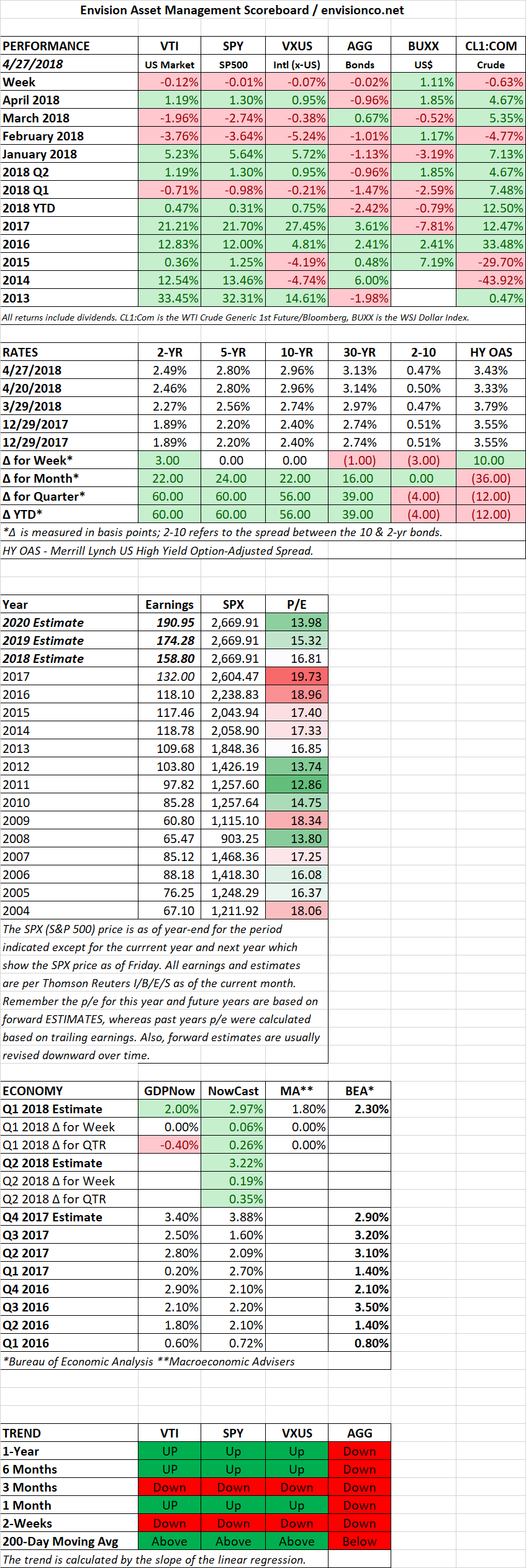
Week Ending 4/27/2018

HIGHLIGHTS

  • US and international stocks down by about 0.10%.
  • “Peak earnings” was the term that was passed around last week.
  • The 10-year Treasury ends the week flat but finished higher than 3% Tuesday, Wednesday, and Thursday.
  • The highest level of backorders since 2014.

MARKET RECAP

The US and international equity markets were down by about 0.10% on the week. Companies continued to report blockbuster earnings, even better than expected, but that was not enough to move stocks higher.  That was due to the fear of “peak earnings”, as in “it doesn’t get any better than this”. Those were the words that were tossed around all week. It is not that investors expect a recession in 6-months, but the rate of acceleration in earnings growth has probably peaked. The Caterpillar CFO, in a post-earnings conference call, said Q1 earnings would be the “high water mark for the year,” that helped send the Dow on a 400-point tailspin on Tuesday.

But it wasn’t just the fear of “peak earnings” that spooked the market. Give some credit to higher interest rates. The 10-year Treasury topped the 3% mark on Tuesday, Wednesday, and Thursday, only to close at 2.96%, the same rate as the previous Friday. A 10-year Treasury yielding greater than 3% presents competition for equities. On one hand, the market fears a flattening yield curve, represented by static long-term rates and rising short-term rates, and then when they get the opposite, with long-term rates increasing, they are still not happy.  A flattening yield curve stirs up thoughts of a recession down the line, while a steepening curve could indicate inflation.

GDP

The government reported the first estimate of GDP growth for Q1 at 2.3%. That was above estimates but lower than the 3% growth rate for the final 9-months of 2017. For the past few years, Q1 has been the slowest quarter of the year. So if recent trends hold true, GDP should expand from here.

ORDER BACKLOGS HIT HIGH

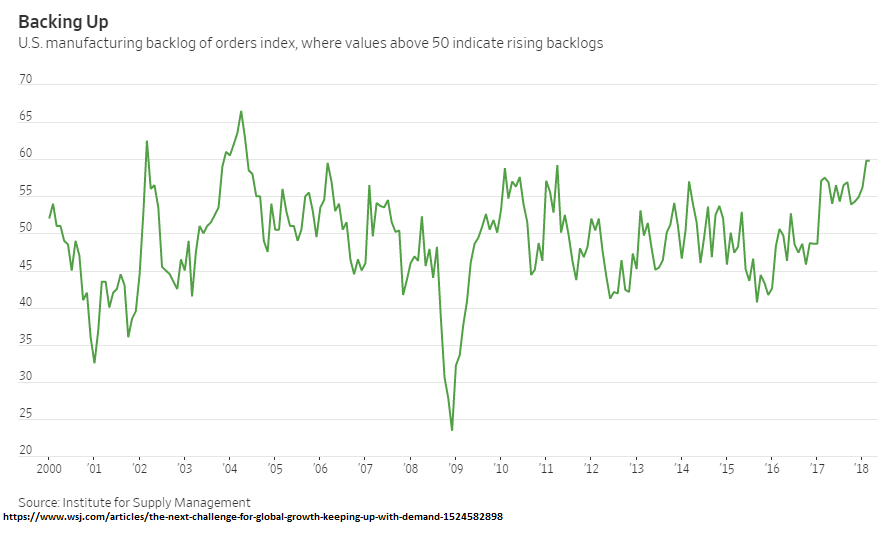
The Institute of Supply Management (ISM) reports the highest backlog of orders in manufacturing since May of 2004. Supply chains are having difficulty keeping up with the demand. The same problem is occurring overseas, a shortage of labor and equipment are limiting production.

SCOREBOARD


Week Ending 4/20/2018

HIGHLIGHTS

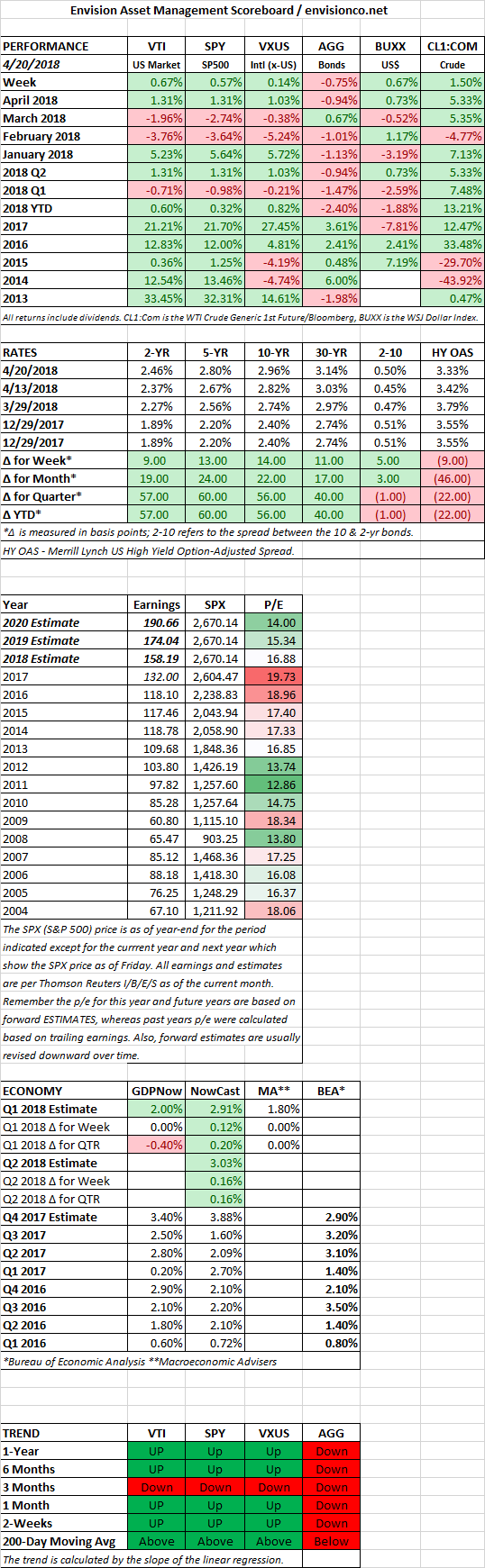
  • Equities were up by 0.67% and are now positive for the year.
  • The spread between the 10 and 2-year treasury hit the lowest level since 2007 on Tuesday at 41 basis points.
  • The yield on the 10-year treasury closed at its highest level since January of 2014.
  • Earnings reports have been strong and the forward p/e on the SP500 is now 16.6.
  • An IMF report shows the magnitude of the US deficit problem.

MARKET RECAP

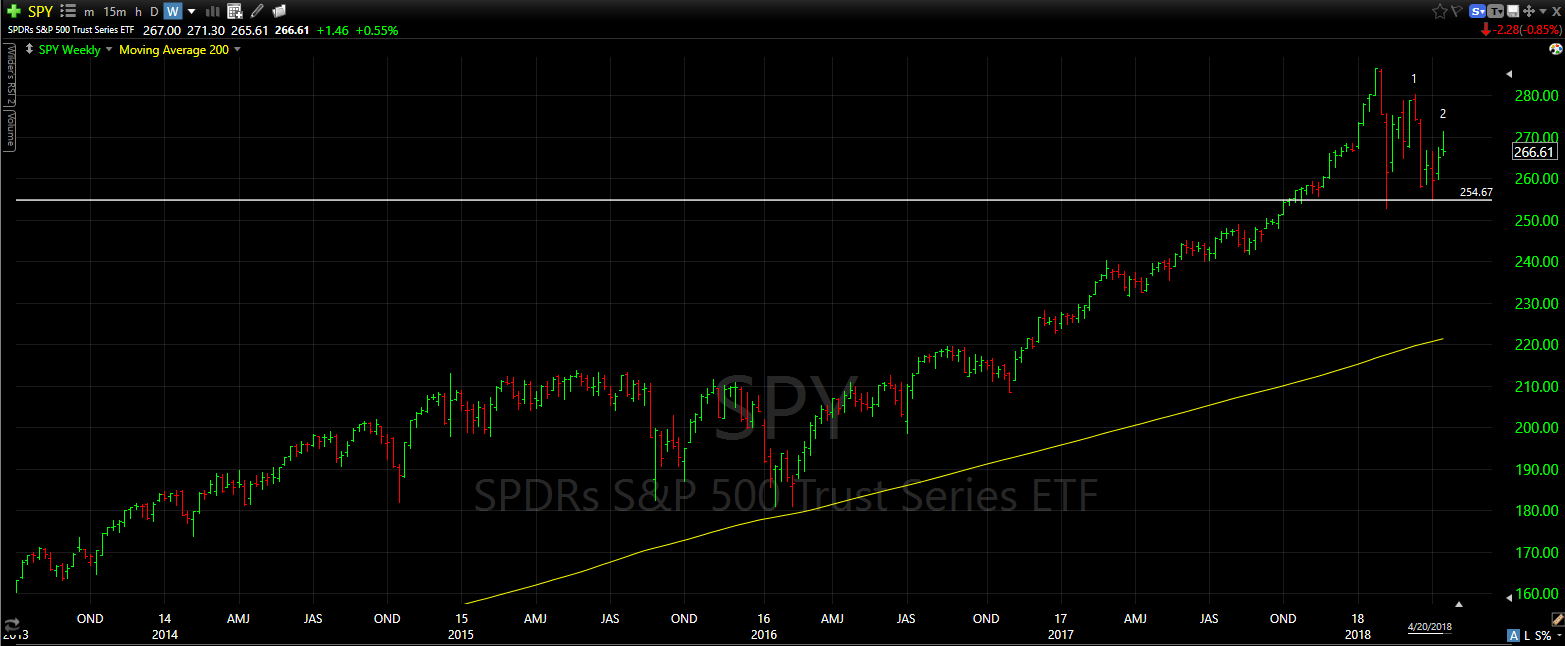
Equity markets rallied on the week, US markets were up by 0.67% and international stocks increased by 0.14%. The rally was good enough to turn US equities positive for the year. But stocks are by no means out of the woods. Stocks advanced on Monday, Tuesday, and Wednesday, but fell on Thursday and Friday. And when looking at a weekly chart, if this coming is week is down, that would be two successive lower highs. Support in the 253-255 level is still crucial to prevent what could turn into a bigger decline.

Interest rates were in the news this week. The spread between the 10 and 2-year Treasuries fell to 41 basis points on Tuesday, the lowest differential since August of 2007. But the 10-year yield jumped higher on Thursday and Friday to close at 2.951%, to widen the spread all the way up to 50-basis points, basically even with the year-end value at 12/29/2017 of 51. The10-year’s closing yield of 2.951% is the highest for this year and the highest since January of 2014. As interest rates rise, all other things equal, investors will have the incentive to move from equities to fixed income, pushing down p/e ratios.

EARNINGS

Earnings reports continue to be positive. Q1 earnings should now be up by 20% according to Thomson Reuters. About 80% of companies reporting so far have beaten estimates and 71% have topped sales estimates. The current forward p/e is 16.6, a somewhat reasonable level.

US DEFICITS

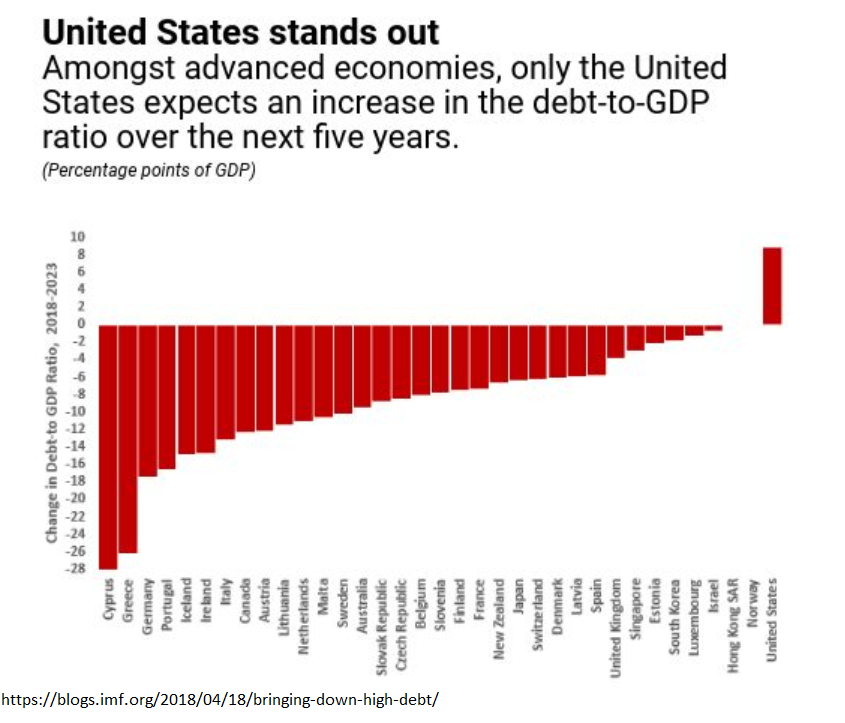
Exploding US deficits are starting to seep more and more into the news. The two graphs below show the magnitude of the problem. An IMF report shows the US is the only advanced economy expected to show an increase in the debt-to-GDP ratio over the next five years.

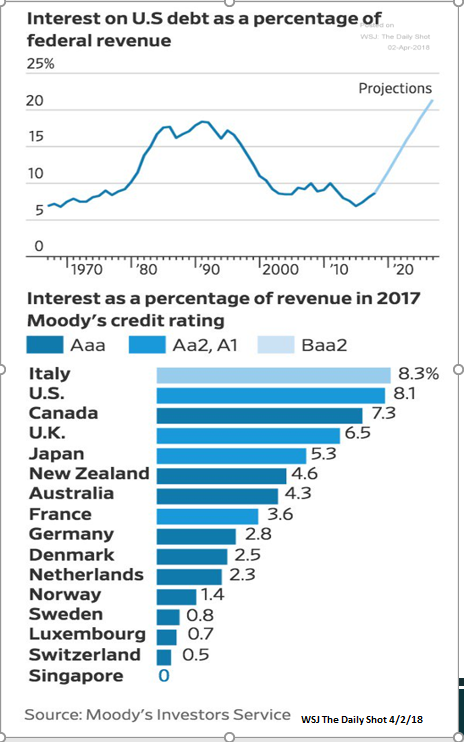
The chart below shows how the cost of paying off just the interest on federal debt is going to massively increase in coming years, hitting north of 20% in future years. That is up from the 2017 number of 8.1%. Only Italy currently pays more.

If the recent tax cuts do not generate the hoped-for growth in the economy, taxes will be increased at some point in the next few years.

SCOREBOARD


Week Ending 4/13/2018

HIGHLIGHTS

  • Chinese leader Jinping says he will relax barriers to trade.
  • Trump to reconsider entry into the TPP.
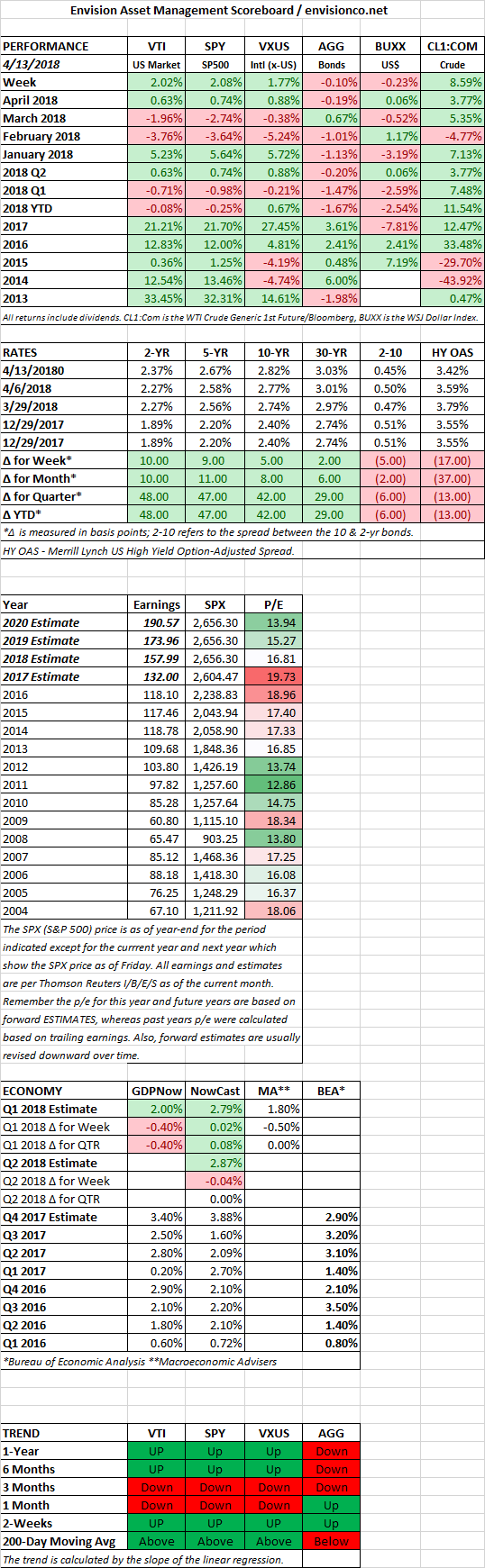
  • Stocks move up by 2%.
  • Earnings season off to a good start.
  • The CBO projects that deficits will explode higher sooner than anticipated.
  • Crude oil hits a three-year high.

MARKET RECAP

It was another week filled with non-stop news. Two Saturdays ago, on April 7, the Syrians launched a vicious chemical attack on their own citizens. On Sunday, Trump said that there would be a “big price” to pay. On Monday, the FBI raided the office of Trump’s personal attorney, Michael Cohen, as part of a wide-ranging corruption investigation. Also, on Monday, the CBO released their latest budget projections. On Tuesday, Chinese leader Xi Jinping promised to relax barriers to trade. And then House Speaker Paul Ryan, announced that he will not run for reelection. Ryan was one of the only members of Congress to even talk about the threat of the budget deficit. Then on Thursday, Trump said he was open to rejoining the Trans-Pacific Partnership. Friday night, hours after the market closed, the US, along with Britain and France made good on Trump’s promise earlier in the week, launching missile attacks against Syrian facilities used for chemical weapons storage and research facilities.

It was Jinping’s comments about trade that moved the market the most. Stocks jumped by 1.62% on Tuesday on his remarks. For the week, US stocks were up 2.02% and international stocks were up 1.77%. Oil advanced by 8.59% and bonds were down slightly. The 2-10 yield curve dropped to 45 basis points.

From a technical perspective, the market held above support and above the 200-day moving average. However, on every day except Tuesday, stocks closed near their low for the day.

EARNINGS

Earnings season got underway. According to Thomson Reuters, of the 30 S&P 500 companies that have reported earnings so far, 70% have beat expectations. That is above the 64% long-term average, but below the average for the last year of 75%. The forward p/e is now at 16.4.

DEFICITS

The nonpartisan Congressional Budget Office announced that US budget deficits will cross the trillion-dollar mark in 2020, two years sooner than previous projections. And that is based on optimistic assumptions such as 3.3% growth this year, unemployment of 3.8% this year and 3.3% next year. In percentage terms, the deficit this year will be 4% of GDP, an increase over the 3.5% last year. By 2019, the deficit will be 4.6% and eventually peak at 5.4% in 2022. But in an “Alternate Fiscal Scenario”, the CBO sees a 6% deficit in 2022 and debt in excess of 100% of GDP by 2027. Both of these projections assume no recession, an unrealistic assumption if there ever was one.

The deficits are blowing up because of the recent Trump tax cuts as well as a wave of red ink that is about to arrive due to the structural problems with social security and Medicare. The US is going to be forced to reverse in some manner the recent tax cuts down the line. And politicians on both sides of the aisle have refused to deal with the structural deficit problems for decades now.

TRADE

In a reversal of trade tensions, Chinese leader Xi Jinping announced on Tuesday that he would reduce tariffs on cars, improve protection of intellectual property and open up the financial industry. And then on Thursday, Trump said he would consider rejoining the Trans-Pacific Partnership (TPP). This was after Trump pulled out of the deal after becoming President, and after spending a good portion of his campaign railing against the TPP. Part of the President’s reasoning might be the threat posed by a rising China. American entry into the TPP, if the other countries would even take the US back in, would be a smart economic and strategic tie-in with one of the fastest-growing regions in the world.

CRUDE OIL

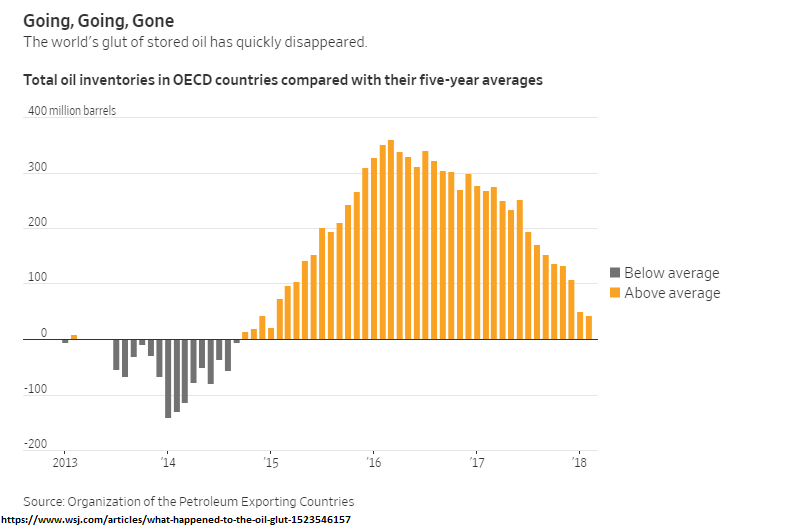
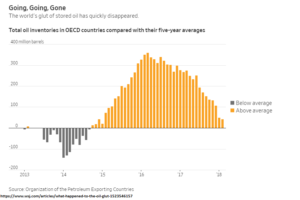
Oil prices ended the week at a three-year high on strong demand and geopolitical tensions. As shown below, the oil glut has worked its way through the system and supplies are back to more normal levels. The threat of military action in Syria and tensions with Iran are also pushing prices higher. In its Friday report, the International Energy Agency (IEA) said that it expects demand for oil to grow by 1.5 million barrels a day in 2018. On top of that, oil production by OPEC nations has been trending lower
SCOREBOARD

Week Ending 4/6/2018

HIGHLIGHTS

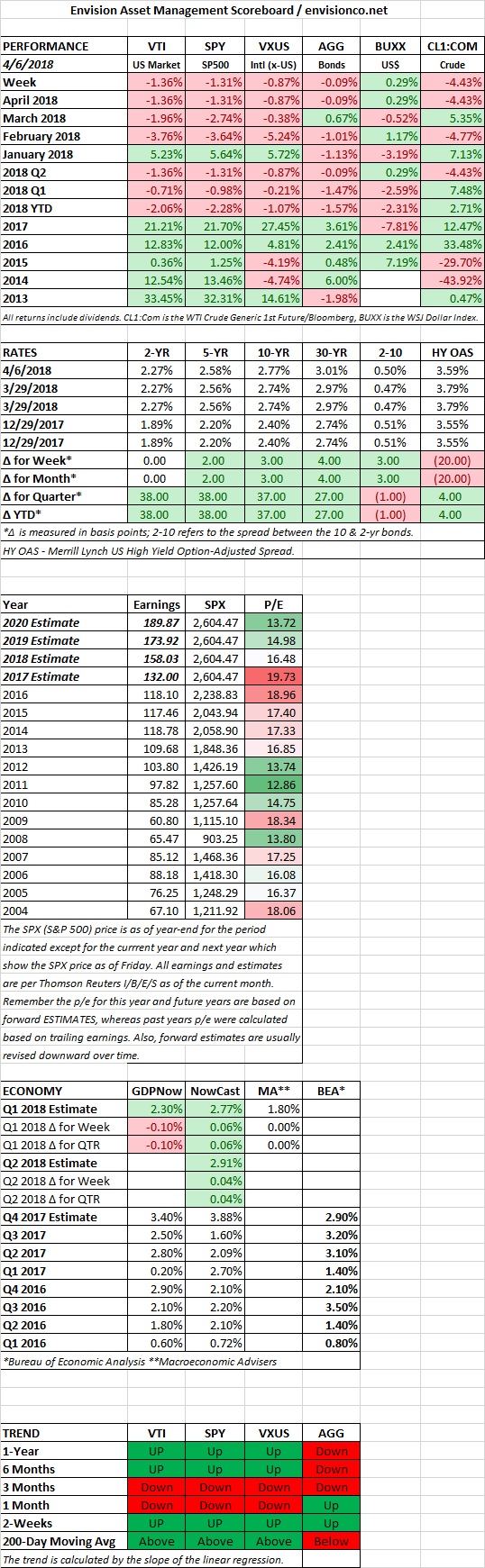
  • Stocks fall by 1.36%.
  • Equities are in a dangerous spot from a technical perspective.
  • Trade news has the market in a tug of war.
  • Employment numbers were below estimates.

MARKET RECAP

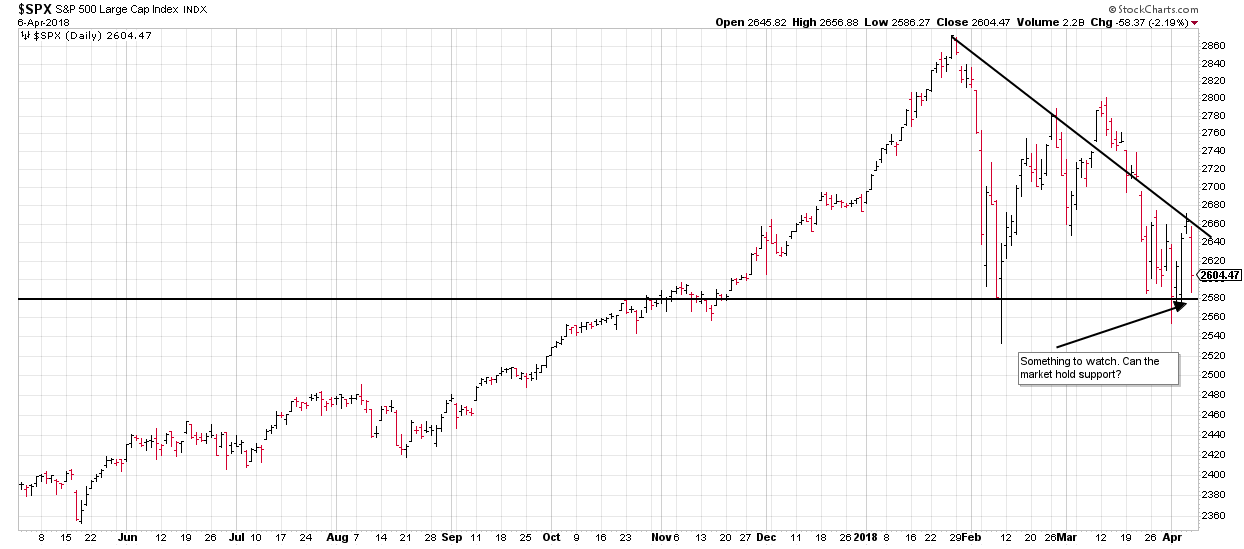
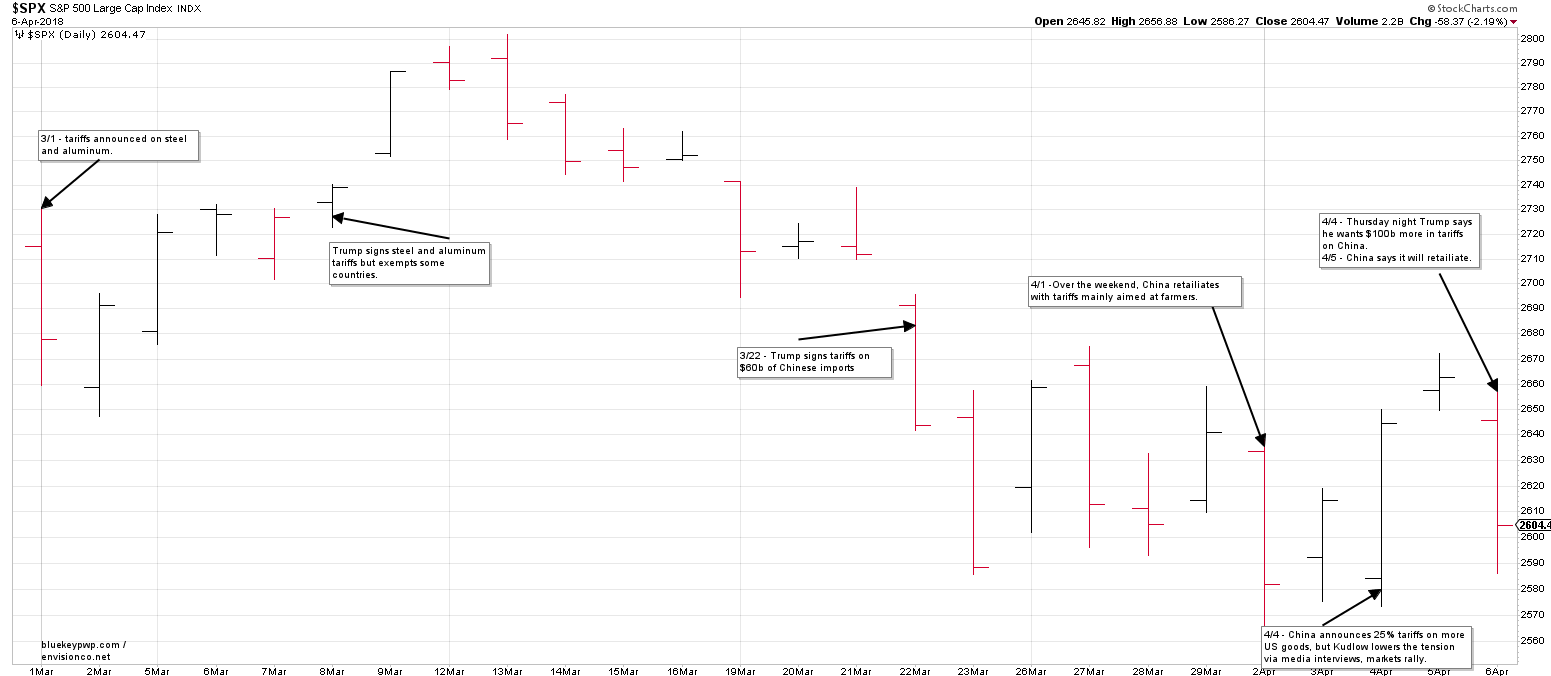
Equity markets were in a tug of war all week over trade news, moving up and down, finally finishing the week off by 1.36%. International stocks dropped by 0.87%. The market has now moved intraday by more than 1% in 9 of the last 11 sessions, that is more than all of 2017. Prices are back again to their 200-day moving average, a marker used by many technical analysts to determine if the market is in bull or bear mode. Equities are also close to breaching through support, a dangerous condition that led to falls in 1962 and 1987 when the economy was not in recession mode but did carry similar valuations.

Bonds fell by 0.09%. The 10-year treasury yield increased by 3 basis points to 2.77%.

TRADE

The Trump administration seems to be doing everything possible to derail the economy and the markets as tensions flare between the US and China over trade. It is true that China does not operate by the same rules as the US in many regards. Chinese trade policy forces technology transfer, takes US intellectual property, forces American companies into partnerships with Chinese entities, and imposes steeper tariffs on American imports than the other way around. But at the same time, China has been moving in the right direction, albeit slowly. And the Trump playbook of publicly attacking Chinese trade policy may not work from a cultural perspective and might box the Chinese into a difficult spot. Unfortunately, this is how trade wars start. The hope is all these threats and tariffs will lead to real negotiations that can produce a fair agreement before more serious damage is done.

Make no mistake about it, there are no winners in an all-out trade war. As most Americans should remember from their middle school or high school education, a contributing factor and perhaps the main factor in the Great Depression was the Smoot-Hawley tariffs of 1930, which led to a full-scale trade war and a subsequent collapse in economies around the world.

For now, the conventional wisdom is that we are not close to a trade war. That common sense and good economic policy will prevail, and that this will all work out in the end. We hope so but are not so sure. A lot of this market rally has been based on optimistic earnings projections, and the threat of a trade war or its eventual implementation will start bringing down forecasts which would bring down equity prices. At that point, the economy could reach a tipping point that could accelerate the start of the next recession. That would also be political suicide for team Trump.

For now, earnings forecasts remain steady. But as the earnings season shortly begins, it will be interesting to see how companies comment on how future business might be impacted.

The market is hypersensitive to a trade war threat. Equities moved up and down all week as the trade news flipped from negative to not so negative and then back to negative (see below).

EMPLOYMENT

Non-farm payrolls increased by 103,000, much less than the 178,000 estimate. However, the longer-term trend is very positive, plus 202,000 per month over the last three months. Unemployment remained steady at 4.1%. Average hourly earnings were up by 0.3% for the month and are now up 2.7% year over year. The average workweek stayed the same at 34.5 hours.

SCOREBOARD