MARKET RECAP
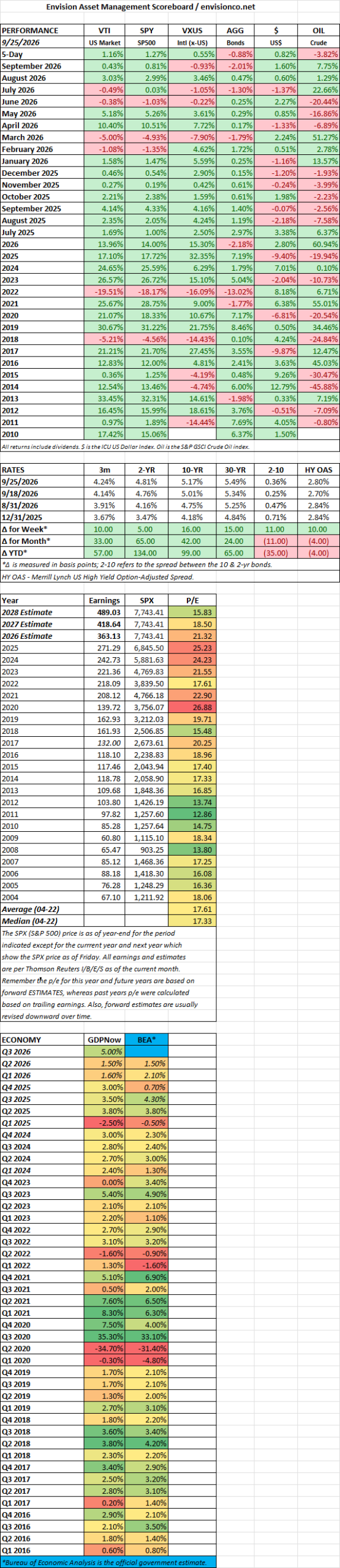
U.S. stocks finished higher for the week ended September 25, rebounding through a choppy stretch marked by crude oil volatility, climbing Treasury yields, and hopes that energy disruptions around the Strait of Hormuz might ease.
Large-cap technology and AI-related names led the rebound, helping the major averages overcome a midweek dip to close Friday with solid weekly gains:
-
S&P 500: Rose 1.21% from the prior Friday to close at 7,743.41.
-
Dow Jones Industrial Average: Added 0.28% to finish at 51,828.62.
-
Nasdaq Composite: Outperformed with a 2.06% gain, settling at 27,068.72.
Market Breadth: Cap-Weighted vs. Equal-Weighted
The tech-led rally highlighted a recurring divergence in market breadth. Over the past month, the cap-weighted S&P 500 resumed its outperformance over the equal-weighted index (Invesco S&P 500 Equal Weight ETF, RSP). While RSP outpaced the broader market during late summer as participation broadened, September’s advance narrowed back toward mega-cap technology and AI leaders, causing the equal-weighted benchmark to lag the headline index over the rolling four-week stretch.
International Equities, Fixed Income, and Commodities
-
International Equities: Vanguard Total International Stock ETF (VXUS) saw a more muted recovery, ticking up 0.55% to close at $86.35.
-
Fixed Income: The 10-year Treasury yield rose roughly 18 basis points to finish near 5.17%–5.18%—its highest area since 2007—as hawkish Fed commentary and firm activity kept another rate hike on the table.
-
Cryptocurrency: Bitcoin gained approximately 4.0%, advancing from around $80,900 on September 18 to $84,100.
-
Commodities: Gold retreated under pressure from higher real yields and a firmer U.S. dollar, with COMEX futures down 2.3% to settle near $4,286 per ounce.
Economic Data & Corporate Earnings
The calendar brought no major monthly inflation or GDP releases this week, leaving markets to trade off secondary data and prior policy signals. Initial jobless claims dipped to 197,000 for the week ended September 19, signaling historically low layoff activity. Earlier releases—including August CPI (3.4% YoY), core PCE (3.3%), and the Q2 GDP estimate (1.5% annualized)—continued to underpin the Fed’s recent quarter-point rate hike to a 3.75%–4.00% target range and its hawkish guidance.
Corporate fundamentals, however, remain a strong pillar of support:
-
Q2 2026 Earnings: The finalized blended earnings growth rate for the S&P 500 surged well above original projections, ultimately exceeding 23% year-over-year (and topping 50% on unadjusted headline EPS driven by mega-cap revisions), marking the index’s seventh consecutive quarter of double-digit earnings expansion.
-
Q3 2026 Outlook: Analysts remain uncharacteristically optimistic heading into the reporting period. Consensus estimates project Q3 year-over-year earnings growth of approximately 27% to 29%, bolstered by upward revisions in Information Technology, Energy, and Financials.
Geopolitics, Energy & Tech Catalysts
-
Diesel Export Ban Rumors: Intraday energy volatility surged midweek following reports that the White House was reviewing a potential 90-day ban on U.S. diesel exports to tame pump prices. Industry groups, including the American Petroleum Institute (API), warned that restricting exports would force Gulf Coast refiners to curtail runs and exacerbate fuel shortages. Energy Secretary Chris Wright and White House officials walked back the report by Wednesday, clarifying that a blanket ban is not on the table and calming crude markets into Friday.
-
Meta Muse Launch: Technology sentiment was buoyed by Meta’s rollout of Muse, its autonomous, multi-modal personal AI agent capable of executing complex end-to-end tasks, web navigation, and scheduling across desktop and mobile ecosystems. The launch reinforced investor conviction in commercial AI monetization, lifting mega-cap tech.
-
Global Trade: High-level meetings between President Trump and China’s Xi Jinping during U.N. week yielded limited incremental dialogue without delivering a meaningful breakthrough on structural trade disagreements.
Equities demonstrated resilience by absorbing another leg up in yields and elevated energy costs. Looking ahead, that underlying strength will be tested with the upcoming release of August PCE inflation figures, the final revision to Q2 GDP, and the September employment report.
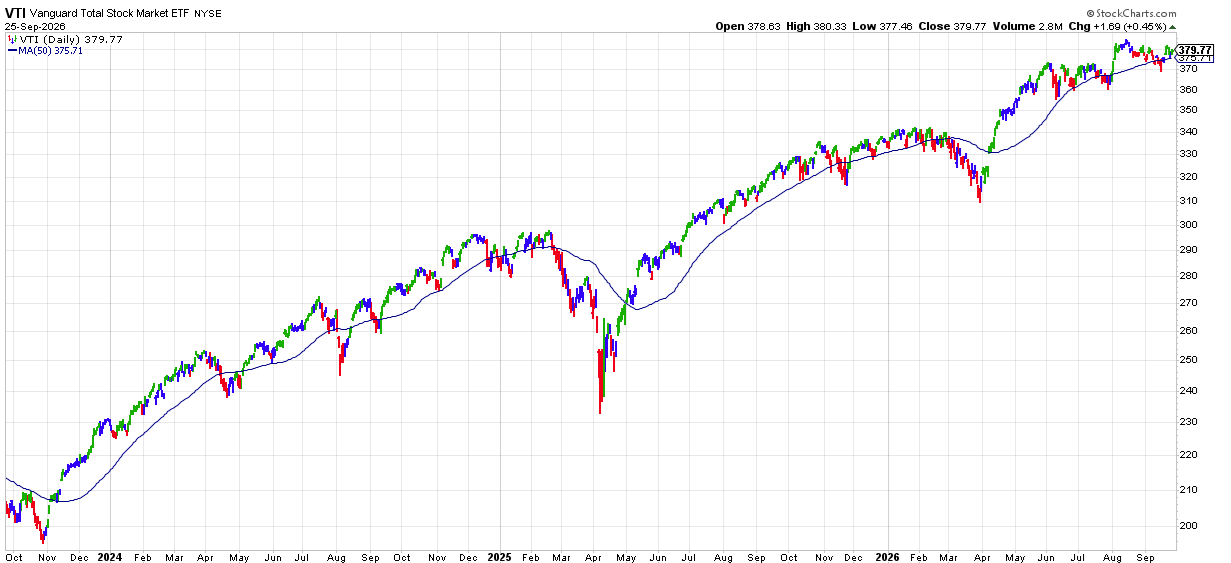
US STOCK MARKET (VTI)
SCOREBOARD