
The unintended consequences of a monetary policy gone wild

The market appears to now be in correction mode as the SPY is down about 6%, bonds have been falling hard as well as gold. We have written previously that this rally is overextended and due for a fall and here it is.

What we are seeing now are some of the unintended consequences of a monetary policy gone wild. The Fed encouraged investors to move out of cash and into risky assets, and now that the markets are beginning to reverse, investors are doing the opposite, with many having bought high and selling low.

We believe the market got ahead of itself due to Fed policy, but equities should still be a good investment over the long term. We think it is important that the Fed begin to taper, and in a more rational world, the sooner the better, but when market participants act like feral pigs (the words of Dallas Fed President Richard Fischer), a very slow and more even path might be preferred as investors withdraw from the drug stimulus of money printing.

The Fed’s easy money policy was necessary in 2008 and 2009, and then again when Europe was about to crash, but it was not necessary since. All kinds of investment behavior have been altered by this policy. Savers have been brutally punished and starved of income. Real estate, equity markets, and fixed income markets all have rallied a more than they should have. And now that the drug might be taken away, the markets are taking a big hit.

Hopefully the hit won’t take on a life of its own and turn into a deadly negative spiral. That again was one of the risks of this Fed’s policy. For now, we are looking for a decline of between 10 and 20%.
 

Back in touch

I have been a little bit out of touch on this blog over the last few weeks, but the market had a big day on May 22 when it shot out to a new high on an intraday basis and then closed below the low of the previous three days. The market has since corrected 2.8% off of that close but has pushed higher the last few days, although still short of the May 22 close. Today the market started with a gap higher, traded in a tight range, and closed at the same price as yesterday (on the SPY).

The Japanese market, and many international markets have been hit hard over this time period, and today, John Mauldin of Mauldin economics talked about why they Yen will decline over the long term.

Fixed income markets, and dividend payers have also been hit over the last few weeks. We have reduced some exposure in this area and moved around some of our MReit investments to better take advantage of the shifting markets.

The party continues as Tepper gives the go-ahead

The party continued on a run that is starting to feel a little bubbly to me. Valuations are not outrageous but it cannot be healthy when the market just continues to go up, especially when the main reason is that the markets are relying on continued printing of money by the Fed and economic news is mediocre at best. The market has backed off here and there when there was even a hint of Fed slowly taking away the punch bowl, but now that won’t even slow down the market, as market guru David Tepper gave the go-ahead yesterday that a slow Fed-tapering would not be bearish. Tepper said “if we don’t taper back, we’re gonna get into this hyper-drive market. It’s a backwards argument. To keep the markets going up at a steady pace the Fed has to taper back.” The market translation, at least for right now, is this – the market will now go up if the Fed continues to print, and the market will go up if the Fed begins to taper!

Mark Travis of Intrepid Capital Management talked about the ridiculous run up in Tesla and the good valuation in depressed Pan American Silver (PAAS) today on Talking Stock. Coincidentally, I added to my position in PAAS (sometimes it hurts to be a value investor)!

On the positive side we have added to several positions in our trading accounts in the last couple of days, including CSCO the other day, which is up over 8% in after-hours trading on positive earnings.

Into the Great Wide Open

The SPY busted through the 159.75 level into new ground with a strong advance on Friday, closing at 161.37. The only negative would be that the SPY closed just under the midpoint of the day.

Many stocks are at fair value or overvalued at this point. A couple that we think are undervalued for the long term are NOV and CAT. We have positions in both. Both stocks are out of favor at this time so there could be more downside.

What is a forward contract?

A friend asked me today what a forward contract is. Here is a brief summary:

A “forward contract” is a private agreement between a buyer and a seller that calls for the delivery of an asset at a future point in time with a price agreed upon today. A futures contract is the same as a forward contract but it is traded on an organized exchange with standardized terms.

To put it in simple terms, ordering pizza to be delivered is a forward contract. The customer and the restaurant agree that the customer will buy the pizza at a specific price at a future point in time (“around 30 minutes”). When the pizza arrives, the customers has to accept delivery of and pay for the pizza, even if the customer found an advertisement for a cheaper pizza elsewhere.

In a forward contract, both parties are legally committed and cannot get out of the commitment. However, one party can enter into a new, offsetting forward contract to unload their end of the commitment. As an example, if the buyer of the pizza decided they want to go out for dinner instead, they can establish a forward contract with their neighbor. When the pizza arrives, they pay for it, accept delivery, then deliver the pizza to the neighbor and get paid from him (or her). Maybe if they are good negotiator they could even have made an extra dollar or two!

In a forward contract, each party is subject to the default of the other. So in the pizza example, when the pizza arrives and there is no one there to pay for the pizza, the buyer has defaulted.

If the contract was on a futures exchange there would probably be something called a daily settlement. For each contract there is an initial margin, which is the amount that must be deposited on the day the transaction is opened and a maintenance margin. The maintenance margin must be maintained every day thereafter.

Those are the basics.

(parts of the pizza example were summarized from “An Introduction to Derivatives and Risk Management” by Don M. Chance and Robert Brooks)

New high, barely

The SPY closed at a new high, barely edging the high from April 30 and April 11. This is now the third attempt to crack the 159.75 level. The market has bounced off the 154 level three times in the last few weeks and refuses to break down. The market closed right at the high. Tomorrow will be interesting.

Margin Debt Nears Record

Check out Dave Wilson’s chart of the day. Margin debt in March was at the second highest level ever, checking in a $379.5 billion, just shy of the record set in July of 2007 when it hit $381.4 billion. July 2007 was a few months before the market tanked.

REGI explodes to upside

Renewable Energy Group (REGI), a stock that we previously owned and liked in the low $5s, topped the $11 mark today. We exited our position around $7, which was good for a very nice gain, but should have held it, as evidenced by the recent price action.

Markets down for the week and Big Money Poll highlights


Market ends down for the week

The market ended down 2.1% for the week, hit by weak profits, falling commodity prices, fears about China, and the Boston Marathon bomber.

Highlights from Barron’s Big Money poll

1. About 1/3 of money managers expect the DJIA to get to 16,000 by the middle of next year.

2. 74% of managers consider themselves bullish or very bullish through December of 2013, this is a high percentage.

3. 86% are bullish on stocks for the next 12 months.

4. 94% like  what they see for the next five year.

5. Managers are skeptical about gold, bullish on commodities longer term. Bonds and cash have few fans. Europe is out of favor.

Gold Miners

Barron’s ran a piece by Andrew Bary this week writing that gold miners are so hated that now might be a good time to get in, echoing our comments of April 15.

BDCs

Barron’s also wrote about business-developments companies (BDCs) this week. Both Ares Capital and Golub Capital, two companies we like, were listed in a table titled “Best Bets on BDCs”.

Crushed

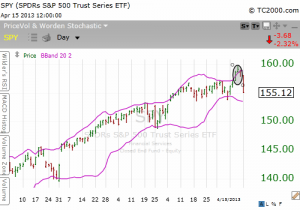
The market got crushed today, dropping 2.30%. The VIX spiked by 43%, the most ever in one day. Commodities, especially metals, continued in free fall for the second straight day and hurt the market early on. The market was down about 1.35% when terrorists struck the Boston Marathon with a couple of bombs. The market would drop about 1% more after that.

Our comment on April 5 that gold might have had a false breakdown turned out to be wrong. Gold was strong for two more days but then finished on the low on April 10th. That would have been the signal that gold was headed further down. Gold collapsed two days later.  But we also wrote on April 5, as well as April 4, that there has been a change in behavior in the market and remarked about the increase in volatility. For the first time, a couple of commentators even wrote today about the end of the bull market that started in 2009. Wow. We will have to see where the market takes us from here but a correction is long overdue.

If you have the guts, now is probably a good time to begin accumulating a position in the metals and miners and then dollar cost average down. The best trades are always the hardest trades. We like PAAS and AUY (but there might still be significant downside from here).

CHART BREAKDOWN

Look at the shaded ellipse from April 10 to April 12. It looks like a possible top. The market finished strong on April 10, opening at the low and then finishing at the high. On April 11, the market opened at the close from April 10th, pushed higher but closed at the midpoint of the day. The close was more than two standard deviations above the 20 day moving average. then on April 12, the market pushed lower, but it closed above the midpoint. Had the market closed lower that day it would have been more bearish. Closing above the midpoint might even be considered bullish, but the massive dropped today negated that. I would guess that the April 11 high was some kind of top, but it might just be a short term top.

spy april 15 2013