New lenders jumping into the subprime personal-loan market

When getting credit starts becoming easy, then that is often a signal that a top maybe near. I don’t think we are necessarily there yet, but when loans are easy to obtain and rates don’t factor in appropriate risk, that is a dangerous sign.

Today’s WSJ points to a step in that direction, the WSJ writes about new lenders jumping into the subprime market. But subprime borrowers no longer hold that title, one such lender called FreedomPlus calls them “emerging prime.” To Lending Club, they are “near prime.” Lending Club originally required credit scores above 660, but that has now dropped to 640.

Santander Consumer USA Holdings (SC), a leader in the subprime auto loan market, now will expand to personal loans. They have agreed to buy the lesser of $30m or 75% of Lending Club’s near-prime loans through July of next year, and $30m or 50% after that.

In today’s 10K, SC recorded a net-charge off ratio of 5.8% for 2013 compared to 5.5% for 2012.

Barron’s 3/3/14

Notes from Barron’s from 3/3/14 – pick up a hard copy or read on line for the complete stories. Below is a very brief review of some notes of interest.

UP AND DOWN WALL STREET

“The broad economic and financial environment today is very similar to that of the second half of the 1990s, when the equity bull market turned parabolic,” wrote Chen Zhao of BCA Research. Social network stocks are trading at 12-13 times sales and the Nasdaq Internet ETF PNQI trades at 52x earnings. But Zhao thinks “there are increasing odds that the US stock market will march to a much bubblier environment.”

STREETWISE

Russell 2000 is at 1.3 times sales versus a historical mean of .9x. Hottest small stock this year is Intercept Pharmaceuticls (ICPT), up 501%.

Michael Harnett of Bank of America Merrill Lynch says “the bull market is likely to end with greed, talk of new paradigms, a soaring US dollar, and the moment when the short end of the US yield curve becomes unhinged.”

REVIEW

DJ30 +1.36% to 16,321.71
SP500 +1.26% to 1,859.45

The Chinese Yuan dropped 1.5%, the biggest downward movement since the currency stopped being pegged to the dollar in 2005. Interbank rates are on the rise in China and the notional amount of credit-default swaps on China’s debt rose sharply, a signal of increased stress.

4th quarter GDP was revised down to 2.4% from 3.2%.

Housing prices were up 11.3% in 2013 to pace the largest gain since 2005.

A major Bitcoin exchange, Mt. Gox, went out of business, with big losses for clients.

Economic indicators for last week (from Barron’s and other sources)

DATE         DAY    STATISTIC                                          ESTIMATE      ACTUAL  LAST MN

02/24/14

 M

DALLAS FED 3

0.3

3.8

02/25/14

 T

FEBRUARY CONSUMER CONFIDENCE 80.1

78.1

79.4

02/25/14

 T

House Price Index 0.3

0.8

0.9

02/25/14

 T

Richmond Fed 5

-6

12

02/26/14

 W

JANUARY NEW HOME SALES 400K

468k

414K

02/27/14

 TH

JANUARY DURABLE GOODS x Transp -1.05%

1%

-1.90%

02/28/14

 F

Q4 GDP PRELIMINARY 2.50%

2.40%

3.20%

02/28/14

 F

FEBRUARY CHICAGO PMI 57

59.8

59.6

02/28/14

 F

FEBRUARY MICHIGAN SENTIMENT 81.2

81.6

81.2

02/28/14

 F

PERSONAL CONSUMPTION 2.9

2.6

3.3

PREVIEW

DAY

EVENT

CONSENSUS

ACTUAL

LAST PERIOD

 M

JANUARY PERSONAL INCOME

0.20%

0.00%

 M

JANUARY PERSONAL SPENDING

0.10%

0.40%

 M

JANUARY CONTRUCTION SPENDING

-0.30%

0.10%

 M

FEBRUARY ISM MANUFACTURING

51.5

51.3

 TH

Q4 PRODUCTIVITY

2.50%

3.20%

 TH

JANUARY FACTORY ORDERS

0.30%

-1.50%

 F

FEBRUARY NON FARM PAYROLLS

          145,000

            113,000

 F

FEBRUARY UNEMPLOYMENT RATE

6.60%

6.60%

 F

JANUARY CONSUMER CREDIT

$14B

$18.8B

FOLLOW-UP

BKS is priced at about $19 and sells for 3x projected EBITDA versus 7 for most retailers. BKS has $5 net cash.

VERIZON HAS THE EDGE IN THE WIRELESS WARS

The stock yields 4.5% with a payout ratio of 60%. Revenue growth should be about 4% with an 11% eps increase. PE on 2014 earnings is 13.6.

FRIED CHICKEN, SEAFOOD PIZZA, AND HUMBLE PIE

YUM – mainly an international play. 31% of profits from the US. Price is $73.79 which is 17.9x 2015 earnings, less than the 50% it normally commands over the SP p/e (which is 14.3). 2% yield.

AN EXCEPTIONAL OIL PLAY

ATW should be 40% higher per the article. Most of their rigs are on contract through 2015 so not as much exposure to day rates, which have been dropping. ATW is more efficient than RIG or RDC. 7.3x forward earnings. Waqar Syed from Goldman Sachs see the stock at $65 in the next couple of years, currently priced at $47.

FLOWER POWER

FTD was spun out of United Online in November. Priced at $31.25. has a 10% free cash flow yield. Adam Strauss of Pekin Singer Strauss figures the stock has an intrinsic value in the high 40s. EPS should jump 40% from $2.14 this year to $3.01 in 2015 if capital allocation plans include buybacks. Should earn $1.96 for 2013. High barriers to entry. But Amazon launched a flower service last year. Not covered by any major Wall Street firm.

STILL IN LOVE WITH REAL ESTATE…AND MORE

An interview with Martin Cohen and Robert Steers

Cohen says the big mistake is looking for yield. What matters is the sustainability of the dividend and the growth rate.

Steers is avoiding defensive property types like health-care REITs. They want to be more cyclical and growth oriented.

Hotel markets fundamentals are currently strong.

They like SPG and PLD.

Stock multiples have room to expand

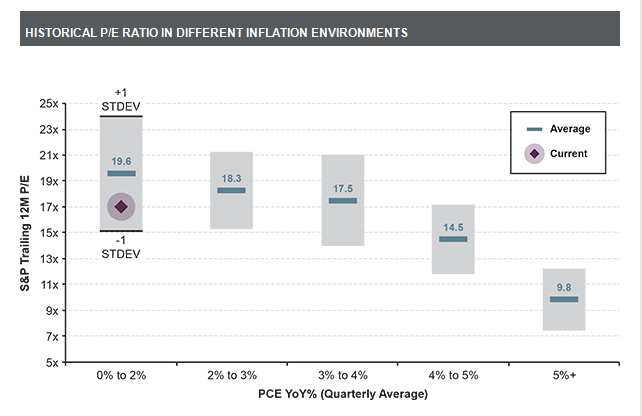
Now here is an argument that the p/e ratio still has room to expand. A Bloomberg / Guggenheim chart shows that the average trailing p/e when inflation is between 0% and 2% is 19.6. Currently, that ratio is 17x, and if you go out 1 standard deviation you get to 24x.

historical pe ratio in different inflation environments

Barron’s 2/24/2014

Notes from Barron’s 2/24/2014

CAT – CAT is up 7.4% this year after a slow 2013 when it advanced just 3.3%. You would think it shouldn’t be advancing given the problems with emerging markets and with miners. But Deutsche Bank’s Vishal Shah, says that nonresidential construction could be accelerating and that generates 40% of revenue. Commercial construction usually lags behind the residential construction rebounds by 15 to 18 months, which would be later this year. Shah thinks CAT could trade up 25% to $122 this year.

REVIEW

DJ30 -0.32% to 16,103
SP500 -0.13% to 1,836.25

Most of the economic reports last week came in less than consensus.


stats for week ending 2 22 2014

Facebook will buy WhatsApp for $19b and some are calling that a bargain. That comes to $42 per user which is comparable to the price Google bought YouTube for and less than the $131 per user that Twitter is going for.

PREVIEW

DAY EVENT CONSENSUS LAST PERIOD
T FEBRUARY CONSUMER CONFIDENCE 80.1 80.7
W JANUARY NEW HOME SALES 400K 414K
TH JANUARY DURABLE GOODS -1.05% -4.20%
F Q4 GDP PRELIMINARY 2.50% 3.20%
F FEBRUARY CHICAGO PMI 57 59.6
F FEBRUARY MICHIGAN SENTIMENT 81.2 81.2

FOUR STOCKS WITH DIVIDENDS THAT COULD DOUBLE

Dividend growers will do better in a interest rate rising environment as compared to high yielders. They are also are usually more expensive based on forward p/e ratios, by about 20%, according to a Bank of America Merrill Lynch analysis.

Four stocks with dividends that could double their yields in next five years:

AIG, DFS, HAL and IR. Also mentions CVS.

YIELD OF DREAMS

Growth is slowing at Kinder Morgan. KMP trades at $79 and yields 6.9%. Kinder Morgan Inc (KMI) controls KMP. KMP has an unfavorable relationship with KMI, it pays for most of all of the new projects but almost half of the distributions go to KMI.

Distributable cash flow, which is an internal measure, might be too aggressive in its calculation. CapEx that is considered for maintenance reduces distributable cash flow, while CapEx for expansion does not. KMP might be understating the maintenance and overstating the expansion. Expansion capital is funded with new debt and equity, they raised $540m last week.

Typical MLP calculation of distributable cash flow is equal to net income + depreciation – maintenance capex.

KMI determines what is maintenance and what is expansion capex. KMP projects DCF of $5.61 per unit with an expected distribution off $5.58. But an analyst at Hedgeye says a more accurate number is $4, putting a 15 multiple on that gets to a price of $60 and the analyst thinks KMP deserves a lower multiple than 15. If the distribution gets cut, look for a big price drop.

MANAGED WITH METTLE – KALU is priced at $69. Value is $80 per Stephen Levenson of Stifel, Nicolaus based on 8x ebitda. EPS to rise to $3.99 and $4.33 next year. 2% dividend.


Using short interest when deciding when to sell

Mark Hulbert writes in this weekend’s WSJ that the level of short interest might be a useful indicator when determining when to sell stocks. Generally, the problem is that investors often hold stocks that they have done well with too long.

Adam Reed, a finance professor at UNC, says “short interest is one of the strongest return predicative signals in the academic literature.”


Barron’s 2/17/14

Note from Barron’s from 2/17/2014. We encourage readers to purchase Barron’s for the complete set of news, some of which are highlighted very briefly below.

Up & Down Wall Street – Stephanie Pomboy of MacroMavens says the markets capitalization has hit 200% of GDP, compared to 204% during the dot-com-bubble and 183% at the peak of the housing bubble.
_______________________________

Review

DJ +2.3% to 16,154
SP500 +2.3% to 1,838

Comcast is buying Time Warner cable for $45b.

Congress increased the debt-ceiling limit through March 2015, February 27 was when borrowing capacity would have run out.

_______________________________

PREVIEW

DAY EVENT CONSENSUS ACTUAL LAST PERIOD
W JANUARY HOUSING STARTS 950K 999K
W JANUARY PPI 0.2% 0.4%
TH JANUARY CPI 0.1% 0.3%
TH JANUARY LEADING INDICATORS 0.4% 0.1%
TH FEBRUARY PHILA. FED SURVEY 10.0 9.4
F JANUARY EXISTING HOME SALES 4.77M 4.87M
Source: Bloomberg/FactSet

_______________________________

Buckle Up!

This could be the hottest economy since the late 1990s according to Applied Global Macro Research based on strong outlook for housing. They are currently invested in consumer discretionary and home builders indexes. This outlook differs from consensus which has 2014 at 2.7% followed by 3% in 2015.

_______________________________

Gulf Driller’s Shares Look Ready to Rally

EPL – $27.35 – trades for less than the value of reserves.  Asset value is $41 per Stephan Berman of Canacord Genuity assuming $90 per barrel. Share count reduced by 3% over last three years.

_______________________________

A New American Team Goes for the Gold

AAL could gain 50% or more in time.

_______________________________

New Strategies for MLP Investors

Streak of MLPs beating the SP500 ended at 12 years last year. Payouts average 5.7% now. They finance construction and other infrastructure management by borrowing which will be impacted if interest rates rise. Companies need to generate real returns. Group has 60% of the volatility of the market. Returns equal yield plus distribution growth or 6% + 7% = 13% (about) but interest rates and commodity prices are the wild cards.

Stephen Marasca – top pick is LNG. Most upside and least downside. Current price ignores two new projects. TRGP  – 28% growth this year. OKE – dividend hike.

John Edwards – PAA is best-in-class operator. MMP – strong balance sheet, solid management and low commodity price risk.

Rise in rates prices will go down in a knee-jerk reaction but if rates are rising due to a better economy spreads should tighten.

Always be careful of distribution coverage – what MLP can pay out divided by what they are paying out. EPD has a strong coverage ration of 1.4.

No gap standard for measuring maintenance capex.

Maresca arrives at price targets by taking expected cash flow and dividends and discounting it back. Discount rates based on commodity exposure and credit quality of customers.

Edwards likes MWE. Located in good areas.

Maresca likes ETE and ATLS.

Greg Reid likes WGP, NGL and RGP.

______________________________________________

HEALTHY GAINES AHEAD FOR CVS

13.9x next year’s earnings. David Larsen of Leerink Partners thinks shares could hit $85 (from about $70) in a year.  Recently been beating estimates.


Using the VIX as an indicator

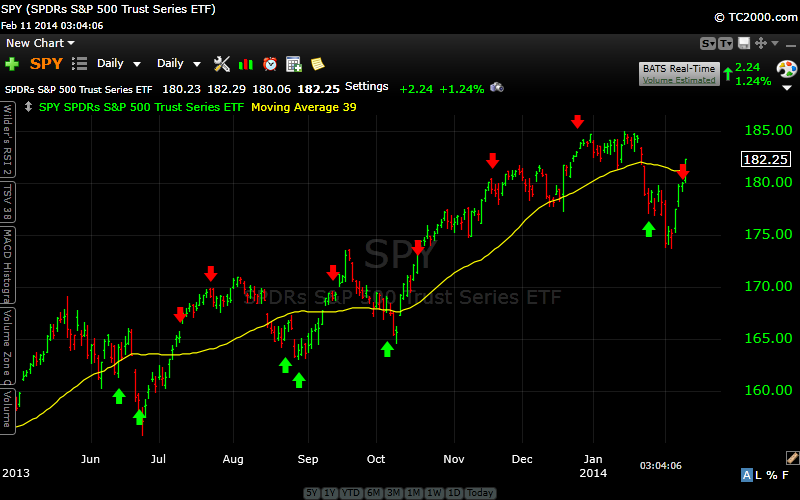
Using the VIX has proved effective as a short-term indicator over the last 8 months. The VIX is a measure of implied volatility of the S&P 500 index options. The VIX will go up in value when fear is high, and go down in value when fear is low.

You can use the VIX as a contrary indicator, going short the market when the VIX spikes and going long the market when the VIX dips. We looked at two ways to measure this, first, we used a 20-day Bollinger Band with two standard deviations and second, a 10-day envelope channel with a 10% spread. The Bollinger Band would generally provide a more extreme measure.

Since the VIX spikes faster when the markets are fearful, we used the Bollinger Band when fear is rising, and then we used the envelope channel when fear was receding. If the VIX closed below the Envelope Channel, we marked the SP500 chart below with a green up arrow, indicating a buy signal. And if the VIX closed above the Bollinger Band we market the SP500 chart with a red sell signal.

We only did this for the last six times, on the upside and the downside, when these signals have occurred. But the VIX has been fairly accurate picking short term tops and bottoms, the only team it clearly failed was on the October 16th down signal.

SPY 2 11 2014